Syria and confusion between external hopes and internal crises
TEHRAN – The current Syrian administration is not seeking political or military alliances as much as it is pursuing economic partnerships to ensure its survival within an increasingly complex region.
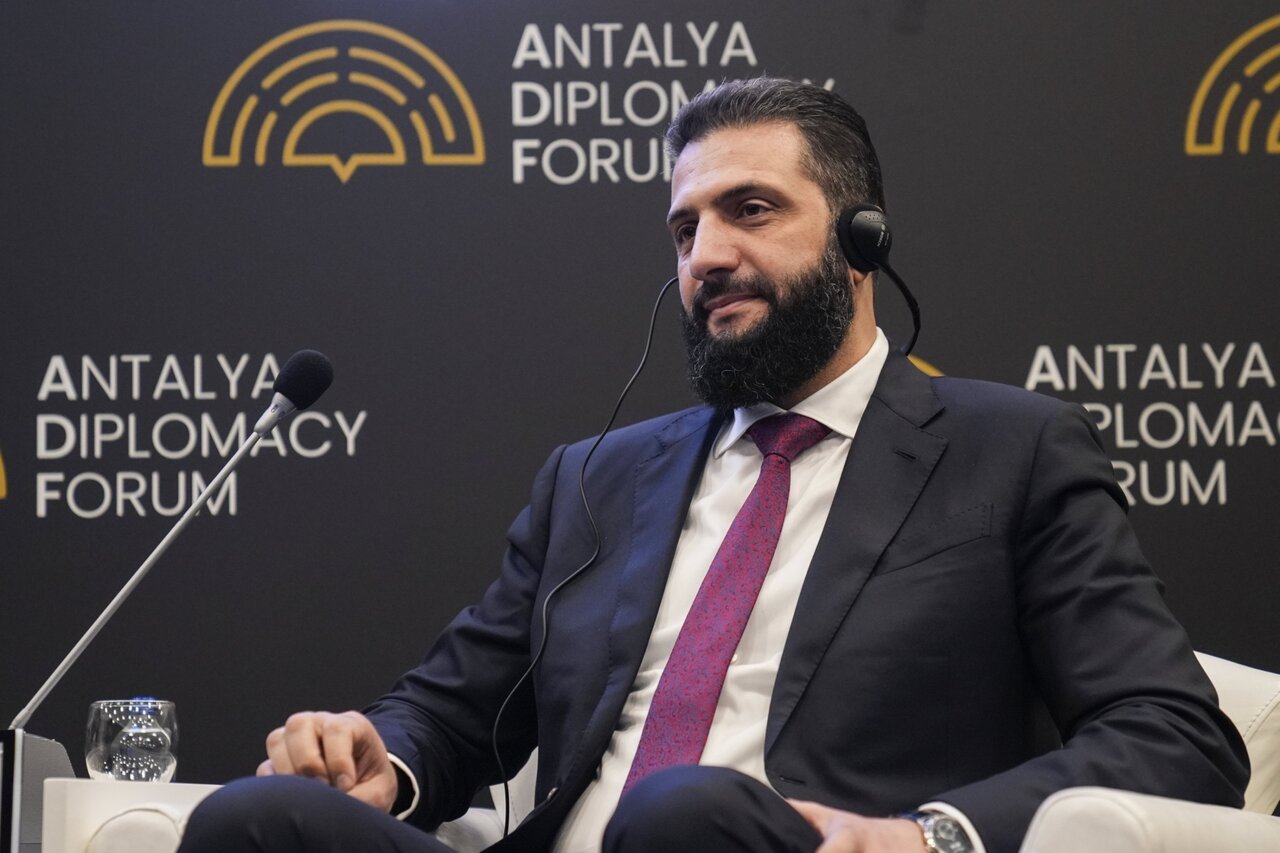
The current situation in Syria goes beyond a stream of rapid daily news, shaping a peculiar form of political pragmatism that the new administration struggles to maintain. Recent foreign tours, starting at the Antalya Forum in Turkey and extending to Persian Gulf capitals and European stops via Cyprus, are more than diplomatic visits; they are part of a broader political rebranding effort that shifts attention from urgent domestic crises.
At the same time, these efforts attempt to portray Syria as a necessary player in the global economy, driven by developments such as the illegal U.S. and Zionist regime’s war on Iran and the closure of the Strait of Hormuz. The European leg also seeks to remove the “extremism” label from the government and preserve its “international legitimacy.”
Officially, Syrian Foreign Minister Asaad al-Shibani announced Wednesday the conclusion of President Ahmed al-Sharaa’s Persian Gulf tour, stating that it focused on “strengthening deep-rooted brotherly relations and exploring ways to boost economic development and reconstruction,” affirming “Syria’s steadfast position alongside Arab brothers and full solidarity in facing various threats.”
Beyond diplomatic statements, reports and information strongly indicate that the “economy” was the main topic Syrian officials carried to both Antalya and the Persian Gulf, aiming to present Syria (with its vital geographic location) as a major economic opportunity for the region by making it a possible alternative for Persian Gulf oil transit away from the Strait of Hormuz.
During the Persian Gulf tour, Syrian officials focused on presenting this security issue and their capacity to achieve it, trying to attract Persian Gulf investments and reconstruction aid through this mutually beneficial door, from their perspective.
But they have not received, so far, any official or serious approvals for this project, despite some Persian Gulf opinions seeing promising opportunities in Syria that align with the Syrian vision for reconstruction and leveraging Syria’s geographic position for energy transit lines.
However, Persian Gulf reservations also appear significant here, whether regarding doubts over overall domestic and security stability, Western sanctions not yet fully lifted, or the weak legal environment for investment. Therefore, no tangible change on this front is expected in the foreseeable future.
This relentless effort by Syrian politicians to return Syria to the regional and international arena, as they constantly repeat, is reflected in ongoing statements during these visits about “Syria’s role” in the region, even though that role has historically been tied to different ruling systems, in their orientations, doctrines, methods of influence, and even slogans, different from the current government’s orientations.
Superficially, this mode of political engagement, meant to appear more prominently during President Ahmed al-Sharaa’s recent tour and accompanying delegations, attempts to affirm that Syria wants to move beyond the “framework of axes” and avoid positioning itself in a clear political stance with all its calculations and complications.
Damascus wants to open up to various regional and international powers, including all Persian Gulf states, but this is not easy for a country where the Zionist regime occupies large chunks of its land, intrudes daily into its territory with no resistance, and violates its sovereignty, or within a region undergoing a new order imposed through expanding illegal American and Israeli wars.
Rather, it is impossible for a new government whose “international legitimacy” is covered by numerous binding conditions, chief among them making great efforts for the benefit of an American-Zionist axis waging a devastating war on some regional countries, who strongly oppose a new “Middle East Project”. Hence, such “balance” seems impossible under these circumstances.
All this is happening amid an internal economic crisis that can no longer be ignored or patched up with crude, dull media shows that no longer convince anyone among the displaced Syrian societal factions searching for the bare necessities of life and dignified living.
On this front, parallel to foreign diplomatic moves, the government reverts to militia-backed tactics aimed at absorbing tension and consolidating its central authority.
The former so-called “Jaish al-Islam” leader Essam al-Buwaydani emerges as a model of political maneuvering; his return from the UAE after a complex legal process was not just a coincidence of timing but rather a deliberate “mediation” by the new administration to calm the so-called “Jaish al-Islam” militia, which had begun threatening domestic escalation. The government’s resort to mediating with a former adversary, whose supporters’ protests nearly caused a diplomatic crisis with the Persian Gulf, reflects an urgent desire to close internal security gaps and cement the new rulers’ image as capable of containing all contradictions.
This is besides the authority’s silence on incitement and terror campaigns against minority groups with sectarian tones and its failure to make any official effort to stop or curb them. Syrian human rights activists describe what is happening as “showcase justice,” especially as the Syrian administration moves toward conducting trials in absentia of major figures from the former government, aiming to close the “transitional justice” policy, in their view.
They believe what is happening is an attempt to transform this matter from a thorny rights issue into a process of liquidating the past legacy in this deficient legal form, while the authority proceeds with settlements involving financial and security figures linked to the former government.
Some Syrians who initially supported the new administration describe this as the former government being “recycled” under a new disguise. Syrians see many signs pointing toward movement in this direction.
Economically, there is a clear gap between official rhetoric and the reality on the ground, and a notable contradiction between official figures citing very high growth and budget numbers and those published by the central bank and finance ministry.
This reflects institutional fragility and an attempt to buy time while awaiting promised investments or external support. This became especially clear with the central bank’s recent decision requiring exchange companies to deliver foreign remittances in Syrian pounds at the official rate, even as it repeatedly claims the economy has been liberalized.
With a gap of nearly 15% between the official foreign exchange rate and the black market rate, this measure may push Syrians toward unofficial transfer channels in a country where most residents, who fought alongside HTS, now rely on foreign remittances to manage their livelihoods.
This would likely require a strict “security grip” to pursue currency traders, potentially plunging the country into a new economic-security spiral, one that was a source of public anger toward the former government, especially in its final years under suffocating U.S.-led sanctions.
Leave a Comment