Research suggests Alamut Castle's role extended beyond military functions
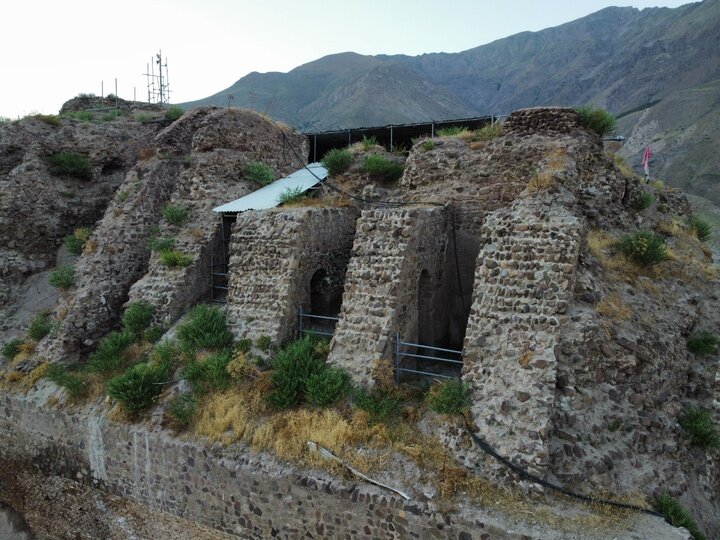
TEHRAN – The ancient Alamut Castle [and its satellite forts and defensive structures], long known primarily as a political and military stronghold of the Nizari Ismaili state, may also have served as a center for preserving and producing scientific knowledge, the head of the library at the Center for Documents of the Great Islamic Encyclopedia said.
Enayatollah Majidi said historical sources, written records and archaeological findings point to the existence of a significant library at Alamut, the presence of scholars and the preservation of scientific works, suggesting the development of a scholarly environment within the Ismaili seat of power.
"The available historical evidence indicates the existence of a valuable library, the presence of intellectuals and the preservation of scientific resources in this castle," Majidi told Miras-e Aria news agency on Saturday.
Majidi said reports by the 13th-century historian Ata-Malik Juvayni were among the most important pieces of evidence. Juvayni, who visited Alamut after its fall to the Mongols, wrote in his Tarikh-i Jahangushay that the castle's library contained scientific books and astronomical instruments, including armillary spheres, full and half astrolabes and other devices used for astronomical calculations.
The presence of such instruments in a mountain fortress with a defensive function suggests that astronomy and cosmology held an important place in the Ismaili intellectual tradition, Majidi said, while cautioning that the evidence was insufficient to prove the existence of a formal observatory.
"No definitive report has yet emerged regarding an observation tower, regular astronomical observation programs or the compilation of astronomical tables at Alamut itself," he said.
Majidi also referred to archaeological discoveries at the site, including a room with unusual architectural features and an opening toward the sky. Some researchers have proposed that the space may have been connected to observational activities, though he said further study and documentation were needed.
He cited the presence of the Persian polymath Nasir al-Din al-Tusi among the Ismailis as another indication of Alamut's scholarly role. Tusi spent about 35 years in the Ismaili environment and composed or revised several major works on logic, philosophy, mathematics and astronomy during that period, Majidi said.
Among the works associated with that period are Sharh al-Isharat, Tahrir al-Majisti and Tahrir Uqlidis, which Majidi said indicate that Tusi had access to extensive scientific resources and suitable conditions for research.
"The collection of evidence - from the famous library of Alamut and the astronomical instruments reported by Juvayni to the scholarly activities of Nasir al-Din al-Tusi - strengthens the hypothesis that Alamut was a center of knowledge, thought and scientific production during the Ismaili period," he said.
Majidi added that continued archaeological excavations, interdisciplinary research and renewed examination of historical sources could reveal further aspects of Alamut's scientific and cultural identity.
The Cultural Landscape of Alamut, nominated for UNESCO World Heritage status, comprises seven strongholds and related fortifications associated with the Nizari Ismaili state of the 11th to 13th centuries.
AM
Leave a Comment