Resistance Film Festival calls for documentaries on Leader’s funeral
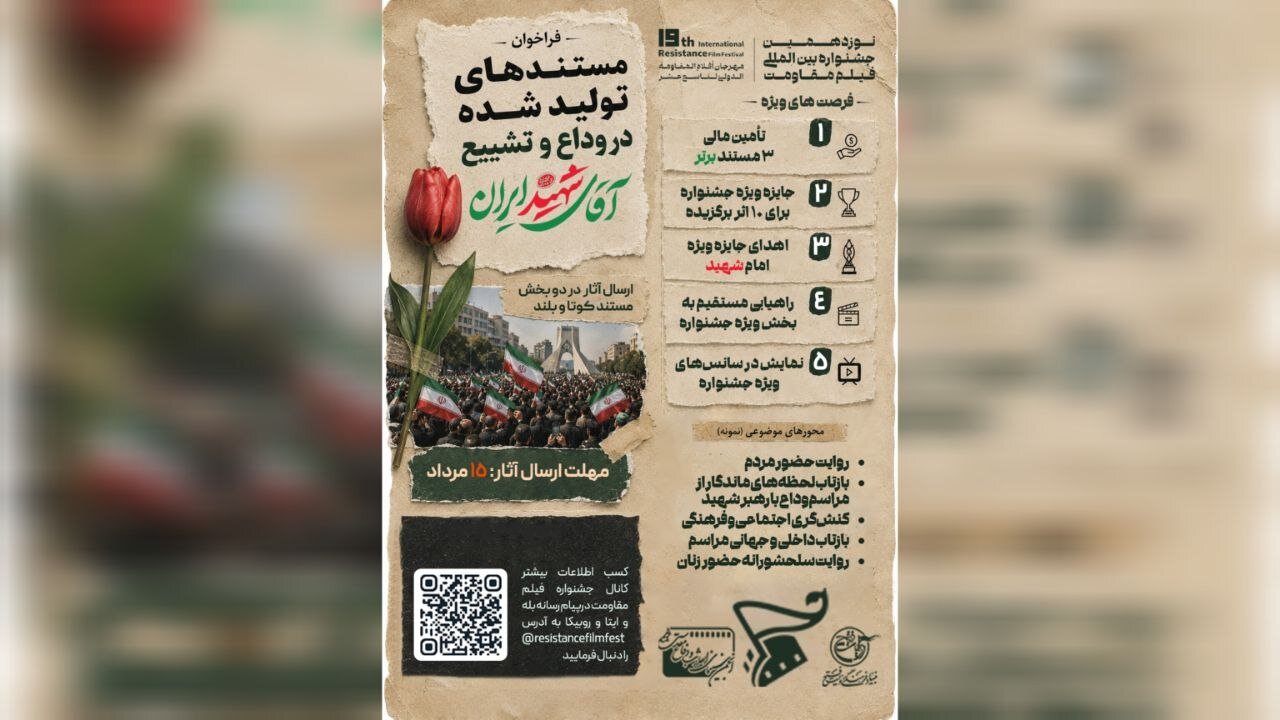
TEHRAN- The secretariat of the 19th edition of the Resistance International Film Festival has issued an official call to documentary filmmakers, directors, and media activists to submit works capturing the farewell and funeral ceremonies of the Leader of the Islamic Revolution Ayatollah Seyyed Ali Khamenei.
The call for entries is divided into two primary categories of short documentaries and feature-length documentaries. The festival seeks submissions that explore the various dimensions of this national and grassroots event.
The festival organizers have announced several incentives for selected works, including the financial funding of the three top documentaries and the granting of a special festival award to ten selected entries.
Furthermore, a prestigious "Imam Shahid" special prize will be awarded, and winning films will be granted direct entry into the festival's special section for exclusive screenings.
The call for entries highlights several key thematic axes, including the massive public turnout, the depiction of enduring moments from the farewell ceremonies, socio-cultural activism, the domestic and global resonance of the event, and the courageous presence and role of women during the ceremonies.
Interested filmmakers and media professionals are invited to submit their works to the secretariat of the 19th Resistance International Film Festival by the deadline of August 6.
Following the coordinated US- Israeli attack on February 28, which targeted key national facilities in Iran, Ayatollah Seyyed Ali Khamenei, the Leader of the Islamic Revolution, was martyred. Ayatollah Mojtaba Khamenei has since been appointed as the new Leader by the Assembly of Experts.
The martyrdom of the Ayatollah Khamenei was not merely the loss of a political figure, but the departure of a spiritual guide whose entire life was dedicated to the pursuit of justice and the liberation of the oppressed. This ultimate sacrifice, born from the depths of a conflict fueled by imperialist ambitions, has left an indelible mark on the collective soul of the Iranian people and the wider Muslim world, transforming a moment of profound grief into a catalyst for renewed resistance and steadfastness.
In the days following his farewell ceremonies, the streets of Iran's major cities were transformed into rivers of black, as millions of followers gathered to pay their final respects to a leader whose guidance had shaped the country's political and spiritual trajectory for decades.
The funeral rites were characterized by their unprecedented scale and geographic reach, spanning six days of mourning. The processions began in Tehran and extended to the holy cities of Qom and Mashhad, and even reached Najaf and Karbala cities in Iraq, reflecting the Leader's influence beyond national borders.
These ceremonies served not only as a final farewell but as a massive demonstration of unity and loyalty. The burial, attended by high-ranking officials and vast crowds of ordinary citizens, concluded a period of intense national mourning, transitioning the country from a state of collective sorrow to a renewed commitment to the principles for which the martyred Leader stood.
SAB/
Leave a Comment