Tehran’s “Unfinished Homework” event honors 400 child martyrs in closing ceremony
TEHRAN- The closing ceremony of the "Mashq-e Natamam" (Unfinished Homework), a cultural and artistic event dedicated to the memory of over 400 Iranian children who lost their lives during the recent war, concluded on Friday at Tehran's Tabiat Bridge—the city's most expansive pedestrian landmark.
The final night of the event was marked by the presence of the family of Makan Nasiri, a missing martyr, who were hosted alongside renowned artists including Babak Khajepasha, Mohsen Sharifian, and Habib Ahmadzadeh. The families were greeted with a standing ovation from the audience after witnessing a series of performances by children on the bridge.
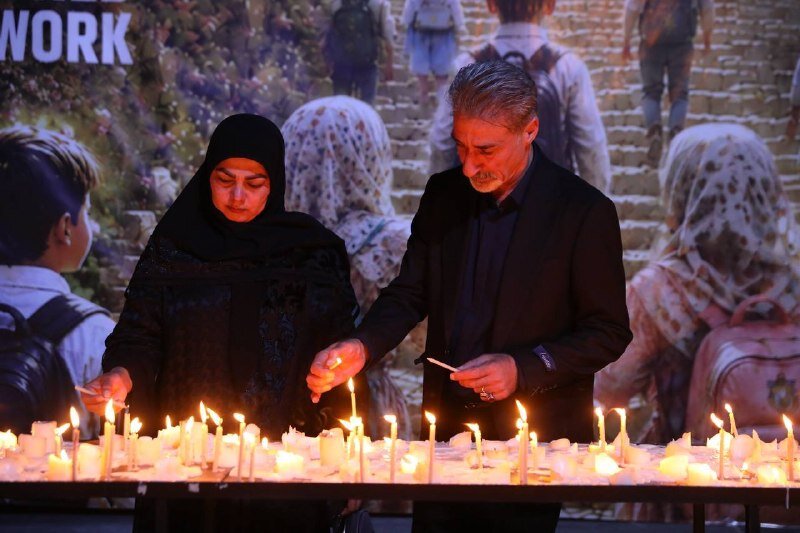
A poignant moment of the evening featured a video tribute performed by veteran actor Parviz Parastoui, produced by the Iran Peace Museum. Following the performances, Hossein Parsai invited the Nasiri family onto the stage, bowing in respect and stating, "We are all here to ease your grief. Your presence is the reward for the children who have spent the last month working on this 'Unfinished Homework'." To conclude the ceremony, the family of Makan Nasiri signed the event's guestbook and lit candles on behalf of the grieving mothers of the child martyrs of Minab.
Makan Nasiri, a seven-year-old student at the Shajareh Tayyebeh elementary school in Minab, was among the 168 children and teachers martyred during a US missile attack on February 28. The strike occurred on the first day of the imposed war, utilizing Tomahawk missiles that caused catastrophic destruction. The intensity of the blast was so severe that the young boy's body was virtually obliterated, leaving behind only a wrinkled blue sweater and cream-colored sneakers as the sole physical traces of his presence.
The event, narrated by Hossein Parsai and produced by Mohammad Sadeq Mirkarimi, spanned ten nights of artistic tributes.
Moreover, during his visit to the event, acclaimed filmmaker Majid Majidi expressed his deep admiration for the organizers and the young performers. In a note written in the commemorative guestbook, Majidi paid tribute to the martyrs of the Shajareh Tayyebeh elementary school in Minab.
"The martyrs of the Minab school will forever remain in the proud history of Iran," Majidi wrote. "Their pure and holy blood will undoubtedly pave the way for the victory of our beloved country."
The filmmaker was joined during his visit by Pirouz Hanachi, the former mayor of Tehran, both of whom praised the efforts of the organizers in keeping the memory of Iran's youngest martyrs alive.
The tragedy of the Ramadan War left an indelible scar on the Iranian psyche, most poignantly seen in the loss of its youngest citizens. Among the most harrowing memories is the attack on the school children of Minab, where the sanctuary of a classroom was shattered by the US-Israeli air strike. These children, whose only crime was a desire to learn and grow, were transformed from students into symbols of national martyrdom. Their desks became empty, and their laughter was silenced, leaving behind a void that can never be filled, yet serving as a timeless reminder of the cruelty of war and the innocence of those it claims.
Beyond the halls of Minab, hundreds of other child martyrs across the country faced similar fates, their "unfinished homework" becoming a testament to a stolen future. Each name and portrait represents a dream interrupted—a game left unplayed or a story left untold. By honoring these young souls, Iran does more than mourn a loss; it preserves the memory of a generation that paid the ultimate price for the nation's sovereignty. These children remain the "martyr angels" of the homeland, forever reminding the world that the deepest casualties of war are those who never had the chance to experience a peaceful adulthood.
Photo: The parents of Makan Nasiri light candles on behalf of the grieving mothers of the child martyrs of Minab during the closing ceremony of the “Unfinished Homework” artistic event at Tehran's Tabiat Bridge on July 24, 2026.
SAB/
Leave a Comment