Pezeshkian urges BRICS to turn economic resilience into practical cooperation
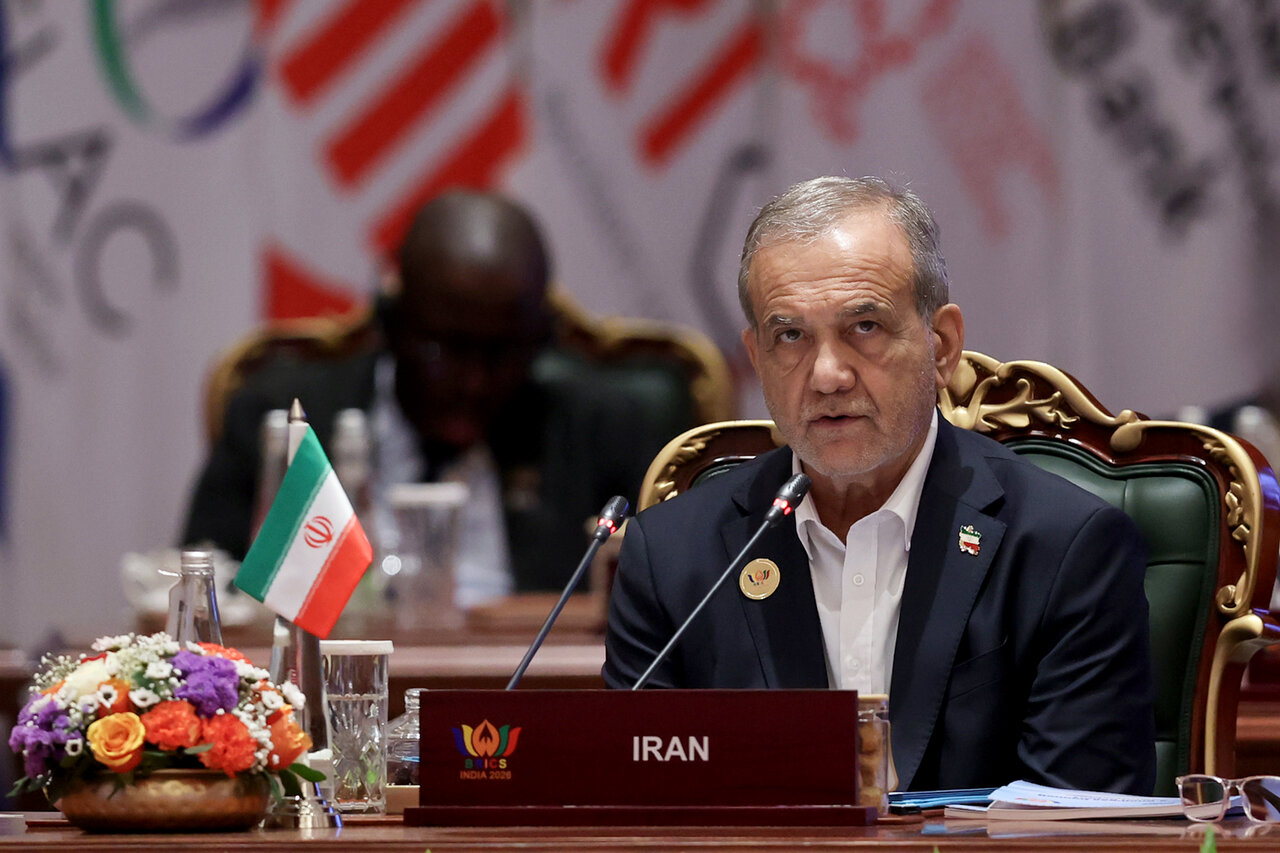
TEHRAN- Iranian President Masoud Pezeshkian has called on BRICS to move beyond political declarations and develop practical mechanisms to strengthen economic resilience, expand financial and trade cooperation and defend national sovereignty, as he linked economic security to the broader security environment confronting countries across the Global South.
Addressing the 18th BRICS Plus Summit in New Delhi on Sunday, Pezeshkian said resilience, cooperation and sustainability should be treated not as slogans but as responses to fundamental global challenges. He argued that nations must not only manage existing crises but also build economic and institutional capacity to withstand future shocks.
“Economic resilience without security will not be sustainable,” Pezeshkian said, pointing to the consequences of military conflict for economic, energy and development infrastructure. He argued that attacks on such infrastructure can rapidly produce repercussions extending beyond national borders and affecting regional and global stability.
Pezeshkian said excessive dependence on a limited number of financial and trade systems leaves economies vulnerable to political pressure. In this context, he described unilateral sanctions as more than an economic issue, arguing that they can directly affect food security and people’s welfare.
The Iranian president urged BRICS members to develop greater collective capacity for economic resilience by expanding trade in national currencies and strengthening the New Development Bank (NDB). He also said BRICS could help its members establish independent mechanisms for trade, investment and financial cooperation, gradually reducing their exposure to unilateral economic pressure.
The issue featured prominently in Pezeshkian’s assessment of the summit. He said BRICS members opposed unilateral sanctions and coercive measures, while participants also supported Iran’s accession to the World Trade Organization and discussed expanding trade through national and regional currencies.
According to Pezeshkian, the summit brought together the 11 main BRICS members and 10 countries seeking to join the group, with discussions centered on resilience, innovation, cooperation and sustainability. He said the gathering created promising prospects for investment, financial exchanges, banking cooperation and broader economic engagement.
For Tehran, the emphasis on financial and trade cooperation is particularly significant as Iran seeks to expand economic ties beyond Western-dominated financial channels and strengthen links with emerging economies.
Iran as a regional trade and transit hub
Pezeshkian said Iran’s geopolitical position, energy resources and transit capabilities could provide BRICS with additional avenues for strengthening trade and energy connectivity among member states.
He singled out Chabahar Port as a major transit hub capable of linking north and south with east and west, arguing that Iran is prepared to revive its historic role as a regional crossroads and create new opportunities for trade, investment and broader economic exchanges.
The president also welcomed greater Indian investment and joint ventures in Chabahar, placing the port within the wider framework of Iran-India economic cooperation. He emphasized Iran’s longstanding historical and cultural ties with India and said Tehran was determined to further expand bilateral political, economic, cultural and scientific cooperation.
The emphasis on transit and connectivity reflects Iran’s broader effort to leverage its geographic position as a bridge between major markets and transport corridors. Within the BRICS framework, Tehran sees such capabilities as a potential contribution to deeper economic integration among emerging economies.
Security and economic development presented as interconnected
Pezeshkian devoted a substantial part of his BRICS address to the relationship between security and economic development, arguing that sustainable growth cannot be separated from national sovereignty, territorial integrity and the prohibition of the use of force.
He condemned attacks on Iran’s economic, energy and development infrastructure, saying the Iranian people had paid a heavy price in the conflict, while infrastructure developed over decades had suffered damage. He also referred to the humanitarian situation in Gaza and Lebanon and called for a stronger international response to military aggression and attacks on civilians.
The Iranian president urged BRICS to play a more active role in defending national sovereignty and territorial integrity. He said the group could transform the “scattered capacities” of the Global South into shared capabilities and become a platform for practical action rather than simply a forum for political coordination.
Pezeshkian also warned against allowing new technologies and artificial intelligence to become instruments of domination, arguing that innovation should instead contribute to empowering nations and expanding development opportunities.
He described BRICS as increasingly representing demand for a more balanced and inclusive international order in which no single center of power can determine the fate of other countries.
Diplomacy no pressure
Speaking separately to India Today on the sidelines of the summit, Pezeshkian rejected US allegations that Iran is seeking nuclear weapons and reaffirmed Tehran’s commitment to the Nuclear Non-Proliferation Treaty and international law.
He said Iran had accepted extensive international inspections and remained prepared to engage in dialogue within international legal frameworks, while describing allegations concerning an Iranian nuclear weapons program as pretexts for military action.
The president said Iran did not seek war and had repeatedly participated in negotiations aimed at ending the conflict. At the same time, he questioned the reliability of agreements following 'the abandonment of previous commitments.'
Pezeshkian maintained that Iran’s military actions had been defensive responses to attacks and said the pressure placed on the country had reinforced national unity. He also rejected the prospect of Iran yielding to sanctions, economic pressure or efforts to create internal divisions.
Hormuz another test of regional cooperation
The Strait of Hormuz was another major issue addressed by Pezeshkian, who said Iran and Oman had discussed a framework for maintaining a shared maritime route through the strategic waterway.
He said Arab foreign ministers were expected to meet in Muscat on Monday to pursue the implementation of the Iran-Oman arrangement and that the proposed route could subsequently be presented to the International Maritime Organization.
Pezeshkian said the waterway could reopen provided the United States ended its blockade and aggression against Iran. He argued that Washington’s pressure had failed to achieve its objectives through military means and would not succeed through maritime pressure either.
The president’s remarks placed the Hormuz issue within a broader regional diplomatic framework, stressing that neighboring countries should cooperate to establish security and prevent their territories from being used for attacks against one another.
He specifically called for Iran, Saudi Arabia, Türkiye, Pakistan and other regional states to work together to strengthen security, expand economic cooperation and prevent political or sectarian divisions from escalating into conflict.
Pezeshkian said Iran had no fundamental problem with regional countries including the UAE, Saudi Arabia, Pakistan and Qatar, as well as major powers such as Russia and China, describing them as friends and brothers. He identified the presence of US military bases in regional countries as Tehran’s principal concern and urged neighboring states to ensure their territories were not used for attacks.
BRICS a platform for a multipolar economic order
Pezeshkian’s remarks in New Delhi brought together two themes that Tehran has increasingly placed at the center of its foreign economic policy: reducing vulnerability to unilateral economic pressure and expanding cooperation with emerging and neighboring economies.
He said the BRICS summit declaration reflected opposition to attacks on Iran’s nuclear facilities and civilian infrastructure, as well as broader concerns over unilateralism, occupation and violations of international law. Participants, he added, stressed the importance of multilateralism and a multipolar international system.
The Iranian president also held a series of meetings with senior officials on the sidelines of the summit, including the leaders of India, Malaysia, South Africa and Ethiopia, while holding brief conversations with the presidents of Russia and China. He said he also held a “good conversation” with the Crown Prince of Abu Dhabi, during which both sides agreed on the need to leave the past behind and build a better future.
In a meeting with the South African President Cyril Ramaphosa, Pezeshkian Invited the President to visit Tehran. Pezeshkian added: "We are prepared to hold the joint commission meeting to advance our cooperative programs and to strengthen and develop ties between our countries."
Taken together, Pezeshkian’s engagements in New Delhi underscored Tehran’s effort to connect diplomacy, trade, transit, finance and regional security within a broader strategy of economic resilience.
For Iran, the BRICS platform offers an avenue to deepen relations with major emerging economies while promoting national-currency trade, alternative financial mechanisms, investment and connectivity. Pezeshkian’s message was that such economic cooperation cannot be sustained without security, while lasting security itself requires stronger regional cooperation and a more balanced international order.
“Resilience does not endure without cooperation, cooperation is not sustainable without justice, and sustainability is not possible without peace and security,” Pezeshkian said.
Leave a Comment