Trump 'only interested' in Venezuela's oil: analyst
'Invoking the term “Monroe Doctrine” by the current regime has a certain element of populist appeal among the isolationist-leaning electorate'
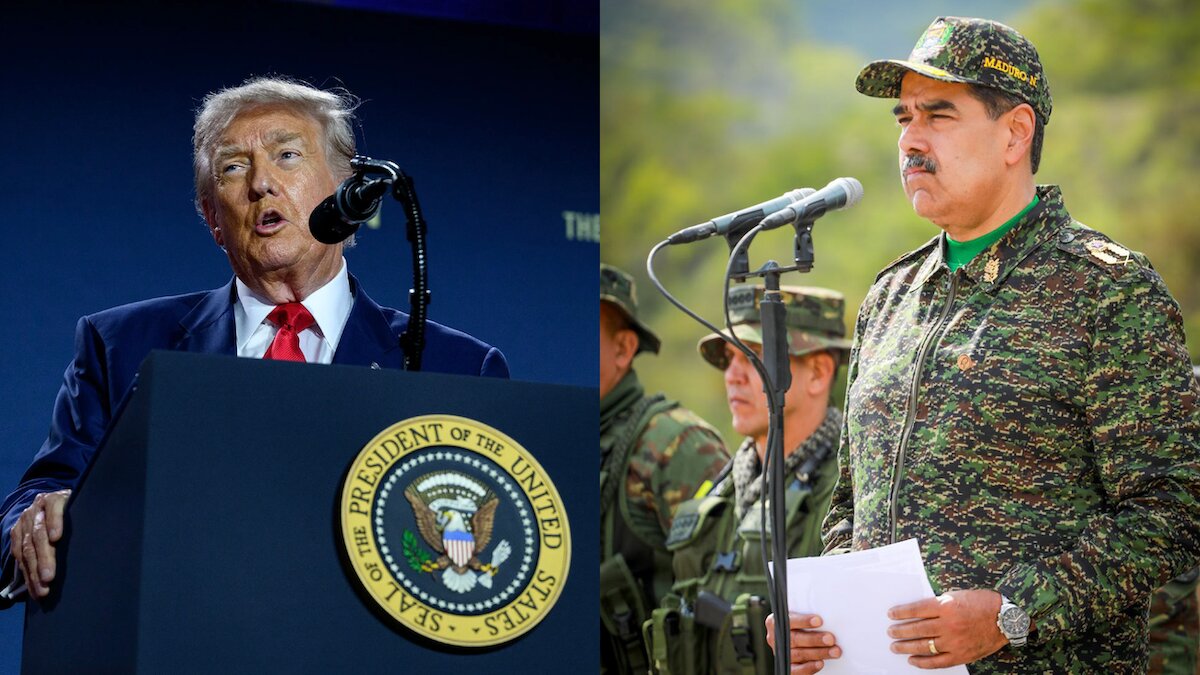
TEHRAN – Yuram Abdullah Weiler, an engineer-turned political analyst, argues that U.S. President Donald Trump’s intense pressure on Venezuelan President Nicolás Maduro stems from a desire to dominate the country and secure access to its vast oil reserves, which surpass those of Saudi Arabia.
Trump is “only interested in getting his hands on Venezuela’s oil, which represents the largest proven oil reserves in the world at an estimated 303 billion barrels (Bbbl) vs Saudi Arabia’s 267 Bbbl,” Weiler tells the Tehran Times.
What follows is the complete interview:
Some argue that Trump’s political, economic and military pressure on Venezuela is intended to gain control over Venezuela’s oil riches given the U.S. president’s great love for oil and his disdain of renewable energy. What is your opinion?
Yes, that is the objective, but one has to look more deeply at the projections of energy use in the coming decades to understand why this is happening. World energy demands are projected to increase at a rate which will exceed the rate of growth of renewable energy sources. The least expensive alternative is, of course, fossil fuels, and hence, there is a scramble among energy producers to maximize their market share of this shortfall. Trump’s distain for renewable energy is merely a consequence of his financial supporters’ wish to maximize the renewable energy gap and thus maximize the return on their fossil fuel investments. The alternative to using fossil fuels to bridge the so-called green energy gap is nuclear energy, however, initial costs for nuclear generating plants are much higher than for fossil-fuel-fired generating plants, which are favored by investors, but contribute to the global climate crisis.
Statements by American officials indicate that an attack on Venezuela seems imminent under the allegation that Maduro’s government is an accomplice in the drugs trafficked into the United States. However, Maduro’s involvement in drug trafficking has not been proven. Your answer please.
While Venezuela has been a minor transit point for cocaine trafficking, the allegation that Maduro’s government is involved in drug trafficking of fentanyl is completely bogus. Most fentanyl comes to the United States through Mexico, where it is produced from precursor chemicals imported mainly from China, India and Myanmar according the U.S. Drug Enforcement Administration’s National Drug Threat Assessment (NDTA). In fact, according to the United Nations Office on Drugs and Crime, neither Venezuela nor any other South American country is involved in synthetic opioid production or transit networks. Trump doesn’t give a hoot about America’s drug problem
Given that the U.S. and the UN both agree that Venezuela is only a minor player in U.S.-bound cocaine, most of which comes from Mexico and Central America, if Trump were truly concerned about drug abuse in the U.S., why would he pardon former Honduran President Juan Orlando Hernández, who was convicted of drug trafficking, smuggling over 400 tons of cocaine into the U.S.? The answer is, of course, he doesn’t give a hoot about America’s drug problem; he’s only interested in getting his hands on Venezuela’s oil, which represents the largest proven oil reserves in the world at an estimated 303 billion barrels (Bbbl) vs Saudi Arabia’s 267 Bbbl.
Trump is sending a message to the world that he is prepared to use overwhelming military force to achieve his nefarious goalsAfter all, the kernel of the illicit drug trafficking problem is U.S. domestic consumption, which is a pervasive societal problem: drug overdoses kill annually over 100,000 people; half of Americans aged 12 and older have used illicit drugs at least once. If Americans stopped consuming such a huge quantity of illegal substances, the profitability of drug trafficking would simply evaporate along with the drug flow into the U.S. However, focusing on drug trafficking completely overlooks the fact that some 125 million opioid prescriptions are filled in the U.S. annually, and nearly all opioid abusers misuse prescription opioids at least once in a year. No one seems to be asking the obvious question, and that is, why does the U.S. have the highest death rate, 15.4 per 100,000, due to opioids in the world?
As far as Trump pushing the world order towards anarchism, he seems to be using the U.S. military as a last-ditch effort to maintain global dominance, which basically means enforcing use of the U.S. dollar as the world’s reserve currency by threat of military force. This is why there are perpetual $1 trillion + annual military budgets and chronic deficits, and no U.S. politician is serious about balancing the U.S. budget. The scheme, known as “twin deficits” depends on a continuous outflow of U.S. dollars due to the so-called trade imbalance due to the U.S. importing more than it exports. These dollars accumulate in other countries’ foreign exchange reserves, and are recycled back to the U.S, as purchases of U.S, Treasury securities, which provide the needed cash to run the debt-burdened U.S. government.
So far, the U.S. has gone to the extreme by targeting Venezuelan boats in the Caribbean and telling Maduro to leave the country. Do these behaviors and statements show that Trump wants to revive the Monroe Doctrine in South America?Democracy and human rights only appear as issues in cases of governments whose leaders Washington wants to topple.
Reviving the Monroe Doctrine of U.S. domination over the Western hemisphere is perhaps better viewed as a corollary of Trump’s attempt to revitalize ailing U.S. preeminence on a global scale. Given that Theodore Roosevelt, Harry S. Truman, Jimmy Carter, Ronald Reagan, George W. Bush and Barack Obama all had their own “doctrines,” it appears that invoking the term “Monroe Doctrine” by the current regime has a certain element of populist appeal among the isolationist-leaning American electorate, and serves as a justifying backdrop for Trump’s attempted expansion of U.S. imperialism. There is no question that the U.S. has been an imperialist power at least since the Spanish-American War and a global hegemon, albeit a declining one, since the Second World War, but with the U.S. economy eroding and China, Russia and India along with other Asian nations on the rise, Trump’s revival of the “Monroe Doctrine” signals Washington’s inevitable imperial retreat.
In general, don’t you see these behaviors as reckless and dangerous?
Yes, Trump’s policies are reckless and dangerous for the rest of the world, particularly for the nations of the Global South. In an evolving multipolar world, such unilateral actions by the U.S. undermine the possibility of effective diplomacy in the international arena and replace it with an atmosphere reminiscent of a global protection racket with Trump playing the role of the mafia’s godfather. Aside from the military aggression against Venezuela, Trump has maintained the U.S. role in perpetuating the Palestinian genocide, has launched an unprovoked bombing attack on Iran, has attacked Yemen, and has threatened most of the rest of the world with tariffs and/or sanctions. Renaming the U.S. Department of Defense the Department of War demonstrates the delight Trump takes in spreading chaos and calamities.
Unilateral actions by the U.S. undermine the possibility of effective diplomacy in the international arena and replace it with an atmosphere reminiscent of a global protection racket with Trump playing the role of the mafia’s godfatherWhat sense do these ultimatums to Venezuela send to the world?
On the surface, there doesn’t appear to be a strategy beyond bullying intimidation of Venezuela’s president. Certainly, deploying such a massive military force, with 15,000 troops and the USS Gerald R. Ford carrier strike group along with the USS Iwo Jima and 15 other warships, is far beyond what would be needed for the alleged drug enforcement operations, so regime change in Caracas is the obvious objective. In any event, Trump is sending a message to the world that he is prepared to use overwhelming military force to achieve his nefarious goals.
Is Trump sending a message to leftist governments in the American continent by sending the world’s largest aircraft carrier in the waters off Venezuela?
Yes, Trump’s bullying tactics include as a subset the leftist governments in Latin America, although the so-called “pink tide” seems once again to be ebbing with the election of right-leaning political leaders such as Javier Milei in Argentina and Nayib Bukele in El Salvador. Trump is supporting the conservative candidate, Nasry Asfura, in Honduras’ election, and has warned of “hell to pay” if Asfura doesn’t win. Trump has threatened to place tariffs on Brazil as punishment for the trial of former right-wing president Jair Bolsonaro, and “take back” the Panama Canal. The risk for Trump is that by using these heavy-handed tactics, he may force left-leaning Latin American regional powers Brazil, Mexico, Chile and Peru to align more closely with China; Brazil and Colombia have already signed a number of agreements with China.
If as Trump and some Republicans claim that the U.S. wants to bring democracy to Venezuela, there are despotic rulers in the world that Trump has friendly ties with. If this claim is true how can these controversies be reconciled?
The main objective in U.S. foreign policy formulation is Washington’s perceived security interests, which translates to maintaining market access for U.S. multi-national corporations, protecting U.S. investments, promoting U.S. arms sales, and ensuring supplies of critical minerals such as lithium. Democracy and human rights only appear as issues in cases of governments whose leaders Washington wants to topple. Honestly, where and when has the U.S. ever supported a popular, democratic movement? Kindly let me know if there is one.
Leave a Comment