Washington’s squeeze on Lebanese Army: Redefining doctrine, loyalty, and identity
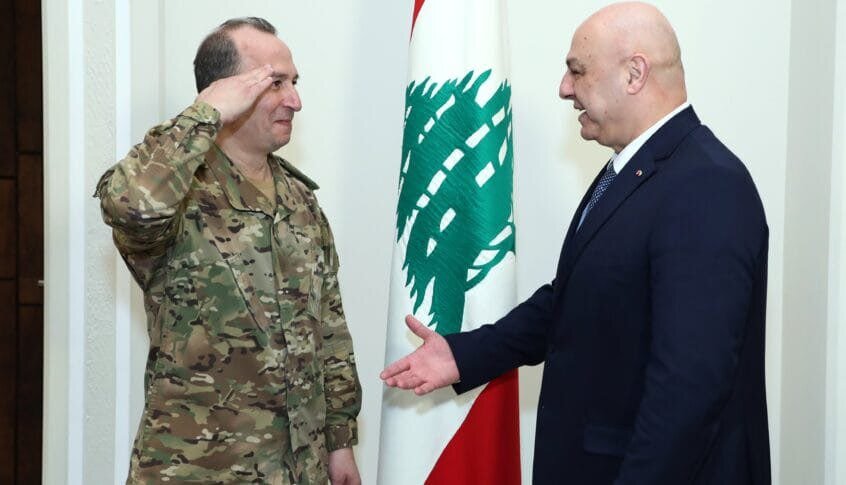
BEIRUT—Over the past months, the Lebanese Army has found itself at the center of an escalating campaign of political, security, and ideological pressure led by Washington in close coordination with Israel.
What is unfolding goes far beyond routine military assistance or technical “reforms.” It reflects a clear effort to encircle the Lebanese Army institutionally, reshape its combat doctrine, and redefine its internal composition in ways that directly serve Israeli security priorities.
At the heart of this pressure lies a gradual but deliberate attempt to alter the army’s foundational perception of threat.
For decades, the Lebanese Army’s doctrine identified Israel as the primary external adversary, a position rooted in experience of occupation, aggression, and repeated wars.
Today, US officials and Israeli intermediaries are pushing for the removal of this designation altogether, reframing Israel not as an enemy but as a “neighbor” or, at most, a party to a border dispute.
This semantic shift is not symbolic; it is strategic. Stripping Israel of its enemy status empties the army’s mission of its national meaning and recasts internal actors—chief among them the Resistance—as the implicit problem.
Parallel to this doctrinal pressure is an unprecedented intervention in the army’s internal makeup. Under the banner of “institutional reform” and “professionalization,” Washington-backed proposals increasingly target Shiite officers and soldiers, portraying them collectively as suspect due to alleged loyalty to the Resistance.
This is not only a dangerous generalization; it is a direct assault on the fabric of the army as a national institution drawn from all segments of Lebanese society.
The underlying message is unmistakable: sectarian affiliation, when politically inconvenient, becomes grounds for exclusion!
These pressures are unfolding alongside the so?called “verification mechanism,” a framework promoted by Washington and enforced in practice by the Israeli enemy through threats of bombardment.
Under this mechanism, the Lebanese Army is increasingly pushed to conduct house searches in southern villages following Israeli claims of weapons storage.
The trap is obvious. If the army refuses, Israel threatens to bomb civilian homes. If it complies, the army appears to be executing Israeli orders, risking a rupture with its own people.
The incidents in Beit Lif and Yanooh exposed the danger of this path. In both cases, homes were searched under duress, no weapons were found, and Israeli claims were proven false. Yet the precedent was set.
Washington treated these episodes not as proof of Israeli bad faith, but as a “successful model” to be expanded. The army’s careful coordination with residents, and its decision to remain physically present to deter Israeli strikes, prevented disaster—for now.
But the long-term objective is clear: normalize the violation of Lebanese sovereignty and transform the army into an auxiliary force tasked with neutralizing Israeli anxieties rather than defending Lebanese citizens.
American officials have attempted to soften this agenda with reassuring language about “restoring confidence” in the Lebanese Army and shielding it from political attacks in Washington.
This “confidence” is conditional; it depends on the army’s willingness to deepen its role in disarmament south of the Litani, accept new monitoring mechanisms, and distance itself—politically and symbolically—from the Resistance.
Support conferences, funding, and even diplomatic backing are all tied to this compliance.
More troubling is the emerging consensus in US policy circles that the army’s cohesion itself is negotiable. Proposals circulating quietly among diplomats and military advisers suggest “cleaning” the institution of elements deemed politically unreliable.
In practice, this means marginalizing Shiite personnel under the pretext of neutrality, despite the fact that neutrality is never demanded of those aligned with openly anti?Resistance factions.
Such a hazardous move would not strengthen the army; it would fracture it along sectarian lines, precisely what Lebanon’s foes have long sought.
The Lebanese Army leadership is acutely aware of these risks. Its recent media and diplomatic tours in southern Lebanon were not mere public relations exercises, but acts of institutional self-defense—an effort to confront Israeli narratives with facts and to remind international observers that occupation and continued aggression are the real obstacles to stability.
The army’s insistence that any second phase of disarmament depends on a full Israeli withdrawal underscores a basic truth Washington prefers to ignore: security cannot be built on coercion, blackmail, and asymmetry.
Ultimately, Washington’s strategy appears aimed at producing an army that is operationally active yet politically restrained, domestically intrusive yet externally deferential, and internally purged of any constituency connected—directly or indirectly—to the Resistance.
This is not reform; it is reengineering!
Lebanon now stands before a stark choice. Either the army remains a national institution anchored in sovereignty, diversity, and a clear understanding of who the enemy is—or it risks being reshaped into a tool of external agendas, alienated from its people and stripped of its unifying role.
The battle over doctrine, loyalty, and identity within the Lebanese Army is not a technical debate. It is a struggle over the future of the state itself.
Leave a Comment