PMF helps break the Iraqi PM impasse
TEHRAN – Iraq’s largest parliamentary bloc has officially nominated its candidate for the country’s powerful post of Prime Minister.
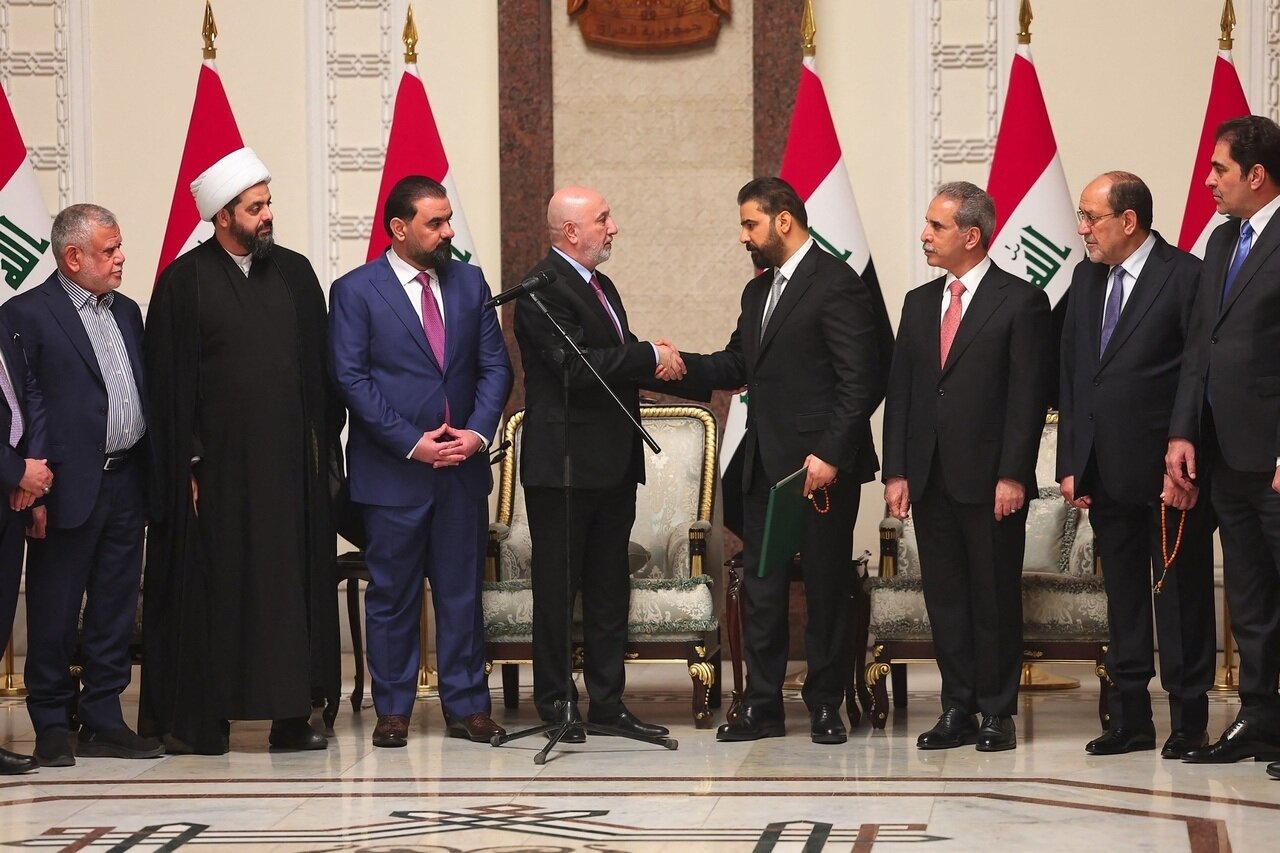
Following a meeting at the government palace in Baghdad, the Coordination Framework selected Ali Al-Zaidi as its nominee. Iraqi President Nizar Amidi has formally tasked the candidate with forming the new government.
Leaders within the Coordination Framework, most notably outgoing Prime Minister Mohammed Al-Sudani and Nouri al-Maliki, agreed to name Al-Zaidi as prime minister.
Disagreements within the Coordination Framework that had delayed the nomination were ultimately resolved after two days of intensive discussions held at the home of Popular Mobilization Forces (PMF) Chairman Faleh Al-Fayyad, according to well-informed sources familiar with the matter.
Efforts led by Al-Fayyad resulted in a consensus within the bloc on Al-Zaidi as a compromise candidate. He has an economic background and is widely regarded as a technocrat. Following this unanimous agreement, the Coordination Framework formally presented Al-Zaidi’s name to the President.
“After considering the names of the candidates, Ali Al-Zaidi was chosen to be the candidate of the Coordination Framework bloc, as the largest bloc in the House of Representatives, to occupy the position of prime minister and form the next government,” a Coordination Framework statement read.
Western reports have suggested that the Coordination Framework replaced its previous nominee, Nouri al-Maliki, due to concerns over potential U.S. sanctions on Iraq.
While Maliki was indeed nominated at one point, he revealed in a television interview that not all members of the Coordination Framework’s 12-member committee supported his nomination. This indicates that the dispute was primarily internal and not linked to U.S. threats.
Several names were also announced after Maliki’s nomination that similarly did not receive the full backing of the Coordination Framework’s committee leaders. This further indicates that internal divisions within the Framework itself were a key factor behind the delay in selecting the prime minister–designate.
Al-Zaidi has been widely described by those who know him as a leader who combines realism with ambition. He has extensive experience in banking administration, investment, financial governance, and educational development, as well as in building an economic environment that supports long-term, sustainable growth.
According to sources familiar with his views, Al-Zaidi sees politics as a serious responsibility centered on state-building rather than simply a competition for power or influence. He believes that true leadership lies in transforming a country’s potential into tangible, measurable achievements that improve governance and public welfare.
In addition to holding a bachelor’s degree in law and being an active member of the Iraqi Bar Association, he also earned a master’s degree in finance and banking.
This academic and professional background has enabled him to hold several prominent leadership positions, most notably serving as chairman of the Board of Al-Janoob Bank, chairman of the National Holding Company, chairman of the University of Al-Shaab, and chairman of the Ishtar Medical Institute.
Prime Minister-designate Al-Zaidi announced that his upcoming government will prioritize addressing both internal and external challenges, while working to build an Iraqi state that is balanced in its regional and international relations. He stressed that the current phase requires the combined efforts of all political and social forces to achieve lasting stability and progress.
Al-Zaidi expressed his gratitude to the leaders of the Coordination Framework for nominating him for the position, acknowledging their confidence and support.
He explained that Iraq’s human and natural resources provide a strong opportunity to manage the country within a clear vision of a state that is economically capable and socially prosperous, with the potential to achieve long-term development and stability.
He pointed out that the upcoming government program will build on and complement previous efforts aimed at improving public services and social conditions, while also setting clear priorities that take into account risk assessment and the effective seizing of available opportunities. Al-Zaidi confirmed that the program is based on a vision of making Iraq a balanced country in both its regional and international relations, strengthening its position while maintaining constructive engagement with all partners.
Under the constitution, the designated prime minister has 30 days to present a proposed cabinet to parliament, and at least 167 votes are required to secure a vote of confidence.
In Iraq’s power-sharing system, which has been in place since 2003 following the U.S.-led invasion of the country, the presidency is typically allocated to Kurdish politicians, the premiership to Shia Arabs, and the speaker of parliament to Sunni Arabs.
The new Prime Minister must now form a government amid the American and Zionist regimes’ illegal war on neighboring Iran, the ripple effects of which have been felt in Baghdad. Several U.S. and Israeli regime strikes have killed PMF commanders as well as civilians during the war.
Factions operating under the Islamic Resistance in Iraq have been striking U.S. bases and interests linked to the Zionist regime. The attacks have halted since the ceasefire between the Islamic Republic and the United States.
Some resistance factions have declared that their “finger is on the trigger” should the war resume. They have also stated that they are closely monitoring U.S.-backed ground proxies, which could attempt to destabilize both Iran and Iraq.
Leave a Comment