Echoes of the past: folio from the manuscript of Layli and Majnun
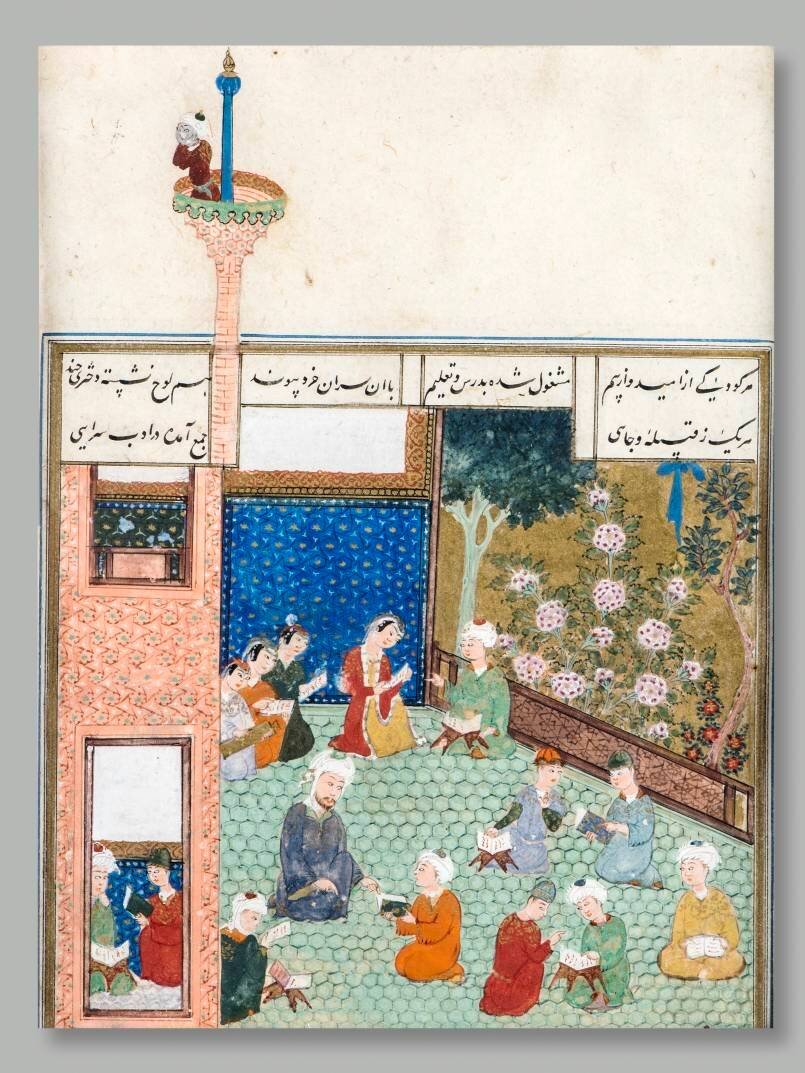
A single folio from the manuscript of Layli and Majnun, illustrating the scene of the lovers attending school, is on display in the Timurid Hall of the Museum of Archaeology and Islamic Art of Iran, part of the National Museum of Iran.
This illustration belongs to the early chapters of the tragic love story, taken from the masterpiece Panj Ganj (Five Treasures) by Nezami Ganjavi, the celebrated Persian poet of the 6th century AH (12th century CE).
The painting, which dates from the 9th century AH (15th century CE), shows a traditional schoolhouse (maktab khaneh) or a gathering for teaching and discussion, set in a space with an iwan (vaulted hall). Groups of children, separated into two sections, are busy learning under the guidance of their teachers. In front of each teacher stands a wooden bookrest (rahl) with a book open upon it. The children study both collectively and individually. In a chamber at the back, a young boy is seen conversing with and learning from his master. On the minaret of the building, a muezzin is likely depicted calling the faithful to prayer.
The outdoor landscape is adorned with trees and flowers, while the sky shines in gold. The background of the painting is light green, and the clothing of both students and teachers is similarly styled and colorful. Notably, the girls' dresses and hairstyles are almost identical to one another, reflecting their equal presence in the learning environment. Above this scene, verses in Nasta'liq script tell the story of Layli and Majnun's education:
Every child, with hope and with fear,
Engaged in lessons and learning sincere.
Each from their tribe and station,
Gathered in a house of education.
Along with the young leaders in line,
Several girls sat with their slates, side by side.
This assembly was painted in the Shiraz school and belongs to the Timurid period. Among the hallmarks of the Shiraz school, besides the bird's-eye perspective, is the clear depiction of diverse Timurid-era clothing.
The Shiraz school was one of the artistic schools of the Ilkhanid period that continued the art and culture of its predecessors, blending little with foreign elements. As a result, its artists better preserved artistic traditions. During the Timurid era, patrons and promoters of art established a vibrant artistic center in Shiraz. Manuscripts surviving from this period reflect the eventful ups and downs of painting in that age. Nezami's Khamseh remains one of the most important and beautiful works of this school.
AM
Leave a Comment