The story behind Zilou coverings in the martyred Leader’s office
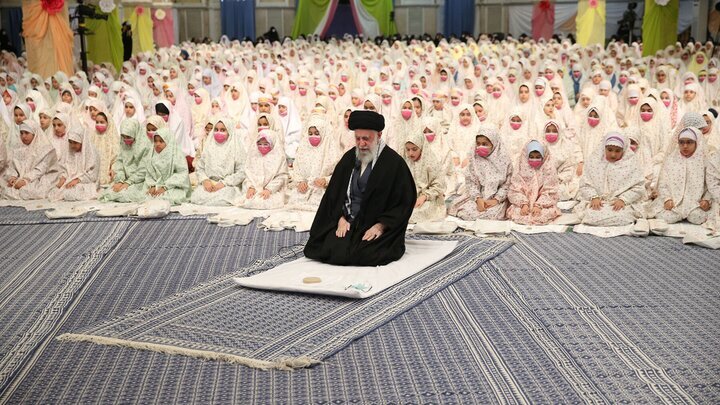
TEHRAN - For years, viewers of official meetings and public ceremonies questioned why the floors of the Imam Khomeini Hussainiya and the office of Iran’s late Leader Ayatollah Seyyed Ali Khamenei were covered with blue-and-white Zilou floor coverings rather than precious Persian carpets.
Ayatollah Khamenei’s office, better known as Beit-e Rahbari, served as his official residence, administrative office and principal workplace from 1989 until it was damaged in an airstrike on Feb. 28, 2026.
According to Mehr news agency, people close to the Leader’s office said the use of Zilou was not based solely on personal austerity. They said the decision was also intended to support traditional Iranian craftsmanship, preserve the centuries-old weaving tradition and encourage domestic production.
Zilou, a handwoven cotton floor covering traditionally produced in central Iran, has long been associated with mosques, religious schools and public gathering places because of its durability and ease of maintenance.

A story that remained untold for years
Abbas Mowzoon, an Iranian television presenter and documentary filmmaker, said that valuable carpets donated by admirers and benefactors were repeatedly offered for use in the Imam Khomeini Hussainiya and the nearby leadership office. However, Ayatollah Ali Khamenei consistently instructed that none of the donated carpets should be used there, Mehr news agency reported on Monday.
One account says that a [handwoven] carpet was once placed in a corner of the Hussainiya to test whether the Leader would notice the change. Upon entering, he immediately saw the carpet and asked why it had been laid there. When told that it was a donated carpet and had cost the office nothing, he reportedly ordered that all such carpets be donated to mosques, hussainiyas and religious gathering places, while the blue-and-white Zilous should remain in place.
Support for production in practice
According to Mehr, people familiar with the office said Ayatollah Khamenei believed that many Iranian artisans had supported their families through Zilou weaving for generations. If the market for the craft disappeared, both a traditional Iranian industry and the livelihoods of numerous families would be threatened.
In this view, support for national production was meant to begin with personal practice rather than remain only a slogan.

The question in Yazd
The issue became more prominent during a visit to Yazd province. In a meeting with local elites, an elderly master Zilou weaver complained that Iranian Zilou was not receiving sufficient support.
Ayatollah Khamenei reportedly replied that people could not be forced by administrative order to buy Zilou, but a cultural initiative could encourage interest in it. He then decided to cover the Hussainiya, his workplace and his residence with Zilou, hoping that others would follow the example.
A traditional craft regains attention
After official images repeatedly showed the blue-and-white Zilous in meetings and ceremonies, public attention turned toward the traditional floor covering. Many mosques, cultural institutions and private buyers began ordering Zilou, particularly from the workshops of Meybod in Yazd province.
Veteran weavers say that many customers later requested “the same Zilou that is used in Beit-e Rahbari,” a development that helped revive an industry that had been close to being forgotten.

About Zilou
Zilou is a traditional handwoven floor covering made mainly from cotton yarn and produced primarily in desert and agricultural regions of Iran. The city of Meybod is widely known for its Zilou weaving tradition.
Unlike luxurious silk or wool carpets, Zilou is valued for its durability, simplicity and practical use. It commonly features geometric patterns and a limited color palette, with blue and white among the most recognizable combinations.
AM
Leave a Comment