Strait of Hormuz: A geopolitical lever
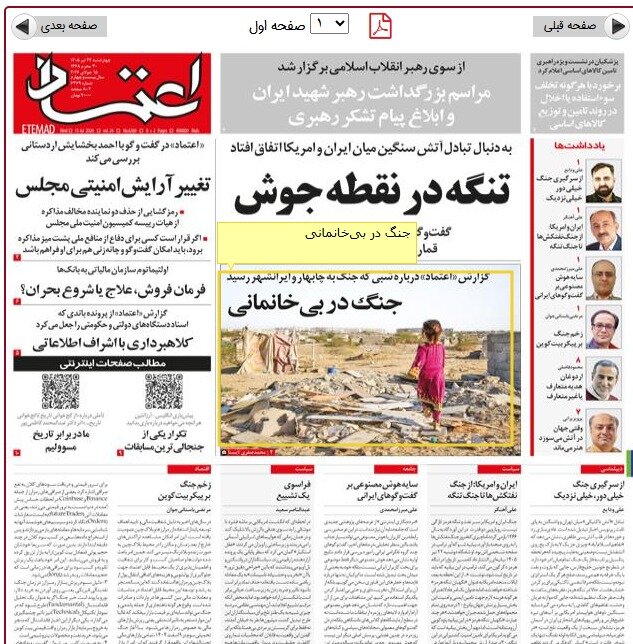
Mashallah Shams‑al‑Vaezin, a prominent analyst of strategic affairs, told Etemad that the recent Iran–US tensions in the Strait of Hormuz should be interpreted in connection with Clause 5 of the memorandum of understanding between the two countries.
According to him, Iran views the Strait of Hormuz not merely as a waterway but as a strategic achievement — a national asset it is unwilling to relinquish under any circumstances. He emphasized that despite rising tensions, the likelihood of a war similar to the 40‑day conflict is extremely low. The Strait of Hormuz functions not only as a vital energy corridor but as a “geopolitical lever” whose stability directly influences global markets. Any sign of insecurity immediately affects global oil prices, maritime insurance rates, and the security calculations of regional and international actors. Politically, the Strait becomes a bargaining instrument — used both in formal negotiations and indirect diplomatic signaling. Shams‑al‑Vaezin argues that Iran, relying on time, strategic patience, and above all its geographical position, can navigate the crisis without escalating it into full‑scale conflict. He also advises Iranian decision‑makers to adopt diplomatic strategies that would convert military achievements into tangible economic gains, turning geopolitical leverage into measurable national benefit.
Sobh‑e‑No: Yemen’s strategic value rises in Iran’s regional calculations
Sobh‑e‑No analyzed the landing of an Iranian aircraft at Yemen’s Hodeidah International Airport, describing it as a move that effectively ended Saudi Arabia’s 11‑year air blockade of Sanaa. According to the paper, Iran’s decision to send a direct flight — without seeking Saudi approval — demonstrated that Tehran rejects Riyadh’s monopoly over Yemen’s airspace. The newspaper argues that Iran showed it does not abandon its allies during critical moments. This action strengthened Tehran’s image as a reliable and powerful supporter within the “Axis of Resistance,” imposed new strategic rules on Saudi Arabia, and signaled that the era of Iranian passivity has ended. The message to Riyadh, according to the paper, is clear: any attempt to continue the blockade will trigger a military response from Yemen. The move also revealed that new regional power dynamics are emerging, confronting Saudi Arabia and its allies with a new reality — the monopoly over Yemen’s skies is over, and future responses may extend beyond Yemen’s borders.
Resalat: The Western–Arab coalition caught in a strategic trap
Resalat focused on Iran’s and the resistance front’s strength in confronting the Western–Arab coalition. The paper described West Asia as witnessing unprecedented field developments and dramatic shifts in regional power structures. Following aggressive actions by the coalition led by the United States and supported by Saudi Arabia, Iran’s armed forces and the Yemeni resistance delivered decisive, multilayered, and historic responses. The newspaper argues that these developments sent a clear message to the world: the era of |hit‑and‑run” imperial behavior in the region is over. It argues that resistance diplomacy combined with military deterrence is the only language understood by aggressors. According to Resalat, the Persian Gulf, the Strait of Hormuz, and the Red Sea are now more firmly under the control of their “rightful owners” than ever before. The Western–Arab coalition, it says, is trapped in a strategic dilemma where any further action will only accelerate the collapse of its already declining regional influence.
Arman‑e‑Melli: A full‑scale war remains unlikely
To analyze recent developments in the United States and the possibility of war with Iran, Arman‑e‑Melli interviewed international affairs expert Kourosh Ahmadi. He noted that Congress plays a minimal role in shaping foreign policy, though its members often adopt anti‑war positions to strengthen their electoral image. Ahmadi believes a full‑scale war is not currently on the US agenda. Instead, he expects tensions to continue below the threshold of total war, with limited military operations and controlled escalation. He suggests that the situation could evolve into a naval blockade, similar to previous episodes. Although the probability of a full war has increased compared to earlier periods, he still considers it unlikely unless major changes occur in the strategic environment.
Hamshahri: The problem began with “necessary arrangements”
Hamshahri criticized the Trump administration’s haste in drafting the memorandum of understanding. The agreement required Iran to provide “necessary arrangements” for safe commercial shipping through the Strait of Hormuz for 60 days and to cooperate with Oman on future administration and maritime services. At first glance, the text seemed to secure what Washington wanted: continued normal functioning of the Strait. But Iran appears to have interpreted these clauses as recognition of its role in managing the waterway after a permanent agreement. Thus, Iran’s current efforts to shape the new situation are, in the paper’s view, predictable.
Leave a Comment