America knows how to start a war, not how to end one
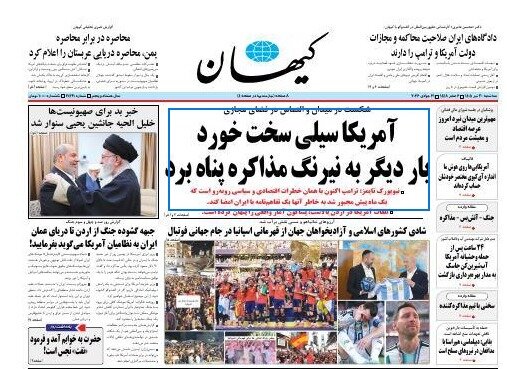
In a commentary, Kayhan argues that US military calculations have reached a dead end. The article claims that Iran’s crushing responses against CENTCOM positions have pushed the White House into an arms-related impasse and an energy crisis.
Trump’s hasty retreat and renewed turn toward the trick of negotiations, the paper says, signal a strategic defeat for Washington on the battlefield. Following precise and heavy Iranian strikes on strategic positions, military bases, and supply arteries of the United States in the region, the White House is portrayed as facing a collapse of its military planning and even its decision‑making centers. According to Kayhan, a wave of harsh criticism has erupted across the American political system, Congress, and media, all pointing to one conclusion: the United States and its “terrorist army” may know how to start a war, but they do not know how to finish one.
Shargh: What is the United States seeking?
Shargh discussed the new phase of US illegal aggression and devoted its editorial to the beginning and underlying causes of the new round of unlawful US attacks against Iran. According to the editorial, Washington has used disagreements over the Strait of Hormuz as a pretext for renewed aggression and for launching an international media campaign aimed at legitimizing its actions. The paper argues that it is obvious the United States could have addressed these disagreements through diplomatic channels. In any case, the editorial claims that the issue of the Strait of Hormuz has become a major, personal, and symbolic matter for Donald Trump, making it unlikely that he will easily accept Iran’s conditions regarding the strait. The US strategy in the ongoing conflict is said to revolve primarily around the Strait of Hormuz and the claim of “reopening” it. To achieve this, Washington is focused on disrupting Iran’s surveillance and monitoring capabilities along its southern coastline and islands, targeting Iranian communications and radar infrastructure as well as offensive assets — including missile and drone facilities — from Chabahar to Mahshahr.
Khorasan: Responding at the source of the threat
Khorasan analyzes the apparent reduction in the intensity of US attacks on Iran. The paper notes that although it is too early for a definitive judgment, an optimistic scenario is that Iran’s increased pressure on regional states has discouraged Washington from expanding the scope of the conflict. The United States relies on bases, ports, airports, and logistical networks located in Arab countries to continue its operations. Washington wants to use these countries’ geography against Iran without paying the price of Iran’s retaliation. Iran’s strategy, the paper argues, is to break this equation: certain states must be struck hard enough that Arab lobbying networks pressure Trump to restrain the war. The message is clear — cooperation with the United States not only brings no benefits and security guarantees; it also entails direct costs. If Kuwait and the UAE become part of the chain of attack, they will also become part of the chain of response, because destabilizing the regional rear base increases political pressure on Washington.
Hamshahri: Should we abandon the Strait of Hormuz?
Hamshahri examines the strategic importance of the Strait of Hormuz and criticizes those who downplay it. The paper notes that while Iran’s southern coastline has recently been subjected to heavy US attacks aimed at weakening Iran’s strategic position in the Strait, some voices still propose sidelining this vital asset, ignoring the geopolitical realities on the ground. According to Hamshahri, recent experience shows that the Strait of Hormuz is not only a strategic energy corridor but also one of Iran’s most important deterrence tools against external pressure. Abandoning it would weaken Iran’s bargaining power, undermine deterrence, and send a message of weakness to adversaries — even raising public suspicion about the intentions of those advocating such an approach.
Arman‑e-Melli: America trapped between two Straits
In an article analyzing Trump’s precarious position in the region, Arman‑e-Melli quotes international affairs analyst Jafar Ghanadbashi. He argues that the United States suffers from military weaknesses that prevent it from overpowering Iran. Iran and the Resistance Front, he says, possess powerful levers — notably the Strait of Hormuz and the Bab al‑Mandab — which can immobilize the US militarily. According to Ghanadbashi, Washington now faces a dangerous crossroads. One path is an extremely risky option: a large‑scale attack on Iran, which could bring enormous dangers for both the United States and the region. Regional states and America’s European allies, he notes, strongly oppose such a scenario. The situation has become unpredictable and chaotic for Washington, especially as American media have reported rising US casualties, intensifying fear of Iran’s decisive response.
Leave a Comment