Germany’s opaque arms export policy toward Israel comes under renewed scrutiny
TEHRAN – Germany’s arms export policy toward Israel is again facing scrutiny after Berlin quietly approved nearly €800 million ($913 million) in military export licenses to Israel during the first five months of 2026—more than the total value approved during the previous 20 months combined. The sharp increase has raised fresh questions about the transparency and consistency of Germany’s export controls, particularly as the government publicly voices concern over the humanitarian situation in Gaza while continuing to authorize major military transfers.
The figures were disclosed in a Federal Foreign Office response to a parliamentary inquiry submitted by the Alternative for Germany (AfD) party. According to the government, almost all of the approvals were issued in April and May, but officials declined to specify the equipment involved, stating only that more than 60 percent of the total value was linked to a single "major maritime project."
The refusal to identify the project has reinforced longstanding criticism that Germany's arms export system lacks transparency. The Federal Foreign Office and the Ministry for Economic Affairs, which oversees export licensing, have both declined to comment on the transaction.
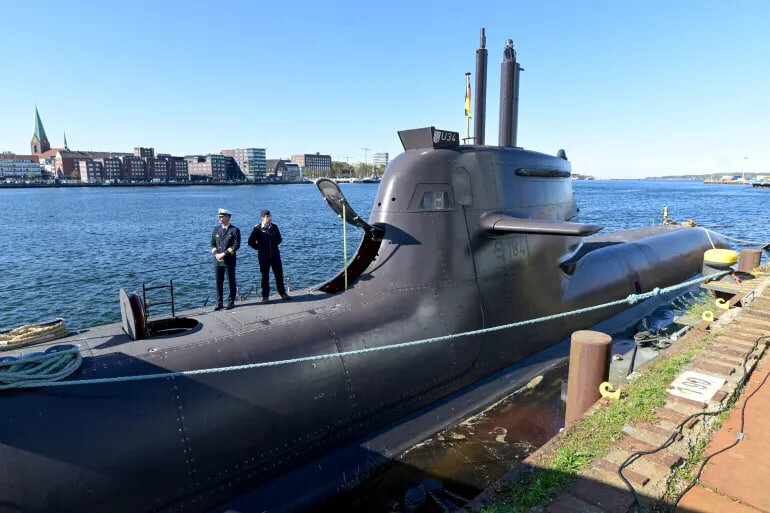
Security analysts believe the unnamed project is almost certainly the INS Drakon, a Dolphin II-class submarine built by German shipbuilder ThyssenKrupp Marine Systems (TKMS). The submarine reportedly completed sea trials in Germany before being handed over to the Israeli Navy. According to multiple reports, it may be equipped with a vertical launching system capable of deploying cruise or ballistic missiles, a capability that would significantly enhance Israel's strategic deterrent.
The secrecy surrounding the submarine has attracted particular attention. During sea trials, its sail was reportedly covered to conceal its weapons configuration, while the German government has provided little public information regarding the licensing process despite the project's strategic significance. Reports last year also conflicted over whether Berlin had even approved the submarine's export, with the government denying approval while the manufacturer indicated otherwise.
Max Mutschler, a senior researcher at the Bonn International Centre for Conflict Studies, said the government's unwillingness to identify the project reflects a broader pattern.
"Unfortunately, the fact that the federal government does not explicitly mention this is also typical of the lack of transparency surrounding arms exports," he told Al Jazeera.
Contradictory policy
The latest approvals also highlight what critics describe as an inconsistent German policy toward military exports to Israel.
In August 2025, Chancellor Friedrich Merz announced that Germany would no longer approve military equipment that could be used in the Gaza Strip, citing humanitarian concerns. However, that suspension proved temporary. By November, Berlin had lifted the restrictions and returned to evaluating export requests on a case-by-case basis, while deliveries approved earlier continued throughout the suspension period.
The apparent reversal has fueled accusations that Germany's public rhetoric has not been matched by its export decisions.
Mutschler said some officials within the German government viewed certain exports as problematic because of "numerous and credible reports of Israeli war crimes during the military operation in Gaza." Nevertheless, he said those concerns ultimately failed to produce a genuinely restrictive export policy.
Naval support under scrutiny
Criticism has focused primarily on Germany's naval cooperation with Israel.
Ruth Rohde of the British research organization Shadow World Investigations argued that German-built naval platforms have played an operational role in Israeli military activities.
"Israel has used German ships to fire at Gaza, to blockade and starve Gaza, and is using submarines to station nuclear weapons," Rohde told Al Jazeera. She added that supplying another submarine while Israel continues military operations in Gaza would provide Israel with "another tool in its arsenal of mass destruction."
Germany has also continued to strengthen industrial cooperation with Israel. In May, TKMS signed a memorandum of understanding with Elbit Systems, Israel's largest private defense company, to expand future collaboration.
Economic interests prioritized over humanitarian concerns
The latest approvals come as Germany's defense industry enjoys unprecedented growth.
According to the German government's Arms Export Report, Berlin approved €13.87 billion in military export licenses during the first half of 2026—more than four times the figure recorded during the same period in 2025. Ukraine remained the largest recipient, while Israel ranked among the leading destinations.
Mutschler argued that economic considerations continue to dominate export decisions.
"Arms exports have been and continue to be viewed by most federal governments primarily from an economic perspective and welcomed as a means of strengthening the defense industry," he said, adding that the possibility such weapons could be used to commit war crimes appears to receive "significantly smaller" consideration in official decision-making.
Analysts note that Germany's defense sector has expanded rapidly as military spending has increased and global demand for weapons has surged. At the same time, critics argue that Berlin's reluctance to fully disclose the nature of its military exports—particularly major projects involving Israel—has made meaningful public oversight increasingly difficult.
The combination of undisclosed projects, shifting political positions, and limited official explanations has reinforced accusations that Germany's arms export policy, especially toward Israel, remains marked by ambiguity rather than transparency.
Leave a Comment