Pezeshkian pursues wider economic ties and financial alternatives on BRICS sidelines
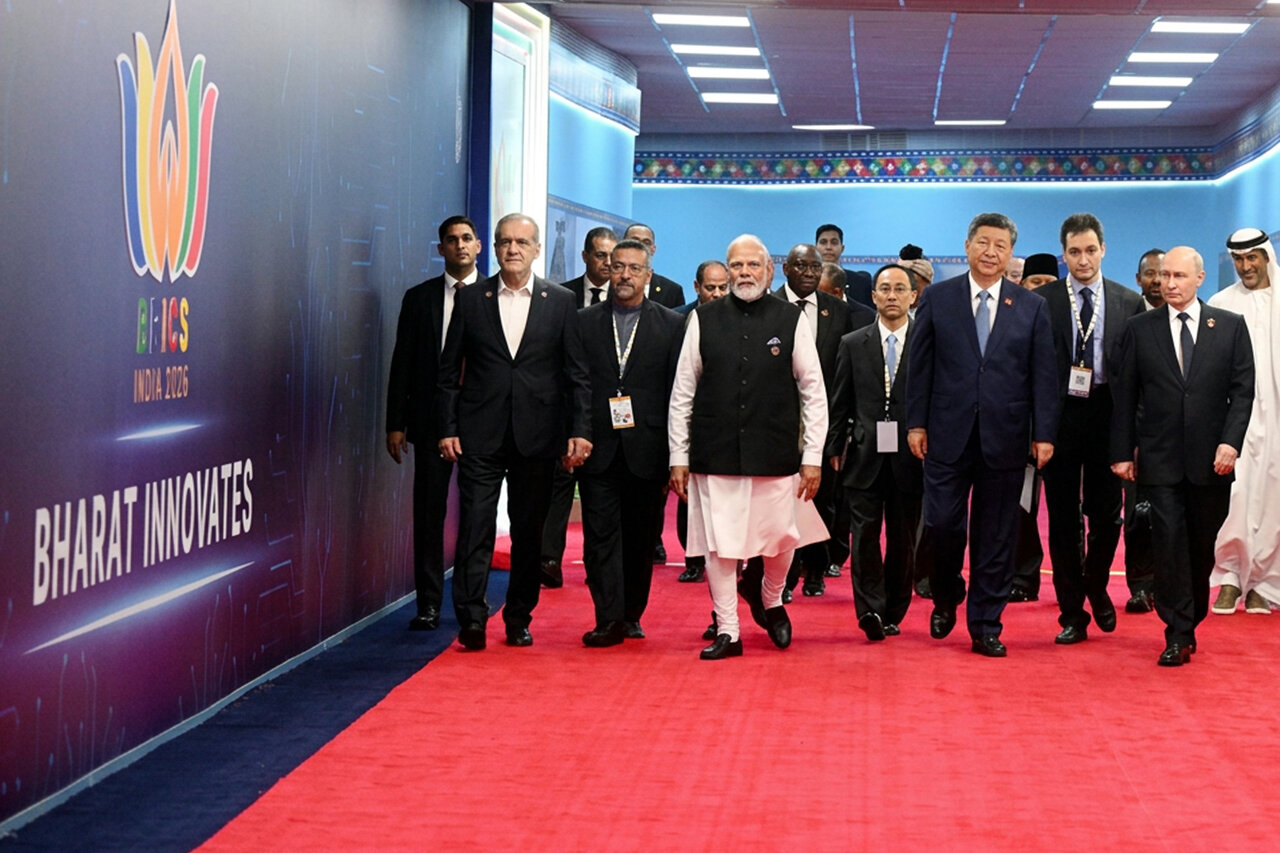
TEHRAN- Iranian President Masoud Pezeshkian has used his participation in the BRICS summit in New Delhi to intensify bilateral diplomacy with key members of the grouping, holding a series of meetings with the leaders of India, Malaysia, Ethiopia and the United Arab Emirates as Tehran seeks to expand trade ties and promote financial mechanisms less vulnerable to Western pressure.
Pezeshkian met Indian Prime Minister Narendra Modi on Friday and held further talks on Saturday with Malaysian Prime Minister Anwar Ibrahim, Ethiopian Prime Minister Abiy Ahmed Ali, Indian President Droupadi Murmu and Sheikh Khaled bin Mohamed bin Zayed Al Nahyan, Crown Prince of Abu Dhabi.
Taken together, the meetings highlight the economic and diplomatic priorities Iran has been pursuing through BRICS: expanding bilateral trade, strengthening ties with emerging economies and neighboring states, increasing the use of national currencies in trade and developing alternative payment channels that could reduce exposure to sanctions and Western-dominated financial institutions.
The approach is also broadly consistent with the direction of the BRICS discussions in New Delhi. The grouping's latest declaration has placed greater emphasis on facilitating cross-border payments and trade settlement in national currencies, while stopping short of advocating an immediate common BRICS currency.
India: Expanding trade and strategic economic cooperation
Pezeshkian's meeting with Modi on Friday focused on strengthening bilateral and multilateral cooperation, with the Iranian president emphasizing the importance of economic and financial cooperation among BRICS members and the continued implementation of strategic agreements between Iran and India.
Pezeshkian said the numerous historical and economic commonalities between Iran and India could provide a strong foundation for expanding bilateral relations and called for greater use of the two countries' economic potential.
The meeting came as India seeks to balance its relations with Iran, Russia, the Persian Gulf states and Western powers. Modi told Pezeshkian that India remained committed to dialogue and diplomacy in addressing regional disputes and stressed the importance of maintaining peace and stability in West Asia, including the safety of navigation and commerce.
Pezeshkian also met President Droupadi Murmu on Saturday, stressing the need for strategic planning to expand relations and make greater use of the economic potential available to the two countries.
Murmu, for her part, said India attached importance to deepening relations with Iran and described Pezeshkian's visit as significant, noting that it was his first trip to India in eight years.
For Tehran, India is particularly important not only as a major BRICS economy but also as a long-standing economic partner with which Iran has sought to develop trade, transport and connectivity links despite sanctions.
Malaysia: Stronger trade and economic ties
In his meeting with Malaysian Prime Minister Anwar Ibrahim, Pezeshkian stressed the importance of strengthening relations between Iran and Malaysia, while discussing bilateral ties, regional developments and issues of mutual interest.
Pezeshkian framed the broader regional confrontation as an obstacle to cooperation among Muslim and neighboring countries and said Iran sought peace, respect for its rights and the removal of ' unjust sanctions.'
Anwar expressed support for closer relations with Iran, particularly in trade, economic and educational fields. He also praised the resilience of the Iranian government and people and reiterated Malaysia's opposition to attacks on Iran's territorial integrity and sovereignty.
The meeting is significant from an economic perspective because Malaysia provides Iran with another avenue for expanding commercial relations with a major Asian Muslim economy outside its immediate neighborhood.
UAE: A high-level channel with a key Persian Gulf neighbor
Pezeshkian's meeting with Sheikh Khaled bin Mohamed bin Zayed Al Nahyan, Crown Prince of Abu Dhabi, was among the most politically significant of his bilateral encounters in New Delhi.
The meeting brought together senior Iranian and Emirati officials at a time when relations between Tehran and Abu Dhabi have been affected by wider regional tensions. The two sides have nevertheless maintained an interest in dialogue, regional stability and economic engagement.
The encounter also carries wider significance within BRICS. Iran and the UAE are both members of the grouping, despite differences over regional security and their respective relations with the United States.
Reuters reported that the two sides backed the BRICS declaration calling for maximum restraint in West Asia and that the Pezeshkian-Khaled meeting was the highest-level contact between Iran and the UAE since the start of the current conflict.
For Tehran, maintaining channels with Persian Gulf neighbors is an important element of its broader effort to strengthen regional economic ties and prevent political divisions from becoming permanent barriers to trade and investment.
Ethiopia: Expanding Iran's African economic outreach
Pezeshkian also met Ethiopian Prime Minister Abiy Ahmed Ali, who praised the Iranian people's resistance, resilience and patriotism and expressed Ethiopia's interest in learning from Iran's experience.
The two leaders discussed expanding bilateral relations, including economic and cultural exchanges. Abiy noted that Ethiopia already maintains extensive economic and cultural relations with Iran's neighboring countries and expressed a desire to develop similar interactions directly with Tehran.
Pezeshkian, meanwhile, emphasized the importance of stronger economic relations among BRICS members, arguing that deeper financial and economic cooperation could contribute to the development of all member states.
The meeting fits into Iran's broader effort to use BRICS as a platform for expanding economic links with countries across Asia, Africa and the wider Global South.
BRICS as an economic and financial platform
Pezeshkian's intensive bilateral diplomacy in New Delhi therefore goes beyond a series of individual political meetings. It reflects an effort to translate Iran's BRICS membership into practical economic partnerships.
For Tehran, the grouping offers a framework for expanding trade with major emerging economies while exploring ways to reduce the exposure of its foreign trade to sanctions, restrictions on conventional banking channels and dependence on Western financial infrastructure.
Iran has repeatedly advocated greater use of national currencies in trade among BRICS members, along with diversified payment mechanisms. At the summit, Pezeshkian said expanding the use of national currencies was one of the most important steps available to the group. AP reported that Iran was also pushing for mechanisms designed to reduce the bloc's reliance on Western financial systems.
The significance of that agenda extends beyond Iran. BRICS countries account for a substantial share of the world's population and economic output, while their members possess major energy, manufacturing, agricultural, technological and financial capabilities. Their ability to increase trade in local currencies and establish more efficient cross-border payment arrangements could gradually reduce transaction costs and limit the impact of unilateral financial restrictions.
The current BRICS approach, however, is incremental rather than a sudden attempt to displace the dollar. Discussions in New Delhi have focused on making local-currency settlements easier, faster and cheaper and on improving interoperability between members' payment and messaging systems.
For Iran, which has faced extensive restrictions on access to international financial channels, such mechanisms have an additional strategic value. They could provide greater room for trade and investment with countries that are willing to conduct business outside conventional Western financial channels.
From diplomatic outreach to economic architecture
Pezeshkian's meetings in New Delhi consequently form part of a broader Iranian strategy: strengthen bilateral relationships, expand trade with emerging economies, deepen regional economic integration and support financial arrangements that give developing countries greater autonomy.
The emphasis is not necessarily on replacing the dollar overnight, but on creating more options for trade and investment — through national currencies, alternative payment channels, regional connectivity and institutions such as the BRICS New Development Bank.
The New Delhi summit has provided Iran with an opportunity to pursue all of these objectives simultaneously: engaging major Asian economies such as India and Malaysia, maintaining dialogue with a key Persian Gulf neighbor such as the UAE, expanding its African outreach through Ethiopia and working within BRICS to promote a more diversified international economic system.
In this sense, Pezeshkian's bilateral diplomacy on the sidelines of the summit represents an effort to turn Iran's BRICS membership from a political affiliation into a practical platform for trade, investment and greater financial resilience.
Leave a Comment