The price of playing with fire: UAE's economic reckoning
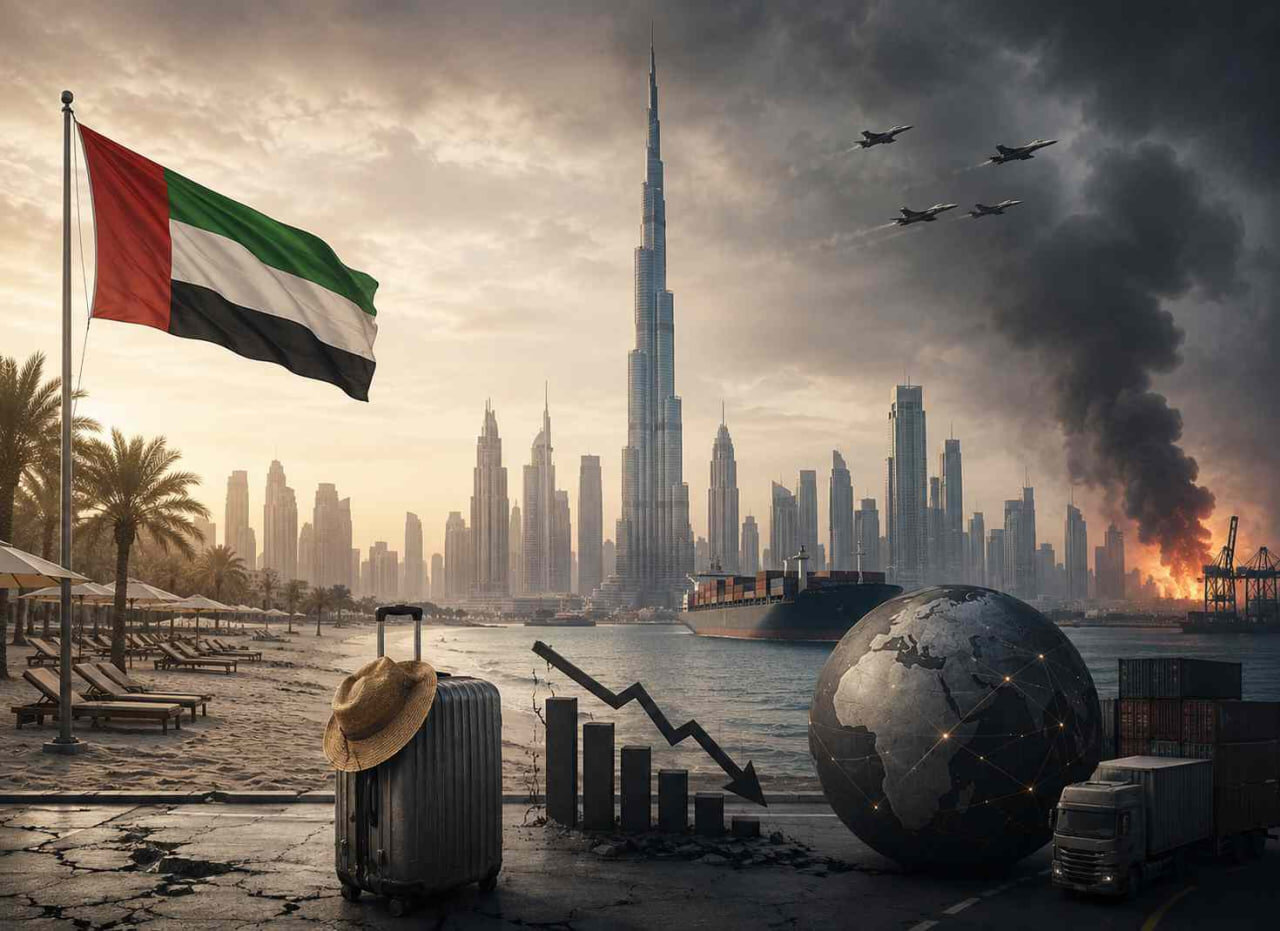
TEHRAN -- The economic consequences of the war against Iran are beginning to appear in figures that the Emirati leadership can hardly afford to ignore. For a country that has spent decades building its reputation as a regional hub for tourism, trade, investment and international business, the latest economic projections offer a sobering reminder: regional instability comes at a price, and those who help create it are not necessarily spared its consequences.
According to a recent assessment by international credit rating agency Fitch, Dubai's economy is expected to contract by nearly 5 percent in 2026 as a result of the repercussions of the war with Iran. The UAE's overall economic growth, meanwhile, is forecast to remain at just 0.5 percent. The agency has also reported a decline in the country's foreign-exchange reserves, from more than $300 billion in February to $265 billion in August.
The damage has been particularly pronounced in the non-oil economy, with disruptions to trade, transportation, manufacturing and tourism weighing heavily on economic activity. These are not peripheral sectors for the Emirates. They are central to the economic model that Abu Dhabi and Dubai have spent years promoting to the international community.
For the Emirati leadership, these figures should prompt a serious examination of the relationship between its regional policies and its own economic interests.
The UAE has built much of its international standing on the promise of stability. Dubai, in particular, has marketed itself as a safe destination for tourists, a dependable hub for international companies, a financial centre and a gateway connecting Asia, Europe and Africa. Its airports, ports, hotels, real estate market and financial institutions have all benefited from the perception that the Emirates offer an environment insulated from the political and military turbulence surrounding them.
Yet that reputation cannot be maintained independently of the security environment in which the country operates.
A state whose prosperity depends so heavily on international confidence cannot expect to remain unaffected when it becomes involved in military confrontation with a major neighbouring country. The contradiction is difficult to overlook: the very regional stability that makes the UAE attractive to investors and visitors is undermined when its territory and military capabilities become part of a campaign against Iran.
From economic partner to military participant
The UAE's role in the war has gone beyond diplomatic alignment or the provision of logistical facilities. A report published by The Wall Street Journal, citing people familiar with the operations, alleged that Emirati forces conducted dozens of airstrikes against Iranian military and energy facilities during the conflict, in coordination with the United States and Israel. The reported targets included facilities on Qeshm and Abu Musa islands, Bandar Abbas, Lavan Island and the Asaluyeh petrochemical complex.
If the reported operations are considered alongside the broader military and security cooperation between Abu Dhabi, Washington and Tel Aviv, they point to a substantial level of Emirati involvement in the confrontation.
This is particularly consequential given the UAE's geographical position. Iran is not a distant adversary whose actions can be treated as an external security matter. It is a neighbouring country across the Persian Gulf, with an extensive coastline, considerable military capabilities and a strategic position along some of the world's most important energy and maritime routes.
Turning the territory of the Emirates into a platform for operations against Iran carries consequences that extend far beyond the battlefield. It exposes the UAE's own infrastructure, commercial interests and economic reputation to the risks of a prolonged regional conflict.
It also raises questions about the extent to which Emirati foreign policy has become intertwined with Israeli strategic objectives.
The deepening security relationship between the UAE and Israel, particularly following the normalization agreements, has created a framework for military and intelligence cooperation that has implications for the entire region. From Tehran's perspective, Abu Dhabi's participation in military planning and operations directed against Iran represents more than an ordinary bilateral partnership. It raises the question of whether the Emirates are increasingly allowing their territory and strategic position to serve Israeli interests in the region.
For a country whose economic prosperity depends on maintaining productive relations with its neighbours, the implications of such an alignment deserve careful consideration.
The vulnerability behind the glitter
The economic consequences are particularly significant because of the structure of the Emirati economy.
Although the UAE possesses substantial oil and gas resources, its international economic identity, especially in Dubai, rests heavily on sectors that are highly sensitive to perceptions of security and stability. Tourism, aviation, hospitality, international trade, logistics, finance and real estate are all dependent on the continued confidence of foreign visitors, investors, businesses and residents.
These sectors cannot be protected by financial reserves alone.
A tourist deciding whether to spend a holiday in Dubai, a multinational company considering where to establish its regional headquarters, or an investor evaluating the Emirati property market all take regional security into account. Even without direct damage to hotels, airports or commercial buildings, the perception of sustained insecurity can influence decisions, redirect capital and reduce demand.
The Fitch projections illustrate this vulnerability. The nearly 5 percent contraction expected in Dubai's economy is especially noteworthy because it concerns an emirate whose international reputation has been built around economic diversification and global connectivity.
The decline in foreign-exchange reserves also deserves attention. Although Fitch considers the UAE's remaining financial buffers substantial, the reduction from more than $300 billion to $265 billion illustrates that the consequences of the conflict are not confined to isolated economic indicators.
The agency has also identified the possibility that prolonged deterioration in regional security could have more structural consequences for the country's economic prospects.
In other words, the question is not simply how much money the Emirates can spend to absorb the immediate shock. It is whether the conditions that made the country an attractive destination for global capital and tourism can be preserved if regional confrontation becomes a recurring feature of its foreign policy environment.
Territorial ambitions and the cost of confrontation
The UAE's approach toward Iran has also been characterized by repeated claims concerning three Iranian islands in the Persian Gulf: Bu Musa, Greater Tunb and Lesser Tunb.
These claims, repeatedly advanced through Emirati diplomatic statements and joint declarations with other governments, remain firmly rejected by Tehran, which regards the islands as inseparable parts of Iranian territory. The dispute has persisted for decades, but its repeated internationalization adds another layer of tension to an already complicated relationship.
The UAE's continued promotion of these claims, including in international forums, sits uneasily alongside its stated interest in regional stability and diplomatic engagement.
At a time when the region is dealing with the economic and security consequences of a major war, the revival of territorial disputes does little to reduce tensions. Instead, it adds another source of friction between two neighbouring states whose geographical proximity makes their long-term security interests inseparable.
There is a fundamental difference between pursuing diplomatic negotiations over outstanding disputes and allowing those disputes to become part of a wider political and military confrontation. The latter carries risks that cannot be easily contained.
A choice with long-term consequences
The UAE still possesses considerable economic advantages, including substantial financial assets, developed infrastructure, international commercial networks and significant hydrocarbon revenues. Fitch itself has maintained the country's sovereign credit rating at AA- with a stable outlook, reflecting these financial strengths.
But financial resilience should not be confused with immunity.
The latest projections show that even a wealthy state with substantial reserves can experience significant economic disruption when regional security deteriorates. And while oil revenues and sovereign assets may provide a cushion, they cannot indefinitely compensate for a loss of confidence in the country's broader economic environment.
For the Emirati leadership, the challenge is therefore much larger than recovering from one year's economic contraction. It concerns the sustainability of the development model on which the country's international standing has been built.
A country cannot indefinitely present itself as a sanctuary for international business while becoming increasingly involved in military and political arrangements that intensify insecurity in its immediate neighbourhood. Nor can it expect its economic interests to remain insulated from the consequences of policies that contribute to regional confrontation.
The future of the UAE will be shaped not only by its financial resources or investment ambitions, but also by the political and security environment it helps create.
The economic figures released by Fitch should be read in this wider context. They offer a warning about the costs of regional instability and the exposure of an economy whose prosperity depends on international confidence.
For the Emirates to navigate the difficult period ahead, the question of its relationship with neighbouring countries, above all Iran, cannot remain secondary to its strategic calculations elsewhere. A meaningful and far-reaching reassessment of its regional policy would have direct implications for its economic future.
Ultimately, the prosperity of the UAE is tied to the stability of the neighbourhood in which it exists. The extent to which its leadership recognizes that connection will be an important factor in determining whether the current economic setbacks remain temporary or become part of a deeper and more enduring challenge.
Leave a Comment