Discover world's longest qanat, an ancient masterpiece of water management in Yazd
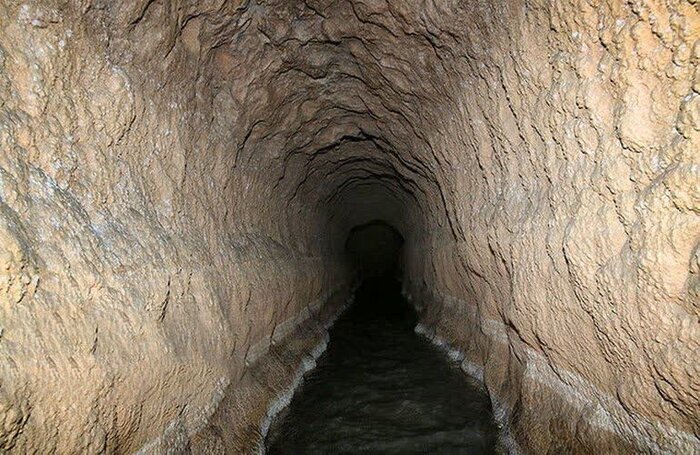
TEHRAN -- As one of the oldest and longest qanats (ancient underground water networks) in the world, Yazd province's Zarech qanat (aqueduct) is a shining symbol of Iranian ingenuity in adapting to nature and providing water in the dry desert climate.
According to IRNA, Yazd province has long faced a shortage of water resources due to its location in the heart of the central plateau of Iran. However, the ancestors of this land, relying on indigenous knowledge, creativity and a deep understanding of nature, have invented lasting solutions for water management, and Zarech aqueduct is one of the most prominent examples of the historical initiative that has played a vital role in providing the drinking water, agriculture and the formation of human settlements for centuries.
The aqueduct, with its considerable length and several hundred years of history, is not only a water structure, but also a living cultural heritage that narrates the lifestyle, effort, and intelligence of the desert people.
The long route of the aqueduct, the numerous wells, the method of directing water, and maintaining the natural slope of the land all reflect the precise engineering and advanced thinking in their time knowledge that was obtained without modern technology and only through traditional experience and calculations.
Today, Zarech aqueduct can be introduced as one of the important historical and scientific tourism attractions of Yazd province, a work that has the capacity to attract domestic and foreign tourists, researchers, and those interested in history, architecture, and the environment. Proper introduction of the aqueduct can play an effective role in developing sustainable tourism, increasing public awareness, and preserving the valuable heritage for future generations.
Zarech aqueduct is not just a water transport route, but is a living document of human wisdom, patience, and creativity in facing the harsh nature of the desert. The extensive and principled introduction of the historical monument to the people and travelers will be an important step in preserving the heritage of our ancestors and strengthening the position of Yazd province as the cradle of Iranian civilization and traditional engineering.
Zarech qanat, with a length of more than 100 kilometers and a number of 2,115 wells, has a history of more than 3,000 years in the country. The aqueduct can be introduced as one of the important historical and scientific tourism attractions of Yazd province, a monument that has the capacity to attract domestic and foreign tourists, researchers and those interested in history, architecture and the environment.
One of the features of the Zarech qanat is its square section, which dates back to the time of the Zoroastrians. Until half a century ago, the water flow of the Zarech aqueduct was more than 150 liters per second, but due to the excessive digging of deep and semi-deep wells in the water area of ??the aqueduct, its water flow has decreased sharply.
The mouth of the aqueduct is located in the city of Zarech and has three separate branches or underground tunnels, the tunnels of which are called Shirin, Shoor and Ibrahim Khavidaki. Of course, the two branches of Shirin and Ibrahim Khavidaki are dried branches of the Zarech aqueduct, and currently only the Shoor branch has a length of 72 kilometers. The water flow of Shoor branch upstream of the Qanat was 60 liters per second, but it is 28 liters per second at the beginning of the aqueduct
Yazd province is considered a treasure trove of Iranian art, culture and civilization with numerous religious buildings, tombs, mosques, Hosseiniehs (places where Shia Muslims come together to observe religious ceremonies), Zoroastrian shrines, historical houses, water storages, historical gardens, windcatchers and various bazaars.
Yazd has been called the first city of raw brick and the second historical city in the world after Venice, the city of windcatchers, work and thatch, the city of bicycles and the city of sweets.
Yazd province, along with Fars and Isfahan provinces, is the first destination for foreign tourists as the golden triangle of Iranian tourism, and this has made tourism one of the axes of development of the province.
The center of Zarech county, with a population of 20,000, is located 15 kilometers from Yazd city.
KD
Leave a Comment