Persian edition of “The Thief Lord” republished
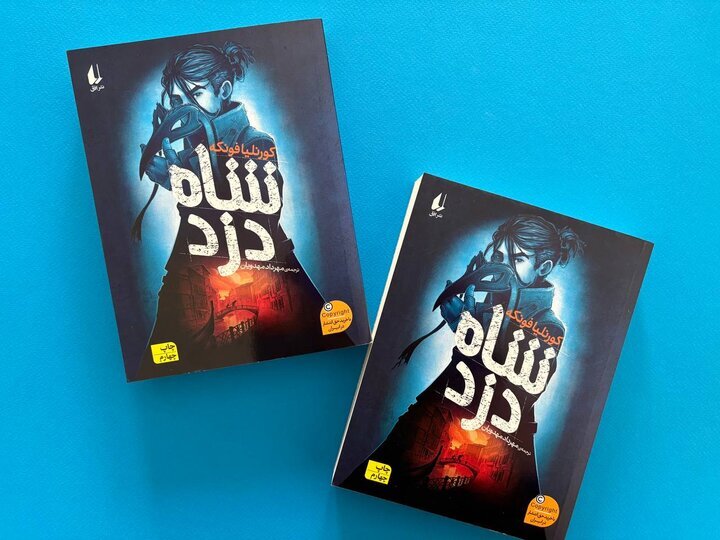
TEHRAN- The fourth edition of the Persian translation of German children’s writer Cornelia Funke’s novel “The Thief Lord” has recently been published.
Ofoq is the publisher of the book translated by Mehdi Mahdavian.
“The Thief Lord” is a children’s novel first published in Germany in 2000 and later translated into English by Oliver Latsch in 2002. It marked Funke’s first novel to appear in the United States and quickly gained international popularity for its blend of adventure, mystery, and magical realism. The novel was later adapted into a feature film in 2006.
The story centers on two orphaned brothers, Prosper and Boniface Hartleib. After the death of their parents, they face separation when their wealthy aunt and uncle declare they will adopt only Boniface, the younger and more charming of the two. Determined to stay together, Prosper and Boniface run away to Venice, a city their mother once loved. There, they fall in with a band of street children led by a charismatic and secretive boy named Scipio, who calls himself “The Thief Lord.” The children take refuge in an abandoned movie theater and survive through small thefts and the sale of stolen goods.
Scipio appears bold and self-assured, presenting himself as an experienced criminal mastermind. He provides the other children with food and money, claiming he steals from wealthy Venetians who can afford the loss. Prosper admires Scipio’s confidence and leadership, while Boniface adapts quickly to life among the gang. Yet Scipio harbors a secret: he is not truly a homeless orphan but the son of a wealthy doctor, Dr. Massimo. At home, he feels trapped by strict rules and emotional coldness, so he escapes to live a double life among the street children, where he can reinvent himself as powerful and independent.
Meanwhile, the boys’ aunt and uncle hire a private detective, Victor Getz, to track them down. Victor’s investigation leads him into several tense encounters with the gang. Although he initially intends to return the brothers to their relatives, he gradually begins to sympathize with them and question whether separating the boys would truly serve their best interests. During his inquiries, Victor uncovers Scipio’s true identity. The children, fearing betrayal, briefly capture Victor, but he promises not to expose them—provided they abandon a dangerous new job.
That job comes from a mysterious nobleman known as the Conte, who asks Scipio to steal a wooden lion’s wing. The wing belongs to an elderly woman named Ida Spavento. When the gang confronts her, Ida reveals that the carved wing is part of a magical merry-go-round hidden on a distant island in the Venetian lagoon. According to legend, the carousel has the power to change a person’s age: adults can become children again, and children can become adults. Intrigued and skeptical, the gang persuades Ida to accompany them to meet the Conte and complete the exchange.
Complications quickly arise. The payment they receive for the stolen wing turns out to be counterfeit, and two members of the gang briefly disappear. With Victor’s help, the group regathers and resolves to confront the Conte directly on his island. There, Prosper and Scipio encounter the Conte and his sister, Morosina—who have both used the magical merry-go-round to reclaim their lost childhoods. Once servants exploited by aristocrats, they restored the carousel in order to escape lives defined by hardship and labor.
For Scipio, the carousel represents the ultimate escape from vulnerability. Tired of being dismissed as a child, he rides the merry-go-round and emerges as an adult. However, chaos follows when Barbarossa, the gang’s fence and an unscrupulous accomplice, attempts to claim payment and is tricked into riding the carousel himself. In panic, Barbarossa damages the mechanism, halting its magic forever—but not before he is transformed into a young boy.
The story concludes with dramatic shifts in identity and circumstance. The adult Scipio chooses independence, working as Victor’s assistant in his detective agency and finally free from his father’s control. Prosper and Boniface find a stable home with Ida Spavento and return to school, joined by their friend Hornet. Barbarossa, now a child again, is adopted by the boys’ aunt but soon reveals his true nature, becoming a bully at boarding school and taking up the mantle of “Thief Lord” himself.
Through its richly imagined Venetian setting and magical premise, “The Thief Lord” explores the tension between childhood and adulthood, the desire for belonging, and the courage required to shape one’s own destiny.
SAB/
Leave a Comment