Makran Coast: archaeological evidence confirms repeated early human occupations in southeastern Iran
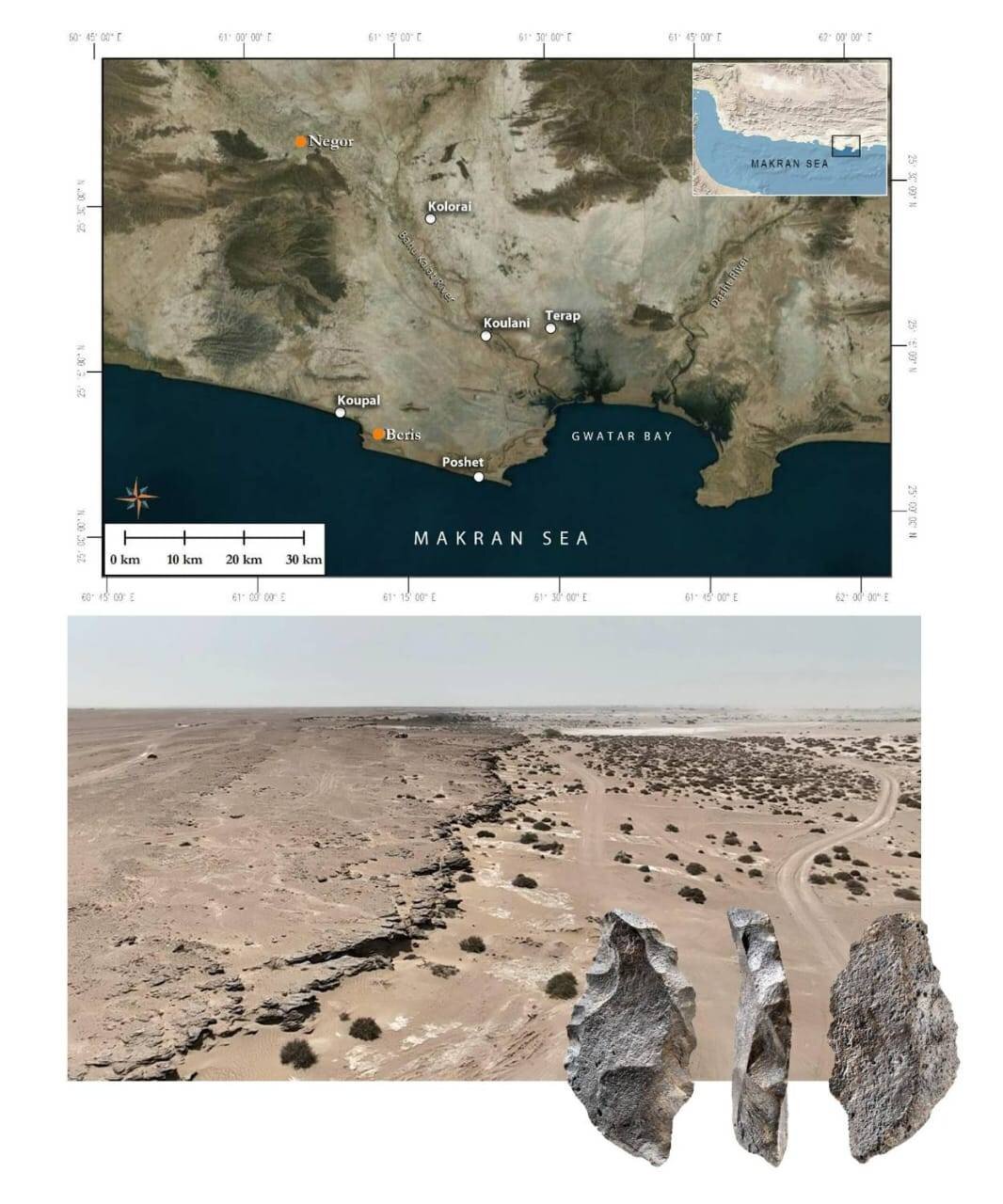
TEHRAN – Archaeologists have uncovered compelling evidence that some of the earliest human ancestors, originally migrating from Africa, not only passed through but also settled and flourished along the southern coast of present-day Iran, specifically within the natural corridor known as the Makran Coast. The findings have been published in the Journal of Sistan and Baluchistan Studies.
Stone tools recovered from multiple sites indicate that distinct groups of ancient hominins inhabited the region during three major phases of the Stone Age: the Lower, Middle, and Upper Paleolithic. The discovery challenges the notion of a mere transient passage, instead pointing to a familiar landscape where small bands of hunter-gatherers returned repeatedly over thousands of years.
At the two oldest sites, Koulani and Kolorai, archaeologists unearthed basic, heavy stone tools typical of early human ancestors, closely resembling artifacts found in East Africa. In contrast, sites such as Terap and Poshet yielded more advanced, specialized tools, including scrapers for cleaning animal hides and jagged flakes for cutting meat or wood, attributed to later human species, possibly Neanderthals or early Homo sapiens.
The site of Poshet has proven particularly significant. There, researchers found a mixture of older and newer tool styles side by side, offering a rare snapshot of a transitional period when human technology was evolving toward sharper, more efficient implements while older methods persisted.
These were not permanent settlements but rather small, mobile hunter-gatherer groups. However, the accumulation of tools across multiple locations over an extended timeframe suggests intimate knowledge of the landscape, including sources of quality stone for toolmaking, water catchments, and animal migration routes.
Some sites appear to have served as workshops where individuals shaped raw stone into new tools, while others were likely campsites or butchering stations. Such planning and environmental familiarity reflect a distinctly human trait: not desperate wandering, but learned adaptation to a sustainable way of life.
The discovery carries an urgent and sobering dimension. These archaeological sites are located in southeast Iran along the Makran coast near the Strait of Hormuz, an area recently struck by American airstrikes during their war with Iran that started on Feb. 28. The strikes underscore the fragility of some of the oldest evidence of human existence. Scientists are now calling for an urgent, carefully planned excavation campaign to document and preserve these ancient remains before further damage or loss occurs.
Researchers from the Iranian Centre for Archaeological Research (ICAR), the Hormozgan provincial Department of Cultural Heritage, Deutsches Bergbau-Museum Bochum, and the Paleolithic Department of the National Museum of Iran contributed to the study.
Makkoran, aka Makran or Mokran, is a semi-desert coastal strip, in Sistan-Baluchestan province, along the coast of the Sea of Oman.
The collective province -- Sistan in the north and Baluchestan in the south -- accounts for one of the driest regions of Iran with a slight increase in rainfall from east to west, and an obvious rise in humidity in the coastal regions. It is home to several distinctive archaeological sites and natural attractions, including two UNESCO World Heritage sites, namely Shahr-e-Soukhteh (Burnt City) and Lut desert.
In ancient times, Sistan-Baluchestan connected the Indus Valley to the Babylonian civilizations.
AM
Leave a Comment