Piercing gaze of innocence: Tajrish Square hosts “Eyes of Minab” installation
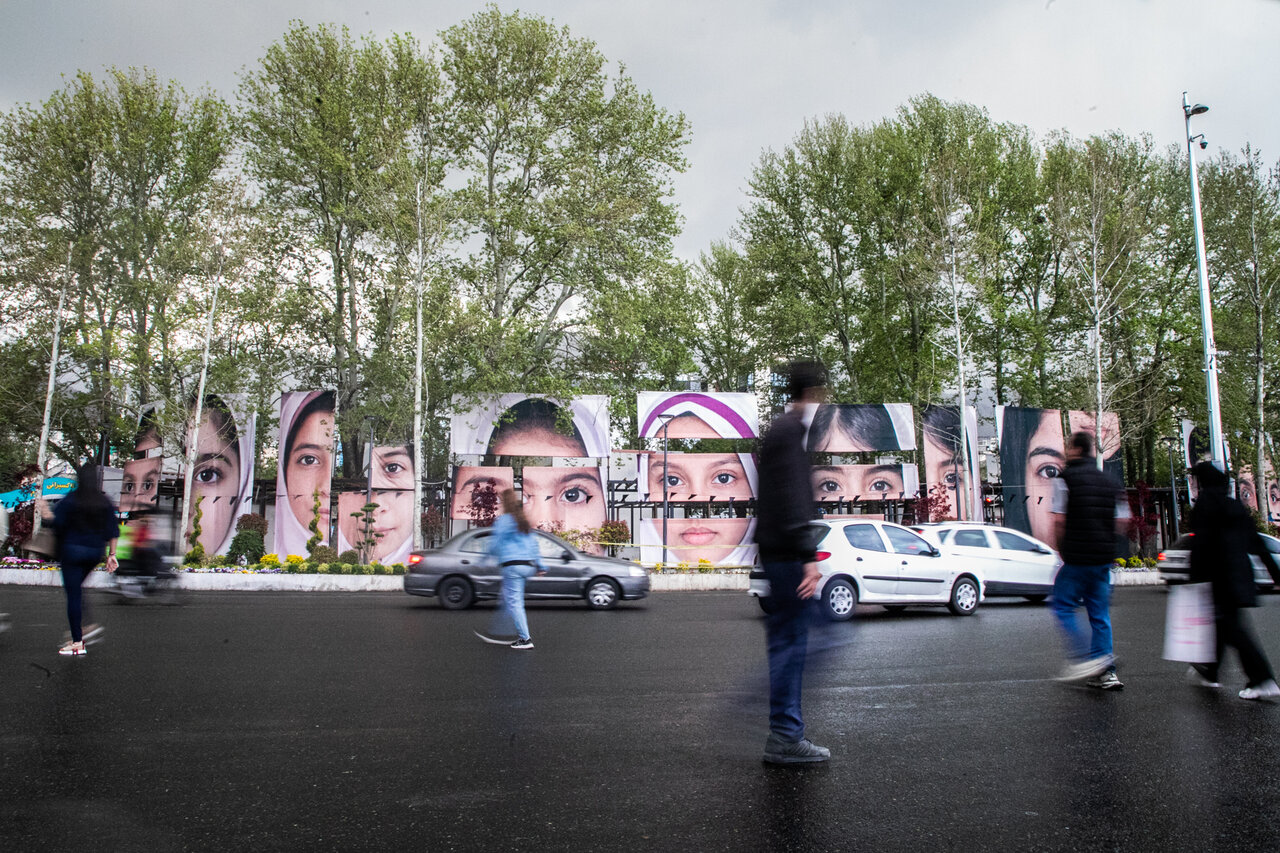
TEHRAN- In the heart of the bustling Tajrish Square, where the vibrant energy of the capital often conceals the quiet sorrow of recent months, a profound artistic intervention has forced passersby to pause.
A new art installation titled "The Eyes of Minab" by architectural designer Reza Golpayegani has transformed the square into a sanctuary of reflection, drawing the gaze of every passerby toward the innocent eyes of children whose lives were tragically cut short during the recent aggressions.
The installation features large-scale, cropped images of the eyes and parts of the faces of children from Minab, young souls who were martyred during US-Israeli attacks.
In Minab, the ordinary rhythm of school life was shattered in an instant. Classrooms that had once echoed with laughter and the scratch of pencils became scenes of unimaginable tragedy. Children, some just beginning to explore the world beyond their homes, were caught in the sudden violence of airstrikes, their lives ending before they had the chance to grow into the futures they had dreamed of.
Streets that were once filled with the chatter of families and friends fell silent, replaced by grief and shock. Parents, who had waved their children off to school with hope, were left grappling with an emptiness no embrace or memory could fill. School that had once been full of life now stand empty and silent, desks and chairs serving as haunting witnesses to the children and teachers whose lives were abruptly taken.
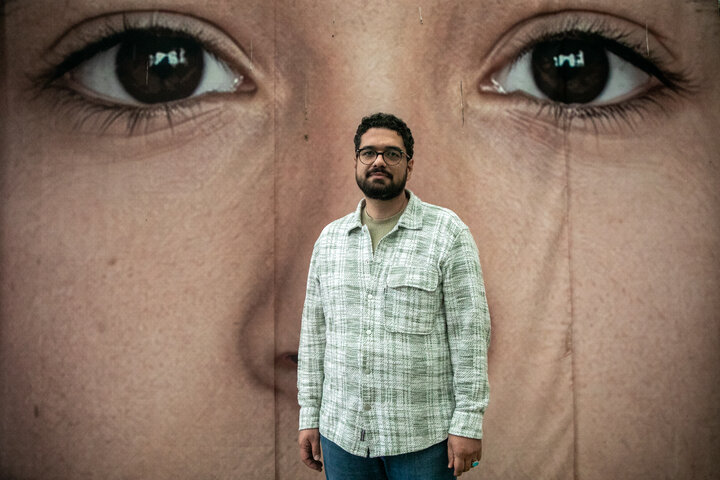
Iranian designer Reza Golpayegani
Golpayegani, a seasoned architectural designer and Soureh University graduate with over 12 years of experience and more than 50 cultural projects to his credit, spoke with the Tehran Times about the spiritual and artistic journey behind this moving tribute.
Through this work, one of Tehran’s most iconic hubs has been transformed into a space of collective mourning and spiritual reflection. The installation serves as a haunting tribute to the young students of Minab, who became unintended symbols of a national tragedy during the airstrikes launched by the Zionist-US coalition against Iranian soil.
Speaking on the origins of the work, Golpayegani recalled a previous collaboration with UNESCO where small photographs of children were used for a memorial.
It was then that he became captivated by the sheer power of a child’s gaze. "Every feature of a child radiates their youth, but their eyes have a unique power to arrest the senses; they hold a reflection of the soul that war cannot extinguish," Golpayegani noted.
The artist explained that the fragmented nature of the images—focusing specifically on the eyes—symbolizes the tragic physical toll of the strikes on Minab, where the suddenness of the aggression tore apart families and futures. Addressing the challenge of depicting such a heavy subject without causing a sense of repulsion, Golpayegani emphasized that the reality of this conflict must be recounted within the social fabric.
"My concern was that the people might find it too heavy to face daily," he said. "However, the feedback has been the opposite. People are drawn to the innocence. There is a purity in these images that prevents them from being jarring; instead, they are perceived as deeply beautiful and a testament to the right to live that was stolen from these students."
Golpayegani chose Tajrish Square specifically because it represents the "flow of life" more than any other location in Tehran, providing a stark contrast to the silence that now hangs over the schools in Minab. The public reaction has been visceral; the artist shared an account of a local professional who, upon first encountering the installation, circled the square ten times in tears, struck by the magnetic pull of the children’s stares.
For Golpayegani, this resonance is a testament to the artist's duty during times of national defense. He believes that while artists should continue their craft, they must choose their subjects with "meticulous obsession" to reflect the truths of war. "I believe the 'Barakat' (blessing) of these martyred children is reflecting itself through the society," he remarked, suggesting that the spiritual weight of the subjects transcends the physical art itself, turning a public square into a site of spiritual resistance.
Looking to the future, Golpayegani insists that this narrative must not fade into the archives of history. The installation, which remains in Tajrish until May 13, is envisioned as a traveling memorial that will move to other affected cities, including Minab itself, as well as Qazvin and Karaj, where other students also fell victim to the aggression.
The artist is particularly committed to keeping the memory of individual victims alive, such as Makan Nasiri—a young student whose remains have yet to be recovered after the strikes and whose DNA tests remain inconclusive. "We must narrate these stories for the children of the future," Golpayegani concluded. "Even years from now, when the next generation looks into these eyes, they must understand the cost of our sovereignty and never forget the innocence that was sacrificed."
On February 28, the Shajareh Tayyebeh girls' elementary school in Minab, Hormozgan province, was struck by missiles as the United States and Israel launched attacks against Iran. Dozens of children aged 7 to 12, along with their teachers, were killed when the building collapsed, leaving 168 dead and at least 95 wounded.
Investigations, including satellite analyses and witness accounts, confirmed that the school was a distinct civilian facility and was deliberately hit three times. Global outlets, such as The New York Times, BBC Verify, CBC, and NPR, have attributed responsibility to the United States, highlighting the deliberate targeting of a civilian school. The Minab tragedy now stands as a stark reminder of the human cost of the aggression and a rallying point for calls for international accountability.
SAB/
Leave a Comment