Ganjoor founder receives National Parsi-jan Award
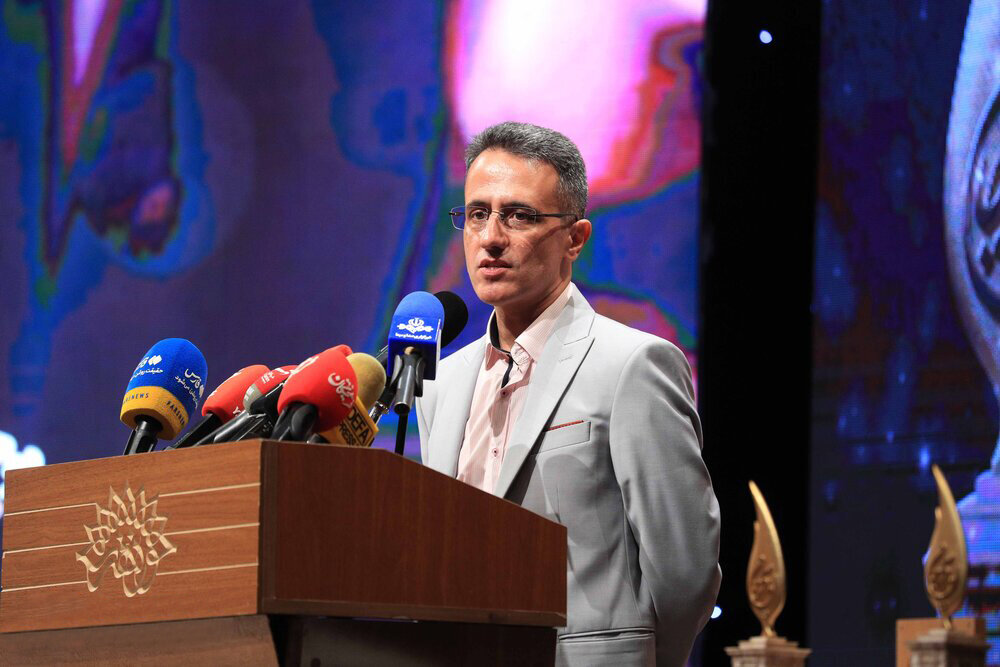
TEHRAN- The National Parsi-jan Award was presented to Hamidreza Mohammadi, founder of Ganjoor website, at the second edition of the event, which highlighted the importance of preserving and strengthening the Persian language.
The ceremony was held on Saturday at the Sooreh Hall of Tehran’s Art Bureau, organized by the Office for the Preservation of the Persian Language of the Art Bureau.
Ganjoor is a digital archive of classical and contemporary Persian poetry that provides free online access to the works of major Persian poets. The website features the works of poets including Ferdowsi, Saadi, Hafez, Rumi and Omar Khayyam, and allows users to search and read poems by poet, book and individual verse. Over the years, it has become a widely used online resource for accessing Iran’s rich literary heritage.
The jury of the second Parsi-jan Award had nominated six individuals and organizations for the National Insignia and Golden Cypress of Parsi-jan: Bale software; Mohammad Mehdi Baqeri, director of the Editors Institute; Hamidreza Mohammadi, founder of Ganjoor; Iranian traditional vocalist Mohammad Motamedi; Tehran Metro’s Cultural Deputy; and Hossein Ezhdehai, a journalist with the Central News Unit in Hormozgan province.
Speaking at the ceremony, Mohammadi, the winner of the top prize, said the recognition should not be considered a personal achievement, stressing that Ganjoor was the result of the efforts of thousands of people.
“Ganjoor is essentially not a face or an individual,” he said, referring to the many people who have contributed to the development of the website and helped turn it into a major online destination for users seeking Persian poetry.
He added that the recognition given to Ganjoor should therefore be seen as an acknowledgment of the collective efforts of those who have worked to develop and expand the platform.
Nasser Feiz, secretary of the award, said the event was held to recognize efforts to safeguard Persian identity and language, which he described as an important factor in Iran’s cultural standing in the world.
He said the Art Bureau had paid particular attention to literature since its establishment, with poetry and fiction among its major fields of activity. Persian language, he added, had also been a longstanding concern of the bureau.
Referring to the Art Bureau’s activities in the field of Sacred Defense literature, Feiz said numerous works of poetry and literature had been produced and published, turning the field into one of the institution’s important areas of activity.
He said the need had subsequently emerged for an institution to focus more specifically on the Persian language, in line with the emphasis placed on the issue by the Leader of the Islamic Revolution, Ayatollah Seyyed Ali Khamenei.
He noted that Ayatollah Khamenei had repeatedly stressed the importance of Persian, adding that various factors could contribute to weakening a language, including the increasing use of foreign words.
“One of the signs of a powerful language is that it remains alive and dynamic in the new millennium,” he said, noting that centuries after their time, Iranians can still engage with the works of classical poets such as Ferdowsi and Saadi.
Explaining the criteria for selecting recipients of the Parsi-jan Insignia, Feiz said the organizers did not necessarily focus on individuals or institutions whose primary responsibility was the preservation of Persian.
“Preserving the Persian language is the responsibility of all of us,” he said.
He added that the organizers sought to recognize people who had voluntarily devoted their abilities and resources to Persian, even though they could have chosen other fields of activity.
“Some may not have received any payment for this work and may even have incurred additional costs,” Feiz said, adding that the award seeks to draw attention to such efforts, which may otherwise receive less public recognition.
According to Feiz, the Parsi-jan initiative also includes a monthly award, presented in the form of the Silver Cypress. An annual award is then selected from among the recipients of the monthly honor, although new candidates may also be added to the annual list.
Seyyed Ali Mirfattah, the scientific secretary of the ceremony, meanwhile, emphasized the cultural and intellectual significance of preserving Persian.
Mirfattah said that it is our responsibility to preserve Persian literature and pass it on to future generations.
He asked how future generations might judge the present period, when the country faced war, economic difficulties and political challenges, while some people nevertheless remained concerned about safeguarding the Persian language.
“Language is not merely a means of communication; language itself is thought,” Mirfattah said.
He argued that disorganized language could contribute to disorganized thought, while coherent language could help shape coherent thinking. Greater attention to language is therefore necessary for addressing a range of intellectual and cultural issues, he added.
Mirfattah also called for greater attention to Persian beyond the fields of literature and the arts, particularly in the country’s administrative and educational systems.
He said the Persian language had not received sufficient attention in administrative and legal structures and stressed the need to address concerns surrounding the use and teaching of Persian in the education system.
The second edition of the Parsi-jan Award brought together figures and institutions working in literature, digital culture, music, journalism and public services, highlighting efforts to preserve Persian and strengthen its presence in contemporary cultural life.
Persian, one of the world’s oldest literary languages, has played a central role in shaping Iran’s cultural and intellectual heritage. With a literary tradition spanning centuries, it has been enriched by the works of poets and writers such as Ferdowsi, Saadi, Hafez and Rumi, whose works continue to be read and studied in Iran and beyond.
Persian is also spoken in different forms across parts of West, Central and South Asia, including Iran, Afghanistan and Tajikistan. In Iran, efforts to preserve and promote the language focus on maintaining its literary heritage while addressing contemporary challenges such as the increasing use of foreign words and changes in language use in the media, education and public life.
Photo: Hamidreza Mohammadi, founder of Ganjoor, speaks at the second National Parsi-jan Award ceremony at Tehran’s Art Bureau on September 19, 2026.
SAB/
Leave a Comment