Persian translation of Bernstein’s “Einstein” republished after 26 years
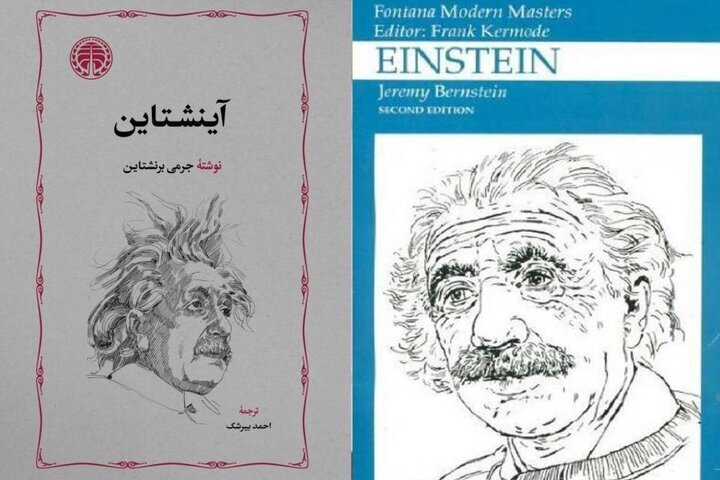
TEHRAN – The third edition of the Persian translation of “Einstein” by Jeremy Bernstein has been released after 26 years.
Ahmad Birashk has translated the book and by Kharazmi Publication has brought it out in 236 pages, Mehr reported.
“Einstein” is a concise intellectual biography of Albert Einstein, written by a physicist who understands both the scientific content and the human story behind it. Rather than offering a massive, encyclopedic life story, Bernstein gives a focused portrait of how Einstein thought, what he accomplished, and why his ideas changed the foundations of physics.
The book aims at readers who are curious about Einstein and modern physics but do not want to be buried in heavy mathematics. It works especially well for interested general readers, high‑school or early university students, and anyone who wants more than anecdotes yet less than a technical textbook.
Bernstein begins with Einstein’s early life in Germany and Switzerland, emphasizing the contrast between his rebellious, independent mind and the rigid educational system of his time. Instead of being a model pupil, Einstein was often bored with rote learning and resisted authority, but he was fascinated by geometry, by Maxwell’s theory of electromagnetism, and by imaginative thought experiments.
The author uses these early experiences to show that Einstein’s originality grew out of a deep habit of thinking for himself, rather than simply mastering what teachers presented. This part of the book also sets the stage for understanding why Einstein often worked outside conventional academic paths, including his period in the Swiss patent office.
A central section of the book is devoted to Einstein’s “miracle year” of 1905, when he was still a patent clerk and yet published a series of papers that reshaped modern physics. Bernstein explains four key contributions in clear language: the paper on the photoelectric effect, which treated light as consisting of discrete “quanta” and later earned Einstein the Nobel Prize; his analysis of Brownian motion, which gave powerful evidence for the reality of atoms; his formulation of special relativity, based on the idea that the laws of physics are the same in all inertial frames and that the speed of light is constant; and his famous relation E = mc^2, which reveals that mass and energy are interchangeable.
From there, the book moves to general relativity, Einstein’s theory of gravitation. Bernstein describes how Einstein, guided by the equivalence principle, came to regard gravity not as a traditional force but as a manifestation of curved spacetime.
An important thread in the book is Einstein’s complex relationship with quantum mechanics. Bernstein reminds readers that Einstein helped launch quantum theory, particularly with his work on light quanta and early quantum ideas. However, as quantum mechanics evolved into a probabilistic theory of nature, Einstein became increasingly uneasy.
Bernstein discusses the Einstein–Podolsky–Rosen (EPR) paper, which used what we now call entanglement to argue that quantum mechanics might be incomplete. Here, Bernstein shows both Einstein’s philosophical depth and his stubbornness; he was crucial to quantum theory’s birth yet dissatisfied with its final form.
In the later chapters, Bernstein portrays Einstein’s life in Princeton, his efforts to construct a unified field theory combining gravity and electromagnetism, and his growing status as a public icon. The narrative touches on his pacifism, his opposition to Nazism, his concerns about nuclear weapons, and his role as a moral voice in the mid‑20th century.
SS/
Leave a Comment