Art Bureau connecting artists, raising global awareness through universal language of art
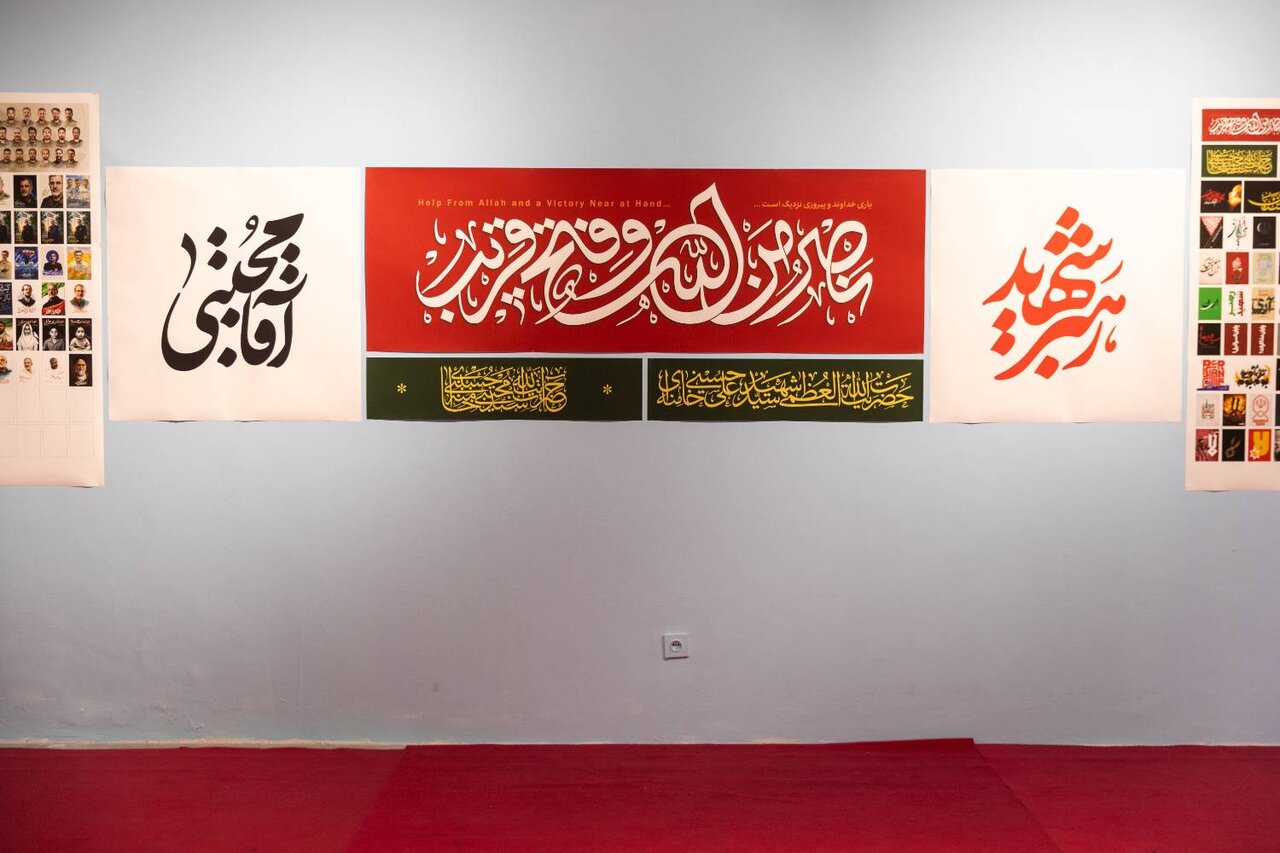
After Iran was attacked by the United States and Israel on February 28, a committee was established at the Art Bureau in Tehran, focusing on the production and collection of artworks related to the war, which lasted for 40 days.
TEHRAN – After Iran was attacked by the United States and Israel on February 28, a committee was established at the Art Bureau in Tehran, focusing on the production and collection of artworks related to the war, which lasted for 40 days.
The Tehran Times conducted an interview with the head of the committee, Mohammad Zaruee Nasrabad, regarding the activities of the committee, or the “Situation Room for Cultural and Artistic Activities during and after the War,” as Zaruee calls it.
“The idea of forming this Situation Room actually began to take shape during the 12-day war last June, when the US and Israel attacked Iran. When the war started, communication infrastructures were naturally disrupted, and our artists, who wanted to react quickly to the ongoing issues, faced numerous challenges. One of the main functions of this Situation Room was therefore to maintain connections among artists, to keep them informed about one another’s activities, and to ensure that their efforts could be coordinated,” Zaruee said.
“Our work is not limited to Tehran; it extends across the entire country. Artists from all over Iran are active and respond promptly when critical events occur. In addition to collecting artworks, the Situation Room has provided a creative environment where artists could continue producing new work,” he added.
As an instance, Zaruee referred to a three-day painting workshop, which was organized on February 29, one day after the martyrdom of the Leader was announced. “Around 15 painters gathered in this space and created works centered on the theme of the Martyr Leader. Simultaneously, through the coordination facilitated by this Room, artists in various cities across the country began producing related artworks as well. Some of them even worked outdoors, in public places, alongside ordinary citizens, allowing people to see that artists were standing with them, creating cultural and artistic works in real time,” he noted.
The US and Israel attacked Iran on February 28, and for 40 days, they martyred about 3,500 people, including the Leader of the Islamic Revolution Ayatollah Seyyed Ali Khamenei, several officials and military commanders, as well as numerous civilians, including women and children.
During the 40-day war (also known as the Ramadan War), besides some military targets, the US and Israel launched organized attacks against civilian infrastructure, including residential homes, hospitals, refineries, power plants, schools, universities, art and cultural spaces, bookstores, museums, and ancient sites in several cities, causing total or partial damage and injuring innocent people.
Regarding the works seen in public places, Zaruee said: “You may have noticed some of these pieces around the city, the stencils and wall paintings. This activity is still ongoing. The works combine visual graphics with meaningful messages, transforming public spaces and shaping the cultural atmosphere”.
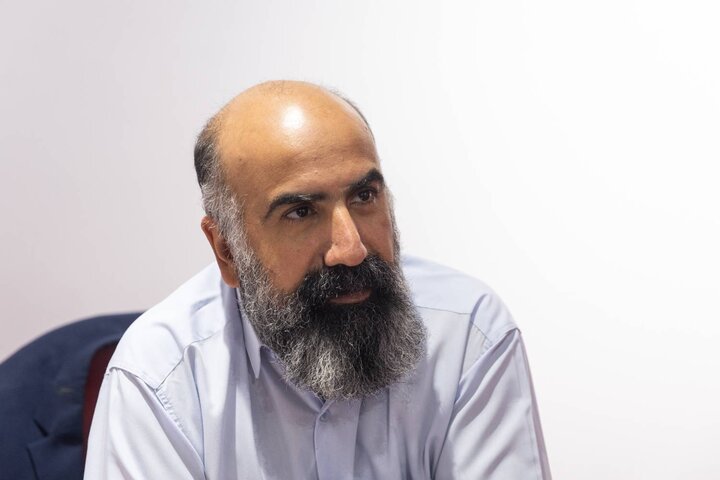
Mohammad Zaruee Nasrabad
“The Situation Room is not limited to paintings and graphic designs. In the field of photography, from the very first day, a group of about 15 to 20 photographers from Iran Photographers' House joined in. They went to the targeted sites as soon as incidents occurred and documented the scenes, often under dangerous conditions. Even a few were injured, not seriously, though. We intend to include the photographs in upcoming exhibitions and eventually publish them in a book once the situation stabilizes,” he asserted.
“In the field of architecture, our colleagues collaborated with the Beautification Organization to install symbolic or memorial structures in areas that had been hit. At Minab School, for example, they created the butterfly-book installation.
On the first day of the war, the Shajareh Tayyebeh elementary school in Minab, Hormozgan Province, became the site of a devastating massacre. While dozens of girls and boys aged between 7 and 12 were beginning their lessons, the school was targeted by a missile strike that caused the building to collapse, trapping children and teachers beneath the rubble. Authorities confirmed a final death toll of 156 people.
To honor the memories of the young students martyred in the tragedy, a conceptual art installation project featuring 2,000 red butterflies and symbolic crimson pages was organized at the ruins of Minab’s Shajareh Tayyebeh Elementary School.
Another notable project, conducted jointly with the Municipality, involved producing two large city murals. These murals are continuously updated by artists in response to new developments. Meanwhile, poets, painters, photographers, and filmmakers are all contributing their work through this shared cultural framework.
Also speaking to the Tehran Times, Hamidreza Jafari, the media manager at the Situation Room, said: “Since the beginning of the war, we have witnessed an outpouring of emotion among artists eager to create new works. Across the country, the volume of artworks, especially in the visual arts, has been immense, to the point that many pieces risked being overlooked. People often do not realize that we are dealing with a form of art that reacts instantly and powerfully to circumstances”.
“Many artists needed support to help their works gain visibility. One of the most important tasks of this Situation Room has been to amplify visibility, ensuring that artworks are published and shared through official and informal media channels. Once artists saw that we were helping their work reach audiences, their motivation and quality of output increased noticeably,” he added.
According to Zaruee, another key objective of the Situation Room is coordination. “It helps us be aware of what other cultural institutions are doing so that we can align our efforts. We have a great number of artists, but it is important to create a clear division of tasks and ensure that their energies complement one another rather than overlap”.
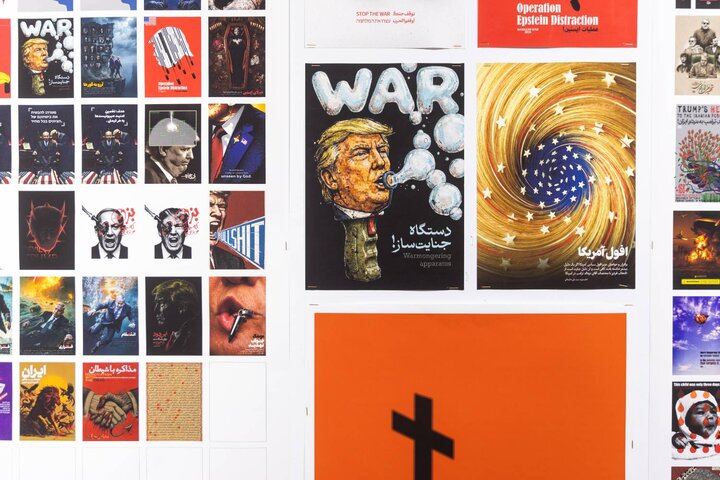
Speaking about the ultimate goal of the Situation Room, he said: “We are pursuing a larger goal, that is to build a comprehensive archive of all the cultural and artistic works produced during this war. This would serve as a valuable resource for developing a range of derivative projects: books, documentaries, and other creative media”.
As for the number of artists whose works have been collected from across the country so far by the Situation Room, Zaruee said: “The figures exceed one thousand across different disciplines. Thanks to the dedication and cooperation of our colleagues, this cultural movement for resistance is rapidly spreading. Awareness is growing, and artists everywhere are responding. So far, exhibitions have been held both in Iran and Iraq, displaying works by artists from Iran, Syria, Lebanon, Pakistan, and Palestine, a testimony to shared cultural solidarity in the face of adversity”.
In response to a question about whether there are plans to present these artworks to a broader international audience, he said: “By God’s grace and through the efforts of our colleagues, this cultural movement for resistance is expanding. Awareness has spread, and artists everywhere have reacted. So far, exhibitions have been held in Iraq and Iran, featuring works by Iranian, Syrian, Lebanese, Pakistani, and Palestinian artists”.
“Today, we are working under certain media and internet restrictions, which have made things more difficult. Despite that, some of our artists have managed to connect directly with foreign artists and share their works through those channels. One of our ongoing efforts is focused on creating artworks with an international perspective, pieces that audiences abroad can understand, connect with emotionally, and receive their intended message”.
Regarding the same issue, Jafari said: “We are witnessing a remarkable growth in artists’ insight during this period. The artworks produced now show that the language is becoming more global and more expressive, and they powerfully convey the meaning of war in terms of defense of the homeland and the suffering of the Iranian people. Through composition, line, color, and light, this message is now being communicated far more effectively to the world”.
When asked about the relationship between art and war and the role artists can play in such conditions, Zaruee replied: “I see art and the artist as parts of a nervous system within a living body. When the body experiences illness, say a headache or fever, it sends out signals to warn us that something is wrong. I believe that is precisely what artists do: they raise awareness and send messages when society is in crisis”.
“If the artist does not play that role, the illness, meaning the social or moral decline, will quietly spread and harm the body of society. In this way, the artist’s alarm, communicated through the universal language of art, works like a nervous alert system, making the entire world aware of what is happening,” he underlined.
Looking at it from a different angle, he said: “In times of soft war, I see the artwork itself as a weapon, and the artists as fighters. If you want to reach the heart of an adversary, graphic works can act like long‑range, high-precision weapons. When an event occurs, and an artist immediately creates a work in response, that artwork can rapidly circulate across the world, informing, moving, and awakening global audiences. In general, both the artist and the artwork form one of the wings of war. Across history, art has always been used in wartime communications and propaganda”.
SS/SAB
Leave a Comment