Rainfall brings intl. Quri Gol wetland back to life
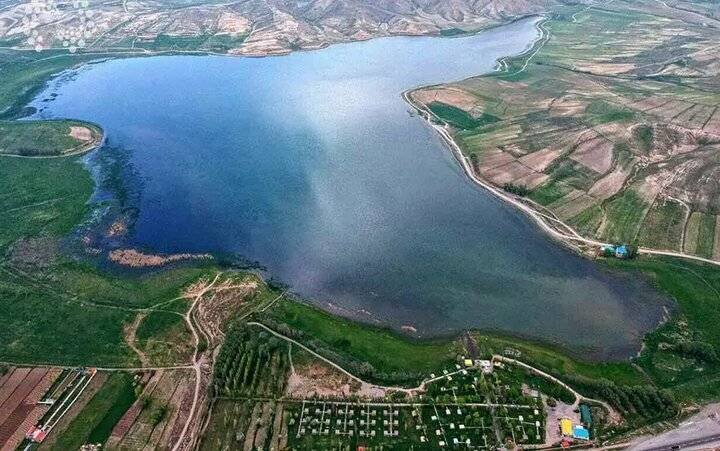
TEHRAN – After several months of water scarcity, spring rainfall has eased the drought in northwestern East Azarbaijan province, reviving the international Quri Gol wetland.
Spanning around 200 hectares, Quri Gol wetland is the only freshwater wetland in the province, with pristine nature and a unique landscape, ISNA reported.
Compared to the same period last year, the water level of the wetland has increased by 27 cm, reaching 1912.43 meters now. Presently, some 116 hectares of the wetland are filled with water. It has about 700 million cubic meters (mcm) of water, which is lower than the 3.8 mcm amount designated for the wetland.
The wetland receives its water supply from precipitation, marginal streams, and a water channel.
Quri Gol wetland hosts over 92 bird species, which are all migratory birds, except redhead coots, 14 species of reptiles, 4 species of amphibians, and one species of fish, as well as 280 plant species.
Currently, the wetland is hosting different kinds of ducks and coots. The interesting point is the return of the white-headed duck to the wetland after many years. The bird is a globally endangered species, and its return highlights the favorable ecological condition of the wetland.
A total of 141 wetlands with ecological value, with an area of over 3 million hectares, have been identified in Iran, 27 of which were listed in the International Ramsar Convention.
The DOE has announced the beginning of a new phase of the wetlands conservation project (2025 –2028) to strengthen sustainable livelihoods and alleviate pressure on the wetlands ecosystem.
Quri Gol is one of the four wetlands that the DOE is reviving. The three other wetlands are namely, Bamdej in southwestern Khuzestan province, Gomishan in northern Golestan province, Arjan in southern Fars province.
The project to restore Bamdej wetland kicked off about two years ago with the help of the private sector, investing 1.3 trillion rials (around 8 million dollars), with 2 trillion rial (about 12 million dollars) more which is needed to complete the project, ISNA quoted Ahmadreza Lahijanzadeh, the deputy head of the Department of Environment (DOE) for Marine and Wetlands affairs, as saying.
Stretching for over 4,000 hectares, the wetland is home to over 134 plant species from 49 plant families, such as lutea, carex brunnea, reed, and syperus, 22 mammal species, 12 fish species, 15 species of amphibians and reptiles, and 148 native and migratory birds.
Gomishan wetland is expected to be revived by June. The wetland was registered on the Ramsar Convention in 2003. It is known as one of the main habitats for the birds. About 20 species of fish, 24 species of reptiles, over 100 water and water-side birds, and more than 30 species of mammals, like Foca Caspinus, live in the wetland.
The Arjan restoration project is in the beginning phase; it covers 2000 hectares. The water of the wetland depends on the amount of rainfall. The wetland is one of the main habitats for migratory birds like cranes, flamingos, wild ducks, and geese. Wetland’s plant species include reeds, astragalus (milk-vetch), and sagebrush. Also, mammals like boar, jackal, and fox live in the wetland.
MT/MG
Leave a Comment