A power lever is not negotiable
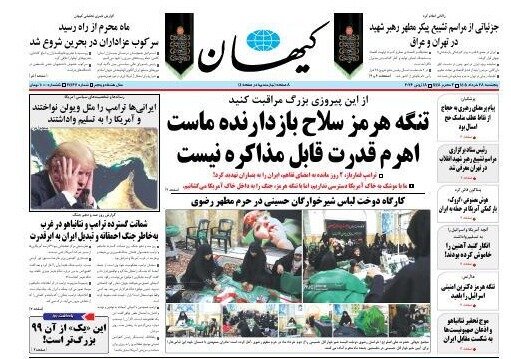
Kayhan, in an article, described the Strait of Hormuz as a deterrent weapon that cannot be negotiated away. According to the paper, Trump's retreat to the negotiating table is the result of Iran’s battlefield strength and the steadfastness of the Iranian people.
Even if we do not have missile access to US soil, the strategic lever of the Strait of Hormuz is a deterrent weapon that brings the war onto American territory. This major achievement must not be lost. The Strait of Hormuz is our strategic deterrent weapon; there must be absolutely no bargaining over this lever of power. The paper argues that the security arrangements and strategic equations of West Asia will not return to the pre–Ramadan War era. Iran must preserve its capability to close the Strait of Hormuz and even Bab al‑Mandab. It must also maintain its ability to target US interests and positions in the region. While preserving diplomatic firmness, Iran must keep its military, defensive, and deterrent posture at the highest possible level. We must beware of Washington’s deceit.
Shargh: A difficult path lies ahead
Shargh, in an interview with Mohammad Irani, former Iranian ambassador to Kuwait and Jordan, examined Iran’s path after the recent understanding. According to this diplomat, under current conditions, we have no choice but optimism. The approach now taken is the correct one. Given the complexity of Iran–US relations in recent years, Iran gradually found itself in a situation where even relations with some neighboring countries became strained, and the country faced a kind of political, economic, and sanctions‑related encirclement. Now, it appears that a serious effort is underway to exit this situation. This approach is a form of diplomatic prudence — a sign that Tehran seeks to move beyond this phase and achieve outcomes that serve national interests and needs. In such circumstances, more than ever, the negotiating team must feel that it enjoys the support of the nation. This is not merely a political performance; it is a national necessity that must be recognized.
Resalat: The Islamabad Understanding; a manifestation of Iran’s victory
Resalat described the Islamabad understanding as a manifestation of Iran’s victory. It wrote that throughout the past three and a half months, Trump pursued one major goal through repeated narrative‑building: falsely projecting US victory in war and diplomacy. But on the battlefield, Washington and Tel Aviv achieved none of their declared objectives in their aggression against Iran. In diplomacy as well, the Islamic Republic displayed its soft power, backed by the people, to the White House. The Iranian negotiating team’s insistence on its clear red lines in Islamabad — and its determination to preserve and even expand those red lines going forward — reduced America’s room for maneuver in diplomacy and negotiations. Under such conditions, Trump’s claims about achieving a good understanding for the US amount to a reverse narrative of the war and negotiation scene. The paper concludes that America’s defeat in this equation is evident.
Etemad: Iran’s economic outlook
Etemad spoke with Saeed Laylaz, a political and economic analyst, about Iran’s economic prospects. Laylaz believes the recent Iran–US understanding could not only reshape regional political dynamics but also pave the way for big economic and social changes in Iran and even in US relations with other countries. If Iran uses the new opportunities wisely, its economy could enter an upward trajectory in a relatively short time. It may even be possible to return to pre‑crisis GDP levels within less than one to one and a half years. However, this depends on economic policymaking that is precise and grounded in global economic realities. Iran has significant capacities in energy, industry, and human capital, which, if properly activated, can generate substantial economic growth.
Jam-e-Jam: Negotiation under threat cannot last
Jam‑e-Jam argued that what is seen today strongly recalls one of Iran’s most important foreign‑policy experiences in recent decades: the JCPOA. Signs of the same pattern are emerging again. On one side, Iran emphasizes ending the war, removing threats, and halting conflict on all fronts. On the other side, Trump and Vance, while welcoming the understanding, keep the option of military attack on the table. If the understanding is to truly mark the end of the war, the first condition is abandoning the language of threat — otherwise the logic of a two‑stage negotiation process collapses. The plan was for the war to end first, and then for complex issues to be discussed in a calm environment without military pressure. If the shadow of bombs and threats remains over the talks, what distinguishes this situation from the period before the understanding?
Leave a Comment