‘Trump’s mouth must be shut’
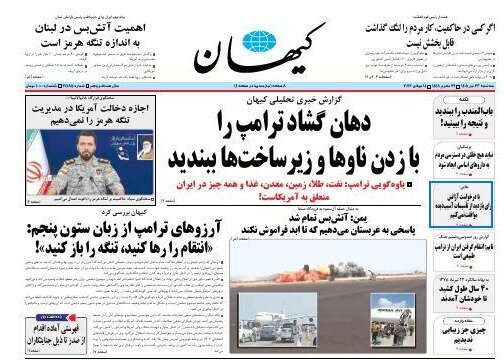
Kayhan, in an article discussing how to silence Trump, wrote: The heroic defense by the brave and revolutionary armed forces of the Islamic Republic of Iran is, these nights in the Persian Gulf and the Sea of Oman, writing a golden chapter in the history of Greater Iran. In recent days, the Persian Gulf has once again become the focal point of the global balance of power—where the US terrorist military, in strategic desperation, has turned frantically to a chain of blind acts of aggression.
But the swift and forceful response of the Army and the IRGC showed that the geometry of power in the region has changed forever, and that the only way to restrain Trump now is the “language of force.” Therefore, Trump’s mouth must be shut with this same logic: through resolute defense, unwavering adherence to principles, and by delivering painful blows to US warships, infrastructure, and strategic interests in the region.
Iran: The core agreement must not be destroyed
The Iran newspaper, in an interview with Davoud Aghaei, professor of international law at the University of Tehran, examined the continuous violation of commitments by the United States and Iran’s responses from the perspective of international law. Regarding the understanding reached between Iran and the US, the reality is that if, at least in the initial phase, its main provisions had been properly implemented, it could have brought significant benefits to the Islamic Republic. But with rising tensions and the violation of the principle of fulfillment of commitments, Iran is now giving a defensive response to this breach. Nevertheless, one must not forget that although violation of commitments by one party can give the other party the right to take countermeasures, the purpose of such measures must be to bring the violating party back into compliance, not to destroy the agreement itself. For this reason, as long as implementation remains possible through negotiation and mediation, preserving the agreement and striving to enforce it should take precedence over escalating tensions and resorting to coercive actions.
Javan: The US wants Iran to retreat on Hormuz and the nuclear file
Javan analyzed the US objective behind the recent attacks. Recent developments show that the US, aiming to force the Islamic Republic to retreat on the Strait of Hormuz and the nuclear issue, has chosen a path of intensified military pressure. However, the course of events on the ground indicates that this strategy has not only failed to change Iran’s behavior but has also expanded the confrontation to sensitive centers and US military bases in the region. What stands out most is the transfer of initiative from Washington to Tehran. While the US seeks to bring Iran back to the negotiating table through increased military pressure, the successive responses of Iran’s armed forces—from strikes on command centers, air‑defense systems, strategic radars, and missile bases to continued drone operations—show that Washington’s desired equation is facing a serious challenge.
Sobh-e-No: No point or corridor is safe for the United States
Sobh-e-No interpreted the IRGC’s missile and drone attacks on the strategic port of Duqm on Oman’s southeastern coast. Duqm is a logistical hub and refueling platform for US aircraft carriers, introduced as a safe corridor and alternative route. Iran’s successful strike on Duqm and the destruction of US fuel storage facilities completely overturned this equation. The message is clear: no point and no alternative corridor outside the Strait of Hormuz is safe for Iran’s adversaries. Duqm, as a haven and alternative escape route from Hormuz, is in the line of fire. Effectively, the key to managing regional maritime security is in Iran’s hands, and no alternative corridor can provide real security for global shipping unless Iran’s central role in securing this vital waterway is recognized.
Khorasan: A dead end in US–Iran engagement
Khorasan addressed the question of why Iran and the US cannot end hostilities through any model of engagement. The reasons behind the failure of every historical attempt at engagement between Iran and the US can be explained through two points. First, the inherently contradictory nature of the two states: Iran cannot trade away its independence in negotiations with the US, and the US cannot accept an actor outside its preferred global order. Second, the difference in the two countries’ weight in political, military, and economic spheres. The unequal conditions between Iran and the US in dealings with other states create avenues for the American side to evade its commitments. The only way out of this vicious cycle is to build indigenous military and economic centers of gravity that can disrupt the prevailing imbalance in US–Iran engagement and bring Iran’s weight in global equations closer to that of the US—which, notably, is experiencing a period of historical decline.
Leave a Comment