Iran urges IAEA to condemn US nuclear site strike
TEHRAN – Iran on Monday accused the United States of deliberately targeting civilian infrastructure and peaceful nuclear facilities during its ongoing military campaign, while confirming that it has received mediation proposals aimed at reducing tensions with Washington but insisting it will continue to defend its national interests through both diplomacy and military action.
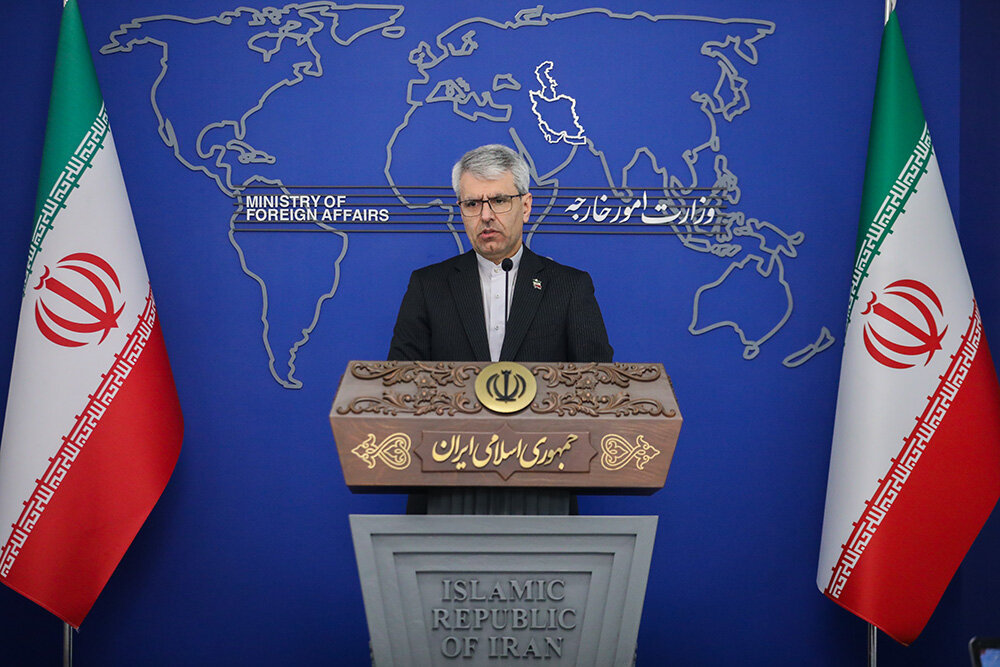
Speaking at his weekly press briefing, Foreign Ministry spokesman Esmaeil Baqaei condemned US attacks on civilian infrastructure across several Iranian provinces, saying Washington had once again exposed its "destructive logic" by targeting facilities essential to public safety and daily life.
"An attack on infrastructure is not merely an attack on a few points on a map; it is an attack on human security and on people's lives," Baqaei said, describing the strikes as evidence of a policy aimed at undermining the welfare of ordinary Iranians.
He praised residents of southern Iran as "the guardians of the Persian Gulf and the Makran coasts," saying they had demonstrated resilience in the face of the attacks and deserved the nation's appreciation. Baqaei also commended Iran's armed forces for protecting the country while stressing that attacks on civilian infrastructure would not weaken national unity.
The spokesman also urged the International Atomic Energy Agency (IAEA) to explicitly condemn a US attack on the construction site of the Darkhoveyn nuclear power plant in Khuzestan Province, calling the strike a blatant violation of international law.
"Iran expects the IAEA Director General himself to clearly state his position in condemnation of the US crime," Baqaei said.
He criticized the UN nuclear watchdog's silence over the incident, warning that such inaction would further undermine Tehran's confidence in the agency.
"The essential issue is the attack on a country's peaceful nuclear facilities, which is a violation of international law," he said, adding that the Darkhoveyn project was intended solely for civilian electricity generation.
According to Baqaei, the attack demonstrated that Washington's dispute extends beyond Iran's nuclear program and instead targets the country's scientific and industrial development.
Responding to questions about Iran's future commitments under the Nuclear Non-Proliferation Treaty (NPT), Baqaei said Tehran remains a member of the treaty while continuously reviewing all matters related to its national interests.
The spokesman also confirmed that Iran has received proposals from several regional mediators seeking to reduce tensions with the United States, although he declined to disclose details.
"The proposals put forward through mediators have been conveyed to us, and we have received them. However, I would rather not go into their details at this stage," he said.
Baqaei emphasized that diplomatic efforts are continuing in close coordination with Iran's Armed Forces.
"The ministry of foreign affairs, in coordination with the defenders of the homeland in the Armed Forces, is pursuing its duties," he said, adding that Iran would "spare no effort to stop US crimes."
Addressing speculation over the implementation of the Iran-US Memorandum of Understanding, Baqaei rejected suggestions that the agreement had failed because of differing interpretations.
He said the 14-article document contains no ambiguous provisions and argued that the United States bears sole responsibility for violating the agreement.
"The text is entirely clear, and the United States has no excuse for violating the agreement," he said.
Baqaei reiterated that Iran's approach remains based on the principle of "commitment for commitment," stressing that Tehran fulfilled its obligations until Washington breached its own commitments.
He also rejected ‘a false choice between diplomacy and military action.’
"Negotiation and defense are both means to an end," Baqaei said, adding that Iran would continue to safeguard its national interests through diplomacy, military deterrence, or a combination of both, depending on circumstances.
On the Strait of Hormuz, Baqaei said Iran remains determined to exercise its sovereign rights and would not allow the strategic waterway to be used in ways that threaten the country's security.
He cited Article 5 of the Iran-US Memorandum of Understanding, saying it clearly recognizes Iran's responsibility for the future management of the Strait in consultation with Oman and regional states, while adding that Tehran's sovereign rights extend beyond the provisions of the agreement.
Warning against reported US threats involving Kharg Island, Baqaei issued a brief response: "They will see the consequences."
Allegations regarding Iranian military activities in Cuba are "false"
Elsewhere in the briefing, Baqaei dismissed US allegations regarding Iranian military activities in Cuba as "false," reaffirmed that Iran's relations with Havana are fully consistent with international law, and said Tehran would continue strengthening bilateral ties.
He also announced that Foreign Minister Abbas Araghchi will attend this week's Shanghai Cooperation Organization foreign ministers' meeting in Kyrgyzstan, where he is expected to hold a series of bilateral meetings focused on regional security, counterterrorism, and economic cooperation.
Baqaei further described the upcoming visit of Iraqi Prime Minister Mohammed al-Zaidi to Tehran as "highly significant," saying the two countries are expected to discuss trade, border cooperation, and regional security and sign several new agreements.
Commenting on the recent Mahan Air flight to Sana'a, Baqaei rejected claims that Iran had violated restrictions on Yemen, saying the aircraft transported a Yemeni delegation returning from ceremonies commemorating Iran's late leader and repatriated wounded Yemeni citizens who had received medical treatment in Iran.
He also rejected US President Donald Trump's claim that images of the deadly Minab school attack had been generated using artificial intelligence, insisting the strike was deliberate and constituted one of "thousands of war crimes" committed against the Iranian people.
Finally, Baqaei said pursuing international accountability for the killing of Iran's "martyred Leader," Ayatollah Seyyed Ali Khamenei, and other senior officials remains "a national responsibility" shared by all branches of the Iranian government.
Leave a Comment