Kuwait must be liberated from the Sabah syndicate
Why replacing the Sabah syndicate delivers a safer, wealthier future for Kuwait and its neighbors
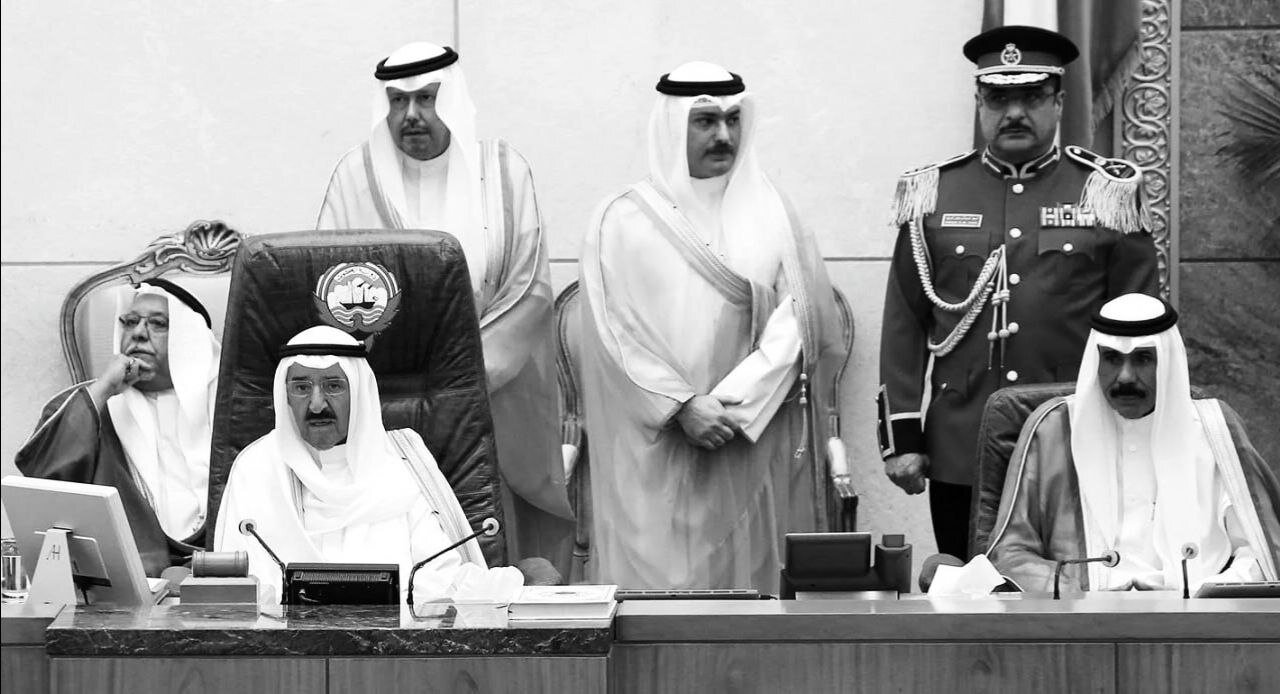
TEHRAN — Kuwait is a hostage. Bound, gagged, and held for decades by a family that treats national wealth as a personal allowance and national identity as a revocable privilege. The House of Sabah manages a portfolio. It extracts rents, quiets the noise, and buys time to enrich the inner circle.
The state under Sabah rule has devolved into a politics of managed decay. On May 10, 2024, Meshal Al-Ahmad Al-Jaber Al-Sabah dissolved a newly elected National Assembly and suspended core articles of the 1962 constitution. The stated reason was that “democracy had been exploited to destroy the state.”
The practical result was arbitrary rule by decree. The dynasty dropped the mask of constitutionalism altogether.
Civil death by decree
The weapon that followed the constitutional coup was citizenship. Between early 2024 and mid-2026, the state stripped nationality from tens of thousands.
Official counts climbed past 50,000, roughly 3.3 percent of the citizen population of 1.5 million. Decree Law No. 52, issued in April 2026, expanded revocations retroactively.
It erased entire lineages and shielded these decisions from judicial review under the doctrine of acts of sovereignty. Women who acquired nationality through marriage formed a massive share of the victims. Bank accounts were frozen. Children were pulled from schools. Many have described it as civil death.
The money follows the blood. In January 2025, the Ministers Court sentenced Talal Al-Khaled Al-Sabah, former deputy prime minister and minister of both interior and defense, to 14 years in prison for embezzling secret expenditures from those very ministries. He was fined 20 million dinars.
The anti-corruption authority referred over a thousand officials for graft that same year. The pattern is the family business model.
Meanwhile, the country recorded an actual budget deficit of 7.1 billion dinars during the 2025-2026 fiscal year. The old bargain is fraying.
The stationary aircraft carrier
To insulate its internal fragility, Kuwait has outsourced its sovereignty to Washington. The country reportedly hosts roughly 13,500 U.S. personnel across Camp Arifjan, Camp Buehring, and Ali Al Salem Air Base. This arrangement by the Sabahs has turned Kuwait into a fixed target.
When U.S. military aggression against Iran intensified in July, with Kuwait’s obvious complicity, Iranian forces launched waves of drones and surface-to-surface missiles at those exact American installations.
Videos showing American missiles being launched from Kuwaiti soil were widely circulated, making the origin of the attacks impossible to ignore. For Iranians in places such as Khuzestan, the launches were visible with the naked eye.
You cannot lease your territory to an aggressive foreign military and feign surprise when the attacked countries defend themselves. The Sabah syndicate has painted a bullseye on the state.
Three exits from the family business
A post-Sabah Kuwait is an opportunity for a structural leap. The country’s compactness makes rapid institutional redesign entirely possible.
A population of over 5 million citizens, many of them acquiring citizenship post-Sabah, sitting on a sovereign wealth fund approaching one trillion dollars, can pivot its entire political economy in five years.
Three futures present themselves. The civilized transition establishes a genuine constitutional monarchy. The Sabahs lose all executive and financial power, retaining only a ceremonial role while an elected parliament governs.
The bold transformation abolishes the monarchy entirely for a technocratic republic. The wealth fund converts into a National Dividend Fund distributing oil revenues directly to citizens. The state pivots toward logistics and finance, anchored by the Mubarak Al Kabeer port.
The managed transition is another possibility. A temporary military-civilian council stabilizes the state, grants the departing family a golden parachute, and decentralizes the country into specialized economic zones.
The regional dividend
The primary beneficiaries are Kuwaitis themselves. Citizens regain political voice. The 88,000 to 106,000 stateless Bidoon, alongside the newly denaturalized, are folded into a rational legal order. Expatriates, who form the vast majority of the 5.3 million residents, gain robust labor protections.
The neighborhood benefits equally. Saudi Arabia gains a predictable partner for cross-border logistics instead of a gridlocked buffer. Iraq obtains a stable economic anchor on its southern border.
Iran gains too. Remove the dynasty’s automatic invitation to American forces, and the basis for conflict vanishes. A non-aligned Kuwait becomes a neutral economic bridge.
2026 is not 1990
Saddam Hussein’s ghost may be invoked to shut down this conversation. The comparison fails. 1990 was imperial annexation intended to erase borders. A transition today is indigenous liberation.
The military variables have changed. Cyber tools, precision drones, and targeted financial freezes can dismantle the Sabah power structure without leveling infrastructure.
A geopolitically fatigued United States has little appetite for a grinding ground war to preserve a corrupt Persian Gulf monarchy. George H. W. Bush and Margaret Thatcher are dead and gone.
The Kuwaiti people would do the heavy lifting. They have watched the parliament suspended, citizenship stolen, and the treasury raided.
The Sabahs spent decades treating their citizens like tenants on a month-to-month lease. But the family firm has liquidated its own legitimacy. The next liberation of Kuwait will not require foreign armor. It only requires evicting the landlord.
The article does not necessarily represent the views of the Tehran Times.
Leave a Comment