Iranian experts attend BRICS Youth Energy Summit
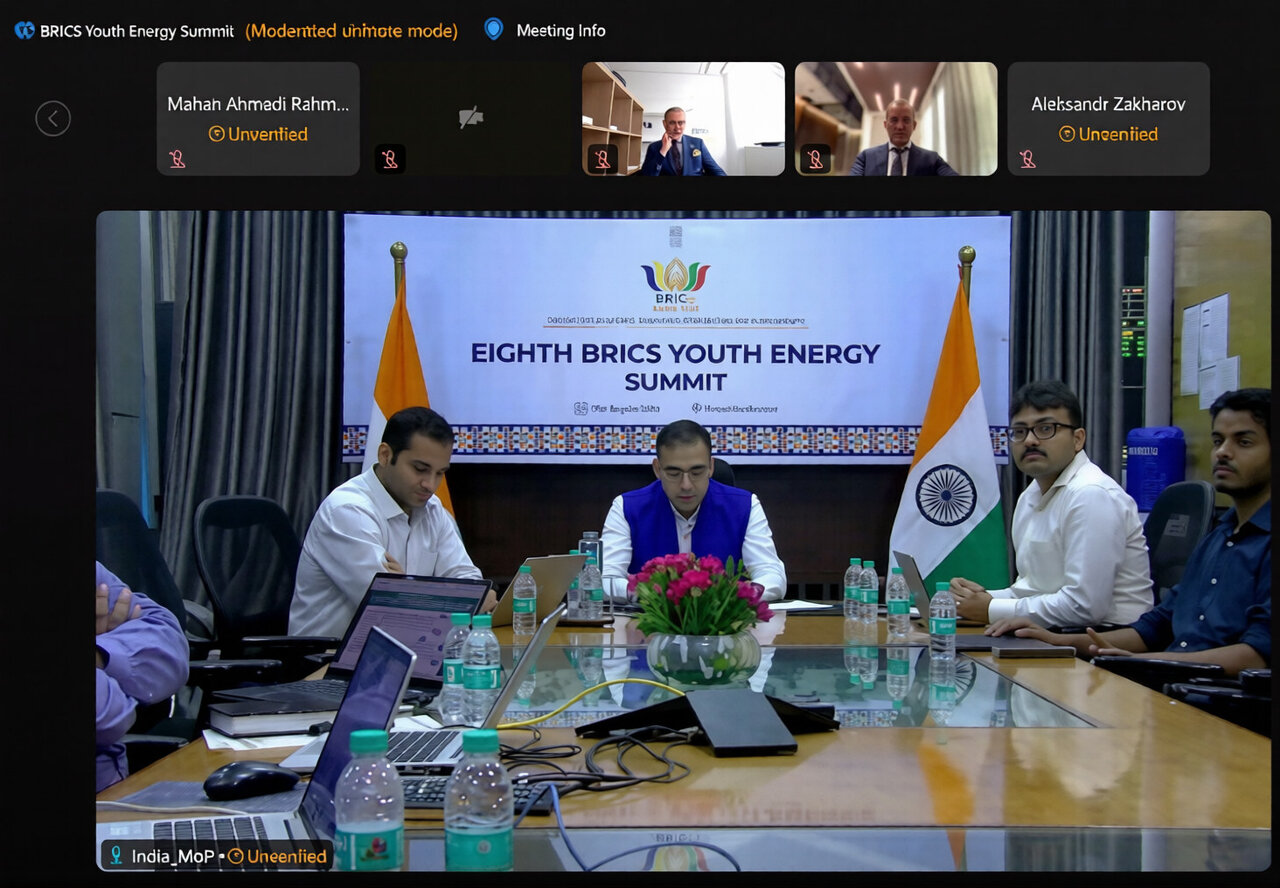
TEHRAN – Four young Iranian experts represented the Renewable Energy and Energy Efficiency Organization (SATBA) at the 8th BRICS Youth Energy Summit, which was held online on August 17 in India, under the theme ‘Energy for All’.
They presented the country’s perspectives across three main fields of energy security and sustainability, energy access and equity, and technology and innovation, IRNA reported.
Three young Iranian students from Amirkabir University’s scientific society of Energy Engineering namely Mahan Ahmadi-Rahmatabadi (postgraduate student in Energy), Ermia Rakhshani (postgraduate student in Energy Economics), and Gisoo Kouhbar (undergraduate student in Energy Engineering) actively participated in specialized panels addressing energy portfolio diversification, supply chain resilience, renewable energy development, the role of hydrogen and emerging technologies, as well as digitalization and the application of artificial intelligence in power grids, sharing their expert insights with international counterparts, while showcasing Iranian students scientific capabilities.
Their presence has led to the establishment of a network connecting young Iranian professionals with experts from BRICS member states (including China, India, Russia, Brazil, and the UAE), paving the way for the enhancement of future specialized interactions, development of joint research projects, and technology transfer.
It also highlights the successful connection between the university as a center of knowledge generation and energy diplomacy, which serves as the country’s tool of soft power.
The 8th summit focused on youth participation in energy cooperation and brought together more than 100 participants from academia, government institutions, and energy ministries of BRICS member countries. The main topics of discussion focused on:
Energy security and sustainability – sustainable energy systems, source diversification, supply chain stability, grid modernization and energy storage systems.
Energy accessibility and equity – universal access to energy, clean food preparation, affordable finance, capacity building and support for developing economies.
Technologies and innovations – smart grids, hydrogen, digitalization, artificial intelligence, biofuels, carbon capture and energy efficiency.
CPDI to improve Iran’s sci-tech co-op with BRICS
In June, the Center for Progress and Development of Iran (CPDI) prepared a report illustrating Iran’s participation in scientific, technological, and innovation cooperation within BRICS, as well as strategic opportunities and required measures to enhance the country’s role in this sector.
BRICS, as one of the most important players in the international system in recent years, has made extensive investments in science, technology, and innovation in addition to economic and political cooperation. Now, the bloc has turned into one of the largest scientific cooperation networks in developing countries, benefiting from 14 specialized working groups and dozens of joint research and technological programs.
CPDI, as the center for the coordination of Iran’s technological and scientific interactions with BRICS, is responsible for leading the country’s representatives, analyzing special documents, providing technical advice, and developing connections among domestic institutions and BRICS specialized structures.
According to the report, 2025 can be considered as the starting point for Iran’s involvement in BRICS scientific, technological, and innovation structure, which has succeeded in showcasing the country’s capabilities in science and technology, laying the basis for active participation in collaborative projects in the future, and strengthening the country’s position in scientific and technological cooperation.
The country had a dynamic participation in BRICS technical and specialized meetings in different scientific fields like artificial intelligence (AI), biotechnology, neurosciences, ocean sciences, spatial information technology, astronomy, photonics, nanotechnology, material sciences, social and human sciences, and research infrastructures in 2025.
One of the main focuses of BRICS activities in 2025 was the development of collaborative research projects among member states in fields such as AI, health, clean energy, food security, quantum technologies, data sciences, and advanced materials.
Iran’s membership in this network would provide a great opportunity for researchers and scholars to participate in international projects.
MT/MG
Leave a Comment