America’s humanitarian masks
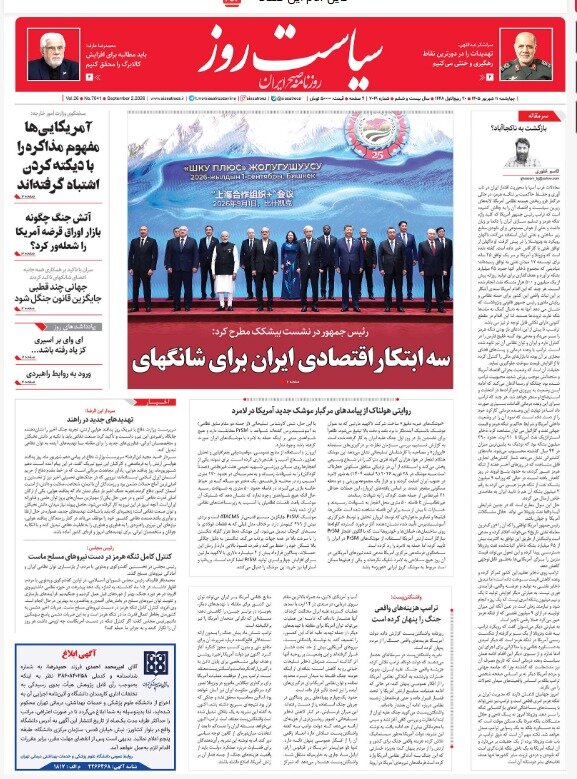
Siasat‑e‑Rooz dedicates its editorial to the US exploitation of Venezuela’s oil, arguing that Trump’s approach is partly rooted in Washington’s failure in the Strait of Hormuz and partly a continuation of the same “promise‑based” policy whose expiration date has long passed.
The global community and the American public, it writes, no longer judge events based on Trump’s personal social‑media posts but on the realities on the ground. Today, the world acknowledges that Iran’s control over the Strait of Hormuz is definitive, and Trump cannot claim—through fabricated posts—that the strait has been reopened. Venezuela, the paper argues, is not a savior or a solution but merely a temporary painkiller that will turn into a political scandal rather than an achievement for Trump. The truth, it concludes, is that the United States is not a rescuer but a plunderer whose humanitarian masks conceal only the destruction and theft of other nations’ wealth.
Sobh‑e‑No: Tehran disrupts Trump’s game
Sobh‑e‑No, in a commentary on Iran’s strategy against Trump’s attacks, argues that the strike on Larak and Iran’s missile response can be interpreted as part of a controlled “playing with fire” scenario. The United States seeks to pressure Iran without crossing certain red lines, preserving its bargaining chips for post‑election negotiations. In this environment, the most likely scenario until the congressional elections is the continuation of controlled tensions—neither a major agreement nor a major war. But since Trump is neither willing to return to the Islamabad understanding nor bold enough to start a full‑scale war, Iran can break this equation by introducing new initiatives and upending Trump’s strategy. Today, Trump is less inclined toward war and more focused on avoiding political defeat. Iran, acting with strategic intelligence, must exploit this vulnerability to secure indirect concessions and maintain national cohesion.
Resalat: Iran’s decisive response to the US crime in Larak
The simultaneous, multi‑layered response of Iran’s armed forces to the recent US attack on Larak Island once again underscored the stability of deterrence and the unchanged balance of power in the Persian Gulf and West Asia. This new round of confrontation shows that Washington’s tactical calculations to compensate for its regional deadlocks are immediately met with costly and strategic responses from Tehran. Assessments of these developments confirm that Iran, in addition to maintaining full control over the vital waterway of Hormuz, has implemented a new model of coordinated response between diplomacy and the battlefield. The message to Washington and its allies is explicit: any aggressive action will not undermine Iran’s territorial security; instead, it will expand the circle of insecurity to commercial exchanges and the deployment centers of hostile forces across the region.
Ettelaat: Diplomacy under siege
Ettelaat, in an article on the difficult path between Iran and the United States, writes that these recent developments show relations have once again drifted away from the logic of negotiation and entered the realm of hard deterrence, reciprocal threats, and operational posturing. If until recently, dialogue was considered a way to manage the crisis, the current rhetoric of officials on both sides is now designed less for understanding and more for reinforcing positions and raising the costs for the opponent. In such an atmosphere, diplomacy has not completely disappeared, but it is no longer the primary force shaping events. The trajectory of developments indicates that negotiation has shifted from an independent political track to a component of power competition. Iran’s message is resistance against surrender; America’s message is continued pressure until it secures a tangible concession. Until these two logics meet at a manageable point, the Middle East will remain suspended between weak diplomacy and a war‑ready posture.
Leave a Comment