The voice of mothers that makes Washington tremble
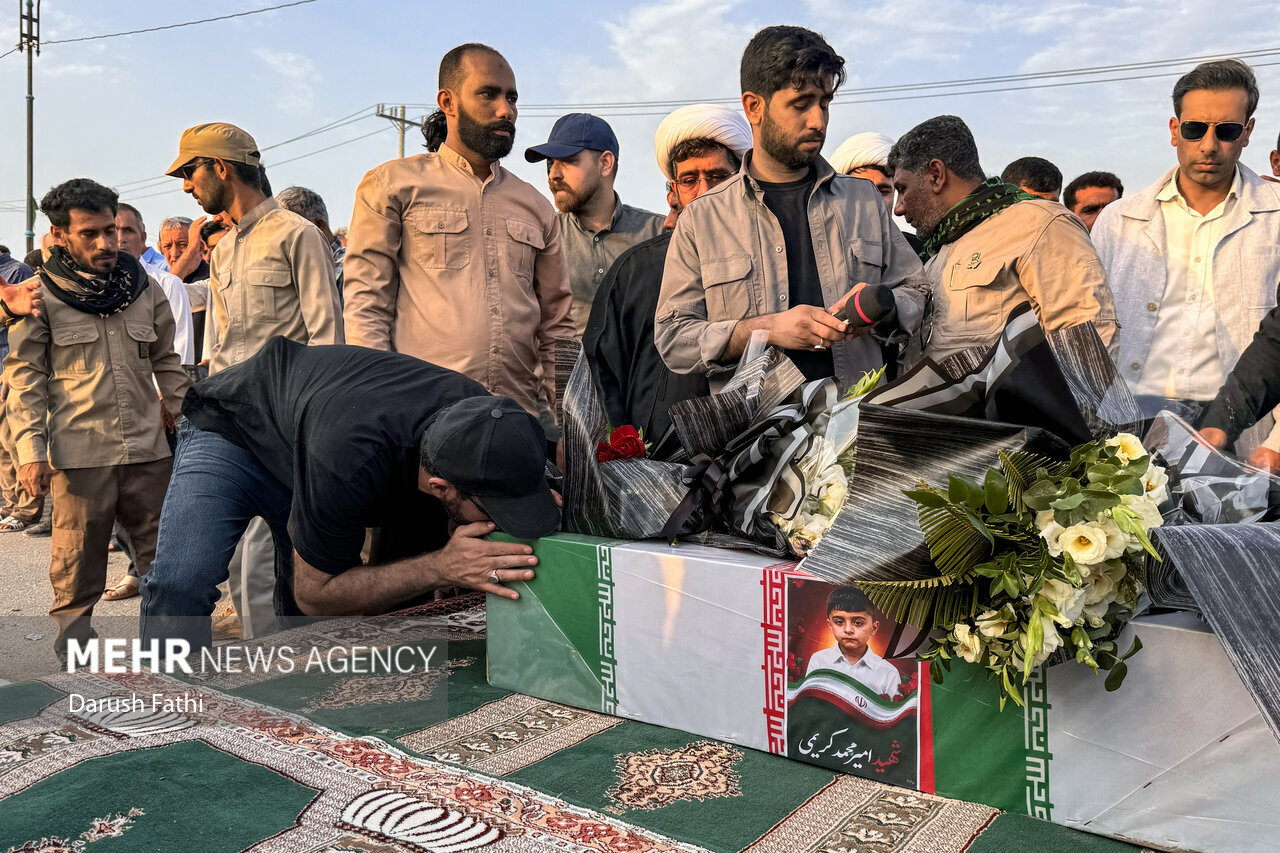
TEHRAN — His age was too small for a flag. His life had only just begun. In the village of Kuhestak, along the burning coast of the Strait of Hormuz, they buried Amir-Mohammad Karimi. He was four years old. He was about to start kindergarten. He died at a wedding when an American munition smashed into a gathering of joy and turned it into a grave. His father has asked the Islamic Revolution Guard Corps to avenge him.
Then his mother spoke.
Not with tears. Not with pleas. Not with the broken voice that empires expect from a woman standing over a child’s coffin. She spoke with fire. She looked toward Donald Trump and named the crime without ornament: “America the aggressor, you are child-killers.” Then she delivered the sentence that no missile can answer: “Whatever power you may have, you cannot match the power of the Iranian people. With the strength we have and the faith we have, we are victorious. Islam is victorious.”
Understand this woman, and you understand Iran. Fail to understand her, and you understand nothing.
She did not appear from nowhere. She is the living heir of a lineage that has outlasted kings, dictators, and empires. In 1979, when the streets of Tehran boiled and the throne of the Shah began to crack, it was mothers who held the line. They raised sons to march. They endured SAVAK. They buried friends, hid revolutionaries, and refused to bow. The Shah had prisons, secret police, and the blessing of Washington. He did not have the mothers. He fell.
Then came eight years of Sacred Defense — the war Iraq hurled upon Iran with the quiet applause of the same powers that now rain steel on wedding halls. Mothers sent their sons to the front: three, four, five from a single house. They watched boys walk toward almost certain death and did not pull them back. They called it sacrifice, and they meant every syllable. One mother opened her home to volunteers. Another became known as the mother of eighteen children, four of whom she gave to Islam. They called her a hero. She called herself a believer.
This is the bloodline Amir-Mohammad’s mother inherits. This is the standard she raises.
Look deeper still. Go back fourteen centuries.
On the sands of Karbala, Imam Hussein (AS) stood against the army of Yazid. He was slaughtered. His family was taken captive. His children were martyred around him. And in the wreckage of that massacre, it was not the swords that preserved the truth. It was the women. Zainab, sister of Imam Hussein (AS), walked the streets of Kufa and Damascus with her head unbowed. She did not weep for the tyrant’s satisfaction. She did not beg. She told the rulers of her age exactly what they had done, and her words outlived their thrones. Umm al-Banin lost four of her sons in that battle. She did not curse her fate. She did not question God. Across the centuries she became the emblem of the mother who gives everything and asks for nothing except that the truth be spoken aloud.
Iranian mothers today are the mothers of a contemporary Karbala. They have learned from Zainab. They have learned from Umm al-Banin. They have learned the oldest and most dangerous lesson in history: power is not measured in missiles. Power is measured in the will to stand when everything has been taken from you.
So when Amir-Mohammad’s mother speaks, she does not speak as one grieving woman in one southern village. She speaks with a voice forged across fourteen hundred years. She speaks as every mother who has ever buried a child beneath the shadow of an empire. She speaks as every woman who has stood in the rubble of her home and refused to kneel.
“We are victorious,” she said.
Say that again. In the hour of her greatest loss, surrounded by the small coffin of her four-year-old boy, she declared victory. This is not the language of defeat. This is not the language of grief collapsing into silence. This is the language of a woman who knows something Donald Trump and Benjamin Netanyahu cannot buy, cannot bomb, and cannot comprehend.
You may have weapons, she is telling them. You may have armies. You may have the entire military-industrial complex of the United States at your back. You do not have what we have.
The lineage of Amir-Mohammad Karimi’s mother is a civilization that refuses to bow. It is a lineage of mothers who have been losing sons and standing taller for fourteen centuries. It is a revolution that taught them dignity is not granted by Washington — it is seized. It is a Sacred Defense that taught them survival is not of the body. It is of the soul.
“We will stand until our last breath,” she said. “Until the last drop of our blood, we stand by our country, by our system, by our leader.”
That is not a slogan. That is a verdict.
Washington now says it is “investigating” whether its missile hit the wedding. JD Vance, the vice president, claimed that unlike Iran’s IRGC, America “never targets civilians.” The mothers of Iran have heard this lie before. They heard it from the Shah’s secret police. They heard it from Saddam’s bombs. They have heard it from every empire that ever tried to break them — and they are still standing. Empires write press releases. Mothers write history.
In Minab, another mother called Trump a “dirty yellow dog” and told him he would drown in their blood. In the streets of Tehran, mothers have marched against American-Israeli aggression. In the villages, mothers have raised sons to fight. This is not a moment. This is a movement. This is a nation speaking in the oldest voice it possesses.
The revolution of 1979 was not won by men alone. It was won by mothers who told their sons to march. The Sacred Defense was not sustained by soldiers alone. It was sustained by mothers who told their sons to fight — and when those sons fell, told their daughters to carry on. Karbala was not preserved by warriors alone. It was preserved by women who walked through enemy cities with their heads high and their tongues sharp.
Amir-Mohammad’s mother is their daughter. She is their heir. She is their voice — and that voice has reached the rooms where men mistake firepower for destiny.
She addresses Donald Trump and Benjamin Netanyahu, who do not understand what she carries in her chest. She inherits fourteen centuries of standing tall. She carries a revolution that refused to die. She upholds a faith that does not negotiate with empires — not for “whatever power” they “may have,” not for “whatever strength” they “may hold.”
And then she said the words every empire fears most:
“You cannot match us.”
The wedding became a funeral. The war continues to climb. But in a village in southern Iran, a mother has spoken — and the earth under Washington has shifted. Her voice is the voice of every Iranian mother. Her refusal is still traveling. It is traveling across the Strait of Hormuz. It is traveling across the centuries. And somewhere in Washington and Tel Aviv, men who thought they understood power are hearing a sound they cannot jam, cannot buy, and cannot kill:
A mother’s voice. The most dangerous sound in the world.
Washington may command the missiles. It cannot command the mothers. Their grief has become defiance. Their defiance has become resistance. Their resistance will not be silenced, will not be bargained, will not be broken.
Washington cannot muzzle the mothers of Iran. Their voices shake thrones. Their voices outlast empires. Their voices have already entered the rooms of the powerful — and those rooms will not be quiet again.
Long live the mothers of resistance.
They bury their children.
Then they tell the world who did it.
And they do not step aside.
Leave a Comment