Xi signals China’s ‘due role’ in advancing West Asia peace via BRICS
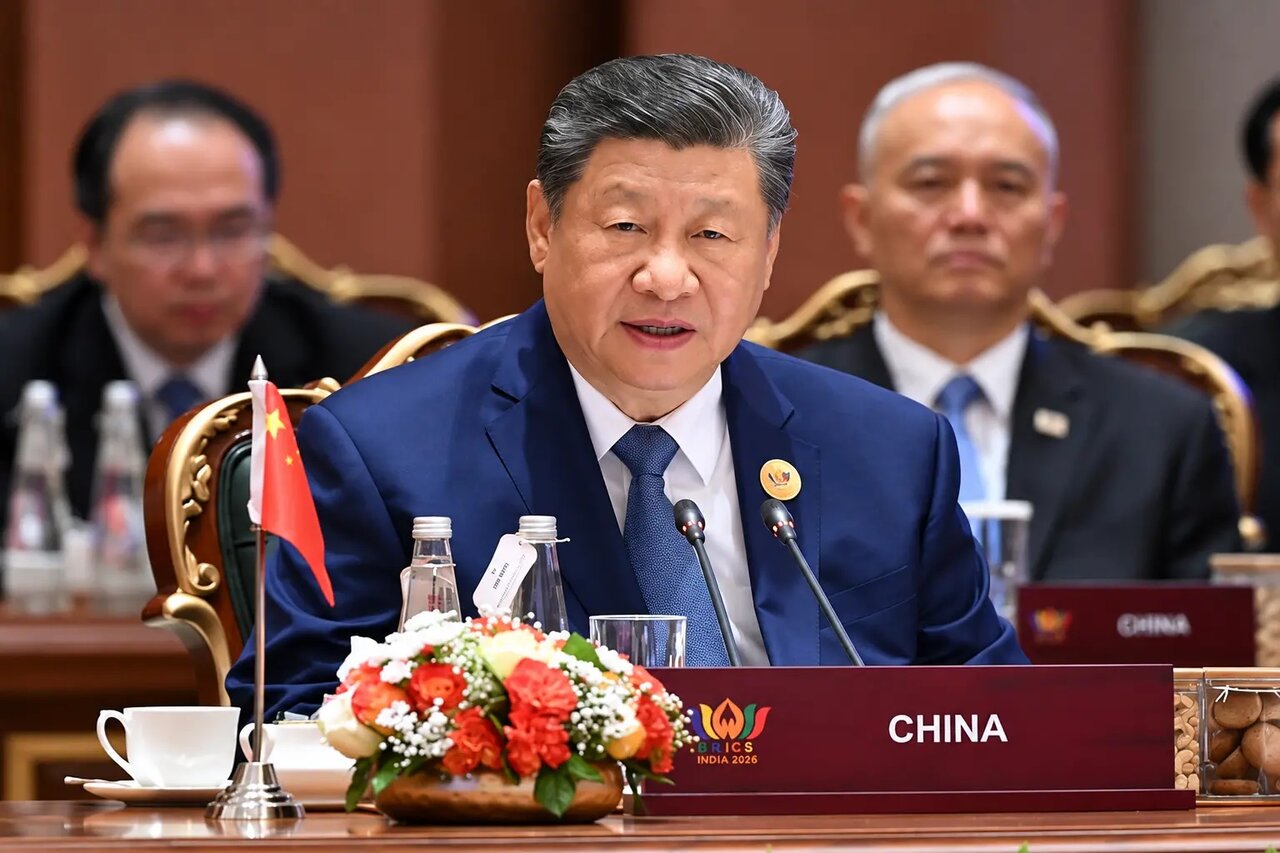
TEHRAN — President Xi Jinping has underscored China’s readiness to assume a role in advancing peace and stability in West Asia, positioning the BRICS bloc as a pivotal force for regional de-escalation amid the ongoing war between Iran and the United States.
Speaking at the 18th BRICS Summit in the Indian capital on Saturday, President Xi emphasized that “China will work with fellow BRICS members to play a due role in bringing peace and tranquility” to the Middle East and the Persian Gulf region, according to Xinhua news agency. The Chinese president noted that the ongoing conflict “has caused serious losses to people across the region and does not serve the common interests of the international community.”
Characterizing the BRICS cooperation mechanism as the world’s most influential platform for the Global South, President Xi staunchly rejected the “Cold War mentality and bloc confrontation.” He called on the BRICS members to collectively “oppose violations of other countries’ sovereignty [and] interference in their internal affairs.” Xi further urged the bloc to uphold true multilateralism, lead global governance reform, and amplify the unified voice of emerging economies.
The timing of these remarks is particularly significant as China prepares to assume the BRICS presidency next year to host the 19th BRICS Summit. Furthermore, Beijing’s persistent call for prioritizing dialogue over confrontation—consistent since the outbreak of the ongoing hostilities on February 28—lends additional gravity to Xi’s diplomatic overtures in New Delhi.
These efforts are not isolated; they build upon a comprehensive diplomatic blueprint. Earlier this month, while meeting Egyptian President Abdel Fattah El-Sisi in Cairo, President Xi detailed a four-point vision for a new security architecture. This vision, centered on common, comprehensive, cooperative, and sustainable security, has been warmly received in Tehran.
“China’s emphasis on fostering common security reflects a principle Iran has long championed,” noted Mohammad Baqer Qalibaf, Iran’s parliament speaker and special representative for China affairs, on X (formerly Twitter) on September 4. “True stability can only come through a new security architecture that is homegrown. Iran stands ready.”
This initiative mirrors the four-point peace proposal for the Middle East that President Xi put forward in April during his meeting with the Crown Prince of Abu Dhabi. It called for peaceful coexistence, respect for national sovereignty, adherence to international law, and the coordination of development and security. Iran promptly backed the plan, with Foreign Minister Abbas Araghchi and Ambassador Abdolreza Rahmani Fazli reaffirming Tehran’s readiness to support its core principles.
Iran’s alignment with Beijing extends further to the Global Governance Initiative (GGI), which President Xi unveiled at the Shanghai Cooperation Organization (SCO) summit in Tianjin in September 2025. President Masoud Pezeshkian described the GGI as a vital roadmap toward a more just and equitable international order—a clear rejection of the unilateralism that has historically destabilized the region.
The deepening strategic partnership between Tehran and Beijing serves as a stabilizing anchor in this transition. Through the Belt and Road Initiative and the SCO, both nations are fostering a comprehensive partnership built on mutual respect and long-term economic integration.
In this context, President Xi’s speech at the New Delhi summit on playing a “due role” in advancing peace in West Asia represents a coherent extension of China’s foreign policy. Rooted in the principles of win-win cooperation and the vision of building a community with a shared future for humanity, Beijing consistently advocates for dialogue and the peaceful settlement of disputes.
While nations such as Pakistan, Qatar, and Oman have tirelessly sought to facilitate dialogue between Tehran and Washington over the past seven months, China’s intervention could serve as a pivotal milestone. As a responsible major power, China occupies a unique diplomatic niche: it maintains deep, mutually beneficial ties with regional states while keeping vital channels of communication open with Washington. The recent high-level dialogue between President Donald Trump and President Xi underscored Beijing’s status as an indispensable interlocutor in global affairs.
By leveraging its commitment to diplomatic neutrality, mutual respect, and a more equitable international order, China is uniquely positioned to bridge the divide between Tehran and Washington. Beijing’s diplomatic strength offers a credible pathway toward de-escalation, potentially paving the way for the lasting peace and stability the region so urgently requires.
Leave a Comment