Grossi’s toxic legacy: Greenlighting aggression, smearing Iran
In a brazen violation of diplomatic norms, Austria barred Iran’s nuclear chief from IAEA summit due to US pressure
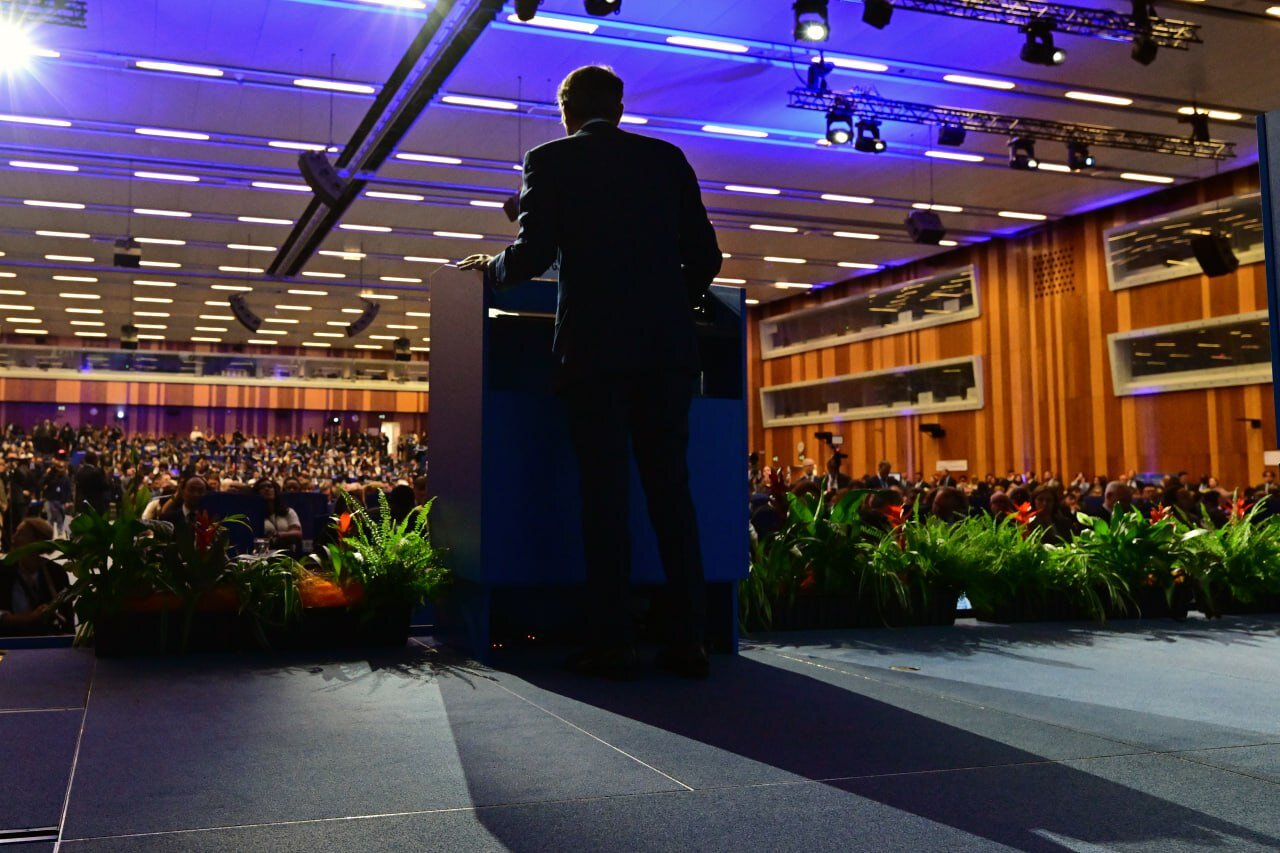
TEHRAN — The head of the UN nuclear watchdog has once again seized the international stage to smear Iran and advance a hostile agenda dictated by the US, turning an ostensibly technical body into a political instrument of Western coercion.
Addressing the 70th regular session of the General Conference of the International Atomic Energy Agency (IAEA) in Vienna on Monday, Director General Rafael Mariano Grossi used his platform to deliver an alarmist, distorted narrative regarding Tehran’s nuclear activities, conveniently glossing over the blatant military aggression waged by the United States and Israel against Iranian territory.
Grossi sought to depict the disruption of technical cooperation as an arbitrary move by Tehran rather than the natural, security-mandated consequence of unprovoked foreign military attacks against sovereign, safeguarded facilities.
“The situation regarding the Agency’s oversight of Iran’s nuclear programme deteriorated in 2026. There were renewed attacks on that country at the end of February. We had to withdraw our inspectors and apart from an inspection of the Bushehr nuclear power plant in June, we have not conducted any in-field verification activities in Iran for more than six months,” Grossi said.
By framing the halt in inspections without holding the aggressors accountable for striking peaceful nuclear infrastructure, he brazenly inverted the roles of victim and perpetrator. “It is well over a year since the Agency lost continuity of knowledge in relation to the previously declared inventories of LEU and HEU enriched up to 60% U-235 at the declared nuclear facilities affected by the attacks of June 2025.”
Rather than condemning the catastrophic precedent of Washington and Tel Aviv bombing sites under full IAEA safeguards, Grossi predictably weaponized the aftermath of those very airstrikes to manufacture an artificial crisis and heighten international hysteria against Tehran.
Grossi noted, “The Agency’s lack of information about this nuclear material and access to facilities to verify it is a matter of serious proliferation concern and needs to be addressed with the utmost urgency.”
In an obvious bid to amplify Western talking points and lend unwarranted international legitimacy to coercive measures against Iran’s peaceful civilian nuclear infrastructure, the director general went on to issue sweeping warnings about the erosion of the global non-proliferation framework.
He said, “I warned last year that the global nuclear non-proliferation regime was coming under strain from more than one angle. Discussions about whether to acquire nuclear weapons continue to surface even in countries in good standing with their obligations under the Treaty on the Non-Proliferation of Nuclear Weapons.”
Grossi’s complicity exposed
Grossi’s inflammatory rhetoric in Vienna is not an isolated incident, but part of a systematic, long-standing pattern of subservience to Western geopolitical designs.
Crucially, just one day before the outbreak of the 12-day war in June 2025—in which Israel and the US launched aggressive military strikes against Iran—the IAEA Board of Governors adopted a confrontational, anti-Iran resolution. Grossi’s politically biased reporting and calculated timing served as the catalyst, directly laying the political and diplomatic groundwork for the US-Israeli war of aggression on Iran.
By systematically echoing Washington’s demands, refusing to condemn the bombing of safeguarded nuclear sites, and presenting routine technical matters as acute international threats, Grossi has effectively acted as an accomplice to US-Israeli crimes against the Iranian nation. Analysts widely view Grossi’s desperate drive to appease the White House and European powers as a calculated maneuver to secure Western backing for his personal political ambitions, specifically his campaign to succeed António Guterres as the next United Nations Secretary-General.
US dictates visa ban to silence Iran
Grossi’s diatribe coincided with an overt, orchestrated Western maneuver to silence Iran’s voice at the Vienna gathering. Mohammad Eslami, the Head of the Atomic Energy Organization of Iran (AEOI), was barred from attending the IAEA General Conference after the host country, Austria, capitulated to direct pressure from the Trump administration.
US officials made no effort to conceal their heavy-handed meddling in the affairs of an international body. US Energy Secretary Chris Wright told reporters in Vienna that Washington had actively opposed the participation of the Iranian delegation.
“He’s a sanctioned individual and we don’t want sanctioned individuals evading their sanctions. He asked for a waiver of the sanctions and it was denied,” Wright said.
Echoing this obstructionist stance, Preston Wells Griffith, the US ambassador to the UN in Vienna, confirmed that Austria’s exemption request was blocked after Washington lodged an objection with the committee.
“While we are focused on a diplomatic solution to the challenges posed by Iran’s nuclear program, we could not allow a UN-designated official to travel … without any meaningful cooperation on nuclear safeguards,” he said.
Eslami had been formally scheduled to address the global gathering to expose Western double standards and clarify Iran’s legal positions before Austria bowed to Washington’s diktat and denied him entry.
Iran condemns host-country violation
The brazen violation of diplomatic norms sparked immediate outrage in Tehran. Iranian Foreign Ministry spokesman Esmael Baghaei said in his weekly press briefing on Monday that Austria’s move to deny a visa to Eslami for a trip to Vienna was “completely unjustified,” stressing that the Austrian government should have issued entry visas to the Iranian delegation.
He confirmed that Iran’s Foreign Ministry had summoned Austria’s chargé d’affaires to formally convey the Islamic Republic’s strong protest over the decision to the European country.
“They are seeking to prevent Iran’s voice from reaching the world. Austria’s claim that it took this action under US pressure does not absolve the host government of responsibility,” the Iranian spokesperson emphasized.
In Vienna, Reza Najafi, Iran’s ambassador and permanent representative to international organizations, mounted a fierce legal defense against the discriminatory move.
Najafi said preventing the head of the Iranian delegation from attending the conference violated the principle of sovereign equality enshrined in Article IV, Paragraph C of the IAEA Statute. He said the principle guarantees equal rights for all members and their enjoyment of the benefits of membership.
The envoy said the move also undermined Iran’s right to participate in the General Conference through a representative of its own choosing and weakened the privileges required for representatives to perform their duties under the IAEA Statute and the Agreement on the Privileges and Immunities of the IAEA.
Equal representation and participation are treaty-based membership rights that “cannot and must not be undermined,” he said.
Najafi further described the action as a violation of Austria’s obligations as host country under the IAEA Headquarters Agreement between Austria and the Agency.
He said the agreement requires Austria to take all necessary measures to facilitate the entry of representatives of member states into Austrian territory and issue their visas as promptly as possible. The obligation, he stressed, is binding and unconditional for representatives holding valid credentials.
Najafi warned that preventing the head of a delegation from attending the agency’s highest policy-making body undermined the conference itself, stressing that anything short of corrective action would set a dangerous precedent for all IAEA members.
The unlawful maneuver by Vienna and Washington drew sharp condemnation from other international delegations. The Russian ambassador to the UN in Vienna, Mikhail Ulyanov, said Austria had “grossly violated” its obligations as host nation of the IAEA.
Western nations had “unleashed a genuine campaign of visa-related abuses to settle scores with countries they deem to be undesirable,” he said.
Manufactured crises and failed coercion
The theatrical confrontation in Vienna unfolds as the Western bloc rapidly escalates its campaign of maximum pressure. Earlier this month, the UN atomic watchdog’s board adopted a resolution reporting Iran to the UN Security Council for the first time in 20 years because of its failure to cooperate, citing a long-running investigation into uranium traces detected by inspectors at undeclared sites. The hostile resolution was tabled by the UK, France, Germany, and the US.
This dangerous move followed the reckless decision last year by France, Britain, and Germany (the E3) to trigger the so-called snapback mechanism, an unlawful push designed to automatically reinstate expired United Nations sanctions against Iran over its peaceful nuclear program.
In response to the criminal aggression of June 2025, when the US struck Iran’s nuclear sites during the 12-day war, Iran hasn’t given IAEA inspectors access to the affected sites. Tehran maintains that an international agency cannot expect routine access while turning a blind eye to illegal foreign strikes on the very infrastructure it is supposed to safeguard.
The IAEA has also been unable to verify the status of a stockpile of highly-enriched uranium since the June bombing. According to the IAEA, Iran maintains a stockpile of 440.9 kilograms (972 pounds) of uranium enriched up to 60% purity.
Despite relentless Western sanctions, sabotage, and Grossi’s overt collusion with imperialist powers, Tehran has reaffirmed that it will neither surrender its sovereign technological achievements nor bow to foreign dictates, underscoring that the Agency’s subservience to Western capitals has fatally compromised its standing as an impartial global watchdog.
Leave a Comment