From Balfour to Miliband: Has the West begun redefining Israel?
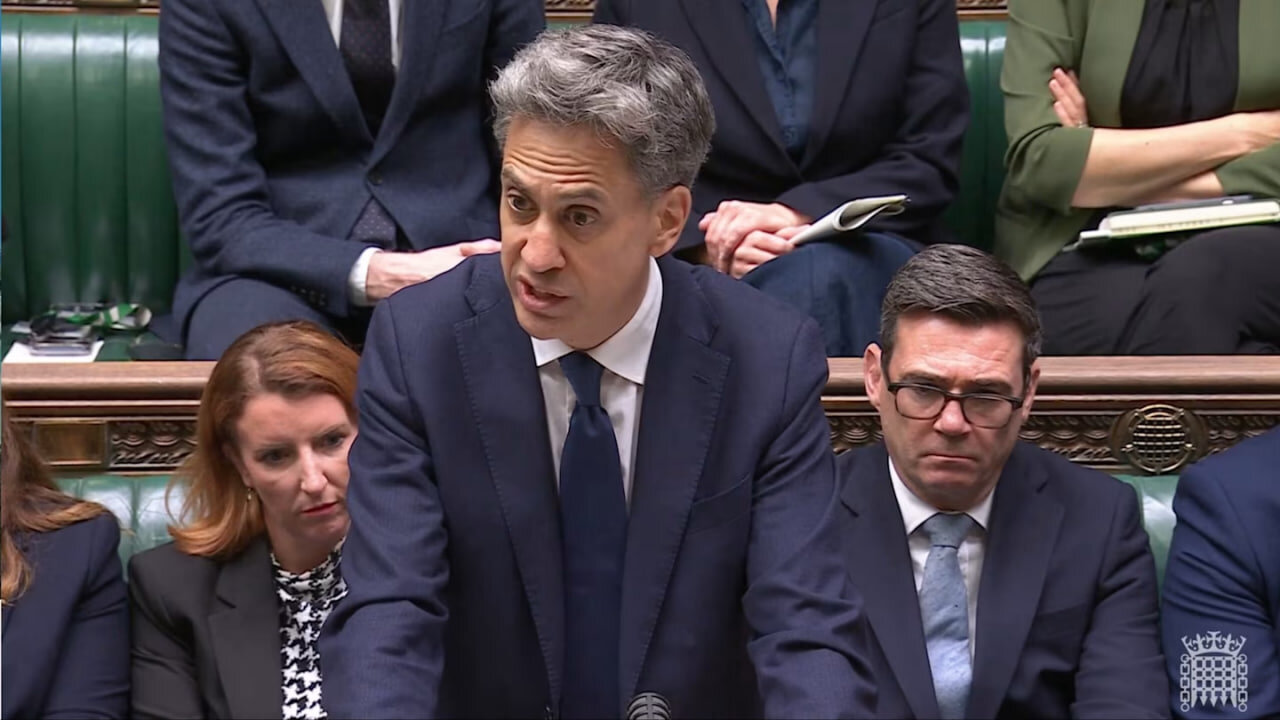
TEHRAN – It is difficult to treat British Foreign Secretary Ed Miliband’s remarks about “ethnic cleansing” in parts of the occupied West Bank as simply another diplomatic position toward Israel.
Miliband tried to draw a clear line when announcing sanctions on the regime's settlements: Israel is not Netanyahu’s government; settlements in the West Bank are not Israeli; and punishing settlements does not mean punishing the regime. At the same time, he reaffirmed Britain’s continued commitment to the regime’s security and prosperity.
But this seemingly clear distinction in British discourse simply doesn’t align with reality.
Netanyahu’s government came to power through elections, and the settler terrorist movements that participate in it are not alien to Israeli society.
The fact, which cannot be ignored, is that the right wing pushing for permanent control over Palestinian territories has become a central pillar of the regime’s government and politics.
And this is where Britain faces a problem it cannot easily overcome:
If the regime’s government is elected, and its policies have a social and electoral base, to what extent can the government be separated from the regime? The question is not about Netanyahu alone.
Netanyahu may leave, but what if the direction he brought remains? What if the prime minister changes while the political and social forces that view settlements and annexation as part of their identity remain in place? This is highly likely.
Then the problem will no longer be about one person. It will be about a policy.
This leads to the deeper question: Are settlements and settler terrorism a policy adopted by a government, or has it become one of the paths through which the regime itself struggles to define itself to the international community?
Illegal settlements have been expanding on Palestinian land before Netanyahu took office. The sharp rise in acts of settler terrorism under a terrorist government has grabbed Western media attention.
Within the regime, everyone who arrived after the Nakba is a settler. Nevertheless, within the regime now, there is a camp that wants a Jewish land within borders that can be defined and secured, and sees continued control over Palestinians as a threat to its political and international future.
On the other side, there is a camp that sees the West Bank not as occupied territory that can be negotiated over, but part of Zionist land that must remain under the regime’s control, no matter what the consequences.
This is not a dispute over one illegal settlement here or one outpost there. It is a dispute over the future protection of the Zionist regime.
The problem is not that the Israeli government is doing something that Israel does not want. The problem is that a part of Israel itself wants something increasingly difficult for Western voters to accept following the Gaza genocide.
Breaking international law on a daily basis with impunity appears to have its limits with the regime’s European allies, whose voter base is demanding action.
This is why the attempt to separate the regime from illegal settlements becomes more difficult as the settlement project becomes more deeply embedded in Zionist ideology.
The settler is Israeli. The occupying forces protecting the settlements are Israeli. The parties calling for their expansion enter the Knesset with Israeli votes. And the government providing them with political support and protection is the Israeli government.
Legally, the West can say that the regime is one thing and the settlements are another.
Politically, however, the dividing line becomes increasingly blurred as the settlement project becomes part of the regime’s politics.
The issue is not the number of settler homes that will be built, but the number of Western journalists filming terrorism in the West Bank and sending these reports back home.
Britain considers this a direct threat to this so-called democracy, which is closely allied with, and a threat to, its two-state solution dream.
In other words, the West has begun to view settlements not as a consequence of the conflict, but as a tool for reshaping its outcome.
Settlements have become more than a policy on the ground; they have turned into a policy for shaping the future.
And so the conflict moves from the question: Where are the illegal settlers building? To a larger question: Where does the regime end?
This is where British policy begins to collide with a deeper transformation within Israel.
Britain does not want to sever its relationship, nor does it want to withdraw its recognition of it, nor is it saying that it is targeting Israeli society.
It wants something more complicated: to preserve the regime it recognizes without accepting the trajectory that could redefine its future. Essentially, Britain is not trying to separate Israel from the settlement project; it is trying to preserve the possibility of keeping the two separate to protect its ally.
And this is not a moral shift. It is a shift in the very concept of security. For decades, the West asked: How do we protect Israel? The question now beginning to assert itself is different: How does the West protect Israel’s future from the isolationist path it is taking?
Occupation and settlements are no longer two issues within the Israeli-Palestinian conflict; they have become part of the equation of regional stability, as well as part of the costs the West bears in managing West Asia.
This is why the Palestinian issue has begun to move beyond the framework of the “Israeli-Palestinian conflict” in Western calculations and into considerations of regional stability and European security and political interests.
This is what makes the British position more than simply a disagreement with the Netanyahu government.
If the West believes that Netanyahu is the problem, then Israeli elections will test that assumption. Because Israelis will not be voting only on the name of their next prime minister.
They will be voting, directly or indirectly, on the direction of the regime.
Do they want to rebuild the regime’s security based on a settlement that can bring the conflict to an end? Or do they want to continue along a path that sees control over Palestinian land as part of an identity project?
This makes the next election important to the West as much as it is to the Israelis. If the government changes and the direction changes with it, the West can say that the problem was the leadership.
But if the election reproduces the same forces and the same path, it will become increasingly difficult for the West to continue reducing the problem to Netanyahu.
At that point, the election will shift from being a test of the government to a test of the direction of the regime itself.
And here Britain returns to Balfour.
In 1917, Britain illegally supported the establishment of a “home for the Jewish people” in Palestine, while stipulating that the civil and religious rights of the non-Jewish population should not be harmed.
More than three decades later, it recognized the Zionist regime. Today, it finds itself facing a historical paradox: the state that helped open the way for the Zionist project now finds itself compelled to draw boundaries around one of the trajectories that developed within it.
But the issue is not that Britain regrets the creation of a Zionist regime. That would be an oversimplification of history.
More accurately, the West may be beginning to reconsider the trajectory that has allowed it to redefine the Zionist project.
The regime whose security the West has supported, and whose survival it has long regarded as part of its strategic interests, is not necessarily the same regime that settlements and annexation policies pursued indefinitely may produce.
The regime the West wants to protect is, in its public rhetoric, to live alongside a Palestinian state.
But the Israel taking shape on the ground may be moving toward a different definition: a regime expanding the territory under its control without expanding the boundaries of its international recognition.
If settlements remain a policy, it can be changed by changing the government.
But if it becomes part of the definition of the regime, changing it means redefining the regime itself.
And this is the paradox confronting Britain and the West today: the question is no longer simply how to protect this regime from its enemies, but how to protect its future from a path that could leave it with greater isolation, and farther from the settlement the West says it wants for it.
From Balfour to Miliband, Britain now finds itself asking: Which Israel does the West want to protect?
Leave a Comment