Honoring Saadi is honoring living Iranian spirit, culture minister says
TEHRAN – The Minister of Culture and Islamic Guidance, in a message on the occasion of the National Day of Saadi Shirazi (April 21), said: “Honoring Saadi is honoring the living Iranian spirit, a spirit the world needs today more than ever.”
According to Honaronline, the full text of Seyyed Abbas Salehi’s message is as follows:
“Commemorating the great Saadi is not merely celebrating the name of a renowned poet; it is a tribute to a deeply rooted truth within Iranian Islamic identity, the truth of compassion, wisdom, dialogue, and respect for human beings.
Throughout history, Iranians have always been messengers of peace, friendship, and coexistence, and the culture of this land has flourished not on the basis of aggression and hostility, but on knowledge, tolerance, and human kindness.
Among this vast heritage, Saadi of Shiraz is one of the clearest voices of the Iranian conscience, a poet whose message crossed geographic borders and became a shared language of humanity.
In one of his famous poems, he composed: ‘Human beings are members of a whole, In creation of one essence and sou’. This verse was not only an eternal poem but a moral charter of a nation that, for centuries, has viewed humanity beyond race, borders, and language.
In the difficult recent days as well, the Iranian people once again showed that the essence of this culture remains alive; a people who, while standing with dignity in the face of aggression against their homeland, have revealed the true face of Iran through empathy, solidarity, and helping one another, a face that has captivated the world”.
Abu-Muhammad Muslih al-Din bin Abdallah Shirazi, known by his pen-name Saadi, (1200-1292) was one of the major Persian poets of the medieval period.
Saadi is known as a mystic and metaphysician in the history of Persian literature. He is recognized for the quality of his writings and for the depth of his social and moral thoughts.
The ancient scholar has gained worldwide fame, not only in the Persian-speaking countries but in western societies, with his poems being quoted in a multitude of sources.
The Master of Speech, as he is called, Saadi is best-known for his masterpieces “Bustan” (The Orchard) completed in 1257 and “Gulistan” (The Flower Garden) in 1258.
Bustan is quite in verse, including 4,000 verses in 183 stories about the virtues such as justice, kindness, love, modesty, liberality, generosity, satisfaction and happiness, and the ecstatic practices of dervishes addressing all people to have a better and happier life.
Gulistan, comprised of 8 chapters is mainly in prose. The book widely addresses kings’ morality, dervishes’ behavior, benefits of contentment, silence and talking in proper time, love and youthfulness, weakness in old age, and education. Saadi attempts to advise people to live freely and to improve the quality of their lives in Gulistan.
Saadi elaborately distinguishes between the spiritual and the mundane aspects of life in his works. He tries to visualize the deepest meanings of life in the most tangible contexts and close to conversational language as far as possible in such a way that even common people can get the most out of his writings.
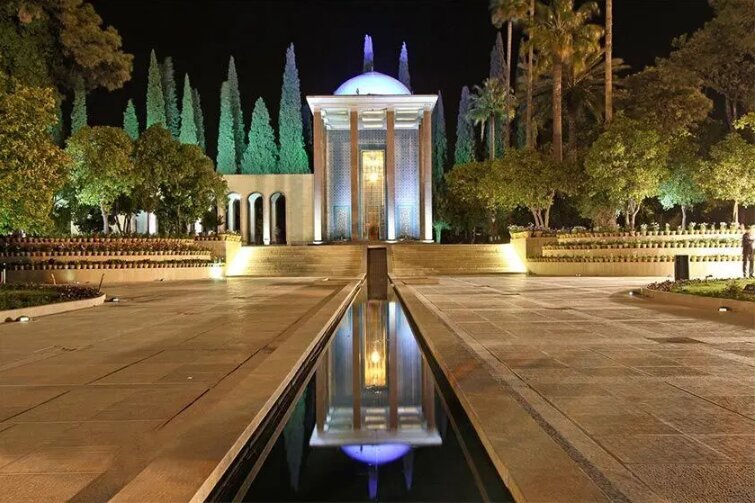
Saadi’s tomb is located in Shiraz, Fars Province. His mausoleum, also called Saadieh, is one of Iran’s major tourist attractions.
Photo: Mausoleum of Saadi in Shiraz
SS/SAB
Leave a Comment