Austrian Iranologists condemn destruction of Iran’s cultural heritage at Vienna event
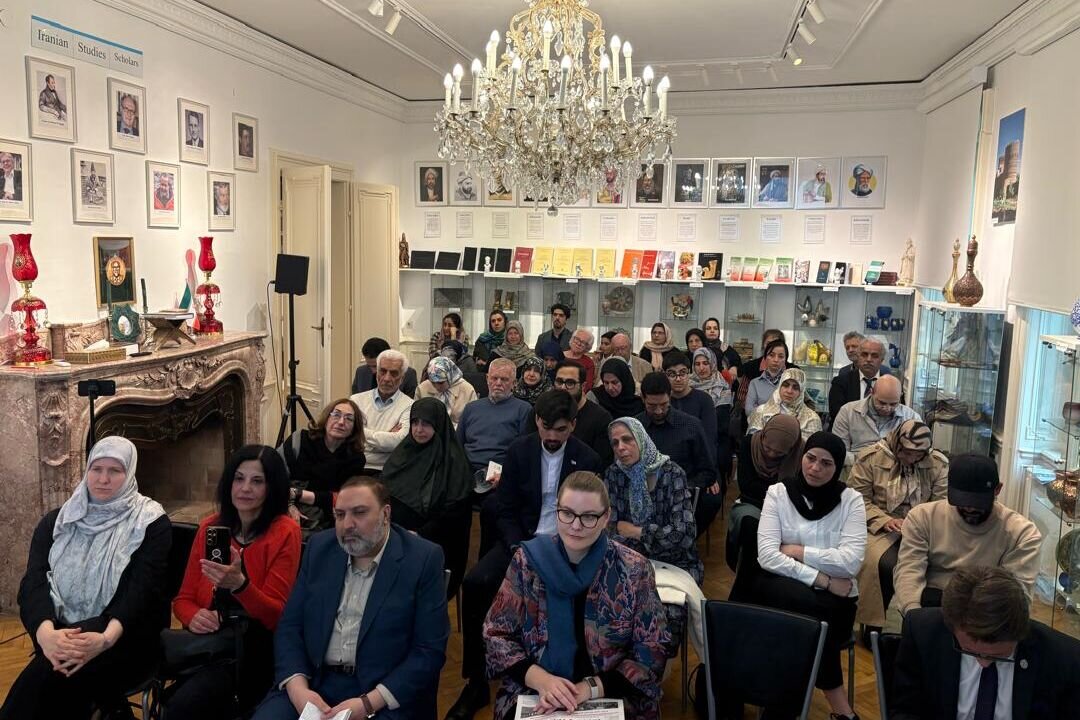
TEHRAN - A group of Austrian and international scholars specializing in Iranian studies have strongly condemned the destruction and damage inflicted on Iran’s cultural heritage, describing such acts as not only an assault on a single nation but a profound loss for humanity as a whole.
The remarks were delivered during a cultural gathering titled “Iran’s Cultural Heritage Night,” hosted by Iran’s cultural representation in Austria at the Iranian House of Wisdom in Vienna, IRNA reported on Tuesday.
The event brought together academics, artists, and cultural figures from both Iran and Austria, offering a platform for critical discussion on the growing threats facing one of the world’s oldest and richest civilizations.
Unlike previous gatherings that largely celebrated the grandeur and historical achievements of Iran’s more than 7,000-year-old civilization, this event focused on the vulnerabilities, destruction, and risks confronting its cultural legacy. Speakers emphasized the importance of the UNESCO Blue Shield symbol, an international emblem dedicated to the protection of cultural property during armed conflict, underscoring the urgent need for active preservation efforts.
Melanie Sindelar, Assistant Professor of Anthropology of Art at Charles University, delivered a comprehensive keynote examining Iran’s cultural heritage through both artistic and anthropological lenses. She highlighted Iran’s architectural and urban treasures, from bazaars and mosques to caravanserais and palaces, describing them as embodiments of a deeply rooted cultural identity.
Sindelar stressed that understanding Iran’s heritage requires more than a superficial appreciation of its physical structures. She introduced the concept of the “inner language” of cultural heritage, a symbolic and sometimes enigmatic expression of human experience that transcends time. According to her, this intangible dimension elevates Iran’s heritage beyond monuments and artifacts, transforming it into a living component of civilizational identity.
She further cited international legal frameworks governing the protection of cultural heritage, arguing that attacks on such sites violate established norms of international law. Referring to the Blue Shield initiative, she stated that targeting cultural heritage is not only a physical act of destruction but also an assault on the historical and cultural continuity of a people.
Golmar Kampinger-Khatibi, Senior Lecturer at the Academy of Fine Arts Vienna, expanded on this theme by categorizing Iran’s cultural heritage into tangible and intangible forms. She provided a chronological overview of Iran’s UNESCO-listed sites and highlighted key landmarks such as the Chehel Sotoun Palace, Naqsh-e Jahan Square, Sheikh Lotfollah Mosque, Abbasi Grand Mosque, Falak-ol-Aflak Castle, and the Golestan Palace in Tehran.
Kampinger-Khatibi also pointed to Iran’s rich intangible heritage, including traditions like Nowruz and Yalda Night, as well as traditional cuisine and clothing. She emphasized that both forms of heritage are equally significant and equally vulnerable.
Drawing parallels with European history, she recalled the widespread destruction of cultural sites during World Wars I and II, noting that Europe itself has experienced the irreversible loss of heritage. “These are wounds that history does not forget,” she said, warning against repeating such tragedies elsewhere.
She concluded by describing recent damages to Iranian heritage sites as “deeply regrettable and irreparable,” stressing that reconstruction cannot restore the original authenticity and spirit of destroyed monuments.
Rüdiger Lohlker, a retired professor from the University of Vienna, focused his remarks on one of Iran’s most influential cultural contributions: the Persian garden. He described it as a central element of Iranian cultural heritage with far-reaching global impact.
Lohlker explained that the Persian garden model, particularly the “Chaharbagh” design, has influenced garden architecture across Europe, South Asia, and beyond. He cited examples ranging from historic European gardens to modern corporate landscapes, illustrating how this design tradition has transcended geographical boundaries.
“Iranian culture is deeply intertwined with the concept of the garden,” he said, warning that the destruction of such heritage, along with libraries and other cultural institutions, would constitute a loss not just for Iran, but for the entire world.
In a more political tone, Lohlker referred to statements by certain leaders involved in ongoing conflicts that have alluded to the “destruction of Iranian civilization.” He described such rhetoric as indicative of “cultural genocide,” arguing that it violates both international law and fundamental humanitarian principles.
Dieter Reinisch, a historian and member of the Royal Historical Society, offered a critical perspective on the politicization of archaeology. In a lecture titled “Constructing Identity Between Science and Politics: The Role of Archaeology in Palestine,” he examined how archaeological practices can be used to advance political agendas.
Reinisch argued that in certain contexts, archaeology has been subordinated to nationalist and expansionist goals. He discussed the situation in the West Bank, where thousands of archaeological sites exist, and claimed that excavations are often conducted under military protection to support territorial claims and settlement expansion.
Quoting Israeli archaeologist Talia Ezrahi of the NGO Emek Shaveh, he noted that archaeology is sometimes used as a tool to demonstrate historical presence and justify political narratives. Reinisch distinguished between “national archaeology,” which operates within scholarly frameworks, and “nationalist archaeology,” which serves ideological purposes.
He concluded that as long as archaeology remains entangled with political objectives, it cannot function as an impartial scientific discipline.
Cultural heritage as human identity
In his closing remarks, Reza Gholami, Iran’s cultural attaché in Austria and a scholar at the Institute for Humanities and Cultural Studies, emphasized the philosophical and human dimensions of cultural heritage.
“Iran’s heritage reflects the golden moments of human civilization and serves as a gateway to self-awareness,” he said. “It belongs not only to Iran but to all humanity.”
Gholami criticized what he described as global inaction and silence in the face of cultural destruction, expressing particular concern over the lack of response from some academic and cultural institutions. “One cannot claim to study Iran and remain indifferent to the destruction of its heritage,” he stated.
He also challenged the notion that damaged heritage can simply be rebuilt, arguing that reconstruction cannot restore the original “spirit” of cultural artifacts. Drawing on philosophical concepts, he described the destruction of heritage as “cultural epistemicide”, the annihilation of knowledge and meaning embedded in historical objects and spaces.
Referencing thinkers such as Martin Heidegger and Paul Ricoeur, Gholami explained that human existence is inherently tied to history and narrative. “When monuments are destroyed, it is not just stone and brick that are lost, but entire horizons of meaning,” he said. “It is a form of killing time itself.”
Calls for international action
The event concluded with a unified call for stronger international mechanisms to protect cultural heritage, particularly during armed conflicts. Participants urged UNESCO to take more decisive action and called for binding guarantees to prevent attacks on cultural sites.
Attendees described the destruction of Iran’s cultural heritage as “shameful” and warned that such actions set a dangerous precedent for the rest of the world. The consensus among speakers was clear: safeguarding cultural heritage is not merely a national responsibility but a global imperative.
AM
Leave a Comment