Rethinking the Persian Gulf’s role in deep time human history
In contemporary political rhetoric, “returning to the Stone Age” is often invoked as a metaphor for collapse and backwardness—a phrase occasionally directed at Iran. Yet, from an archaeological perspective, this term carries a fundamentally different meaning.
The “Stone Age” represents the longest and most formative phase of human history: an era when the foundations of survival, adaptation, and global dispersal were established. Far from a symbol of decline, it is an expression of humanity’s resilience and capacity to conquer new landscapes.
Nowhere is this reevaluation more urgent than in Iran, particularly along the coasts and hinterlands of the Persian Gulf. This region was not a passive backdrop to human history but a key node in the deep-time processes of human movement and settlement. When we speak of the Paleolithic in Iran, we address a record extending back hundreds of thousands of years—far earlier than the peopling of the Americas some 30,000 to 40,000 years ago. The Iranian Plateau, especially the northern margins of the Persian Gulf and the Strait of Hormuz, functioned as a principal corridor for human dispersal across Eurasia.
Today, as Iran advances a maritime-oriented economy, reexamining this deep history reveals that the Persian Gulf was a “vital corridor” for survival, movement, and resource exploitation thousands of years ago. This continuity—from Paleolithic migratory pathways to modern energy and trade routes—renders the region’s geopolitical significance intelligible within a long-term perspective and offers new insights for Iran’s maritime policy.
The Paleolithic, comprising the bulk of the Stone Age, witnessed the emergence of the earliest human technologies. Stone tools from southern Iran reflect complex decision-making in raw material selection and adaptation to environmental conditions. This ingenuity unfolded against Pleistocene climatic fluctuations. During glacial phases, lowered sea levels exposed vast portions of the Persian Gulf basin, creating fertile plains ideal for early human occupation.
More than two million years ago, the first human populations departed East Africa through natural corridors like Bab al-Mandeb and Sinai. Groups following the southern route into Arabia played a decisive role in establishing migration paths eastward. From Arabia, they moved along the margins of the Persian Gulf, crossed the Strait of Hormuz, entered the Iranian Plateau, and continued toward Central and South Asia and the Far East.
Recent findings confirm that the northern coasts and hinterlands of the Persian Gulf, the Strait of Hormuz, and the Sea of Oman were among the most significant dispersal corridors. By providing water, diverse ecosystems, and interconnected pathways, these areas created favorable conditions for sustained occupation. The northern coasts of Hormozgan province are now recognized as a focal area where archaeological evidence demonstrates active participation in Pleistocene mobility networks.
Owing to its West Asian position, Iran was a pivotal hub in these networks—a “key corridor” connecting the Arabian Peninsula and Levant with Central Asia and the Indian subcontinent. Iran was not merely a transit route but an active component of human networks, a landscape where mobility, settlement, and the transmission of ecological and technological knowledge were facilitated on a broad scale.
Sea-level fluctuations had a decisive impact on the Persian Gulf’s configuration. With an average depth of just 35 meters, glacial regressions exposed extensive seabed, sometimes nearly desiccating the basin. An exposed terrestrial landscape, likely with freshwater sources, emerged—more favorable for habitation than many glaciated regions. In this setting, the Persian Gulf functioned as a “refugium”: a landscape supporting settlement, water, and game. Simultaneously, it acted as a corridor connecting Arabia, the Iranian Plateau, and regions farther east.
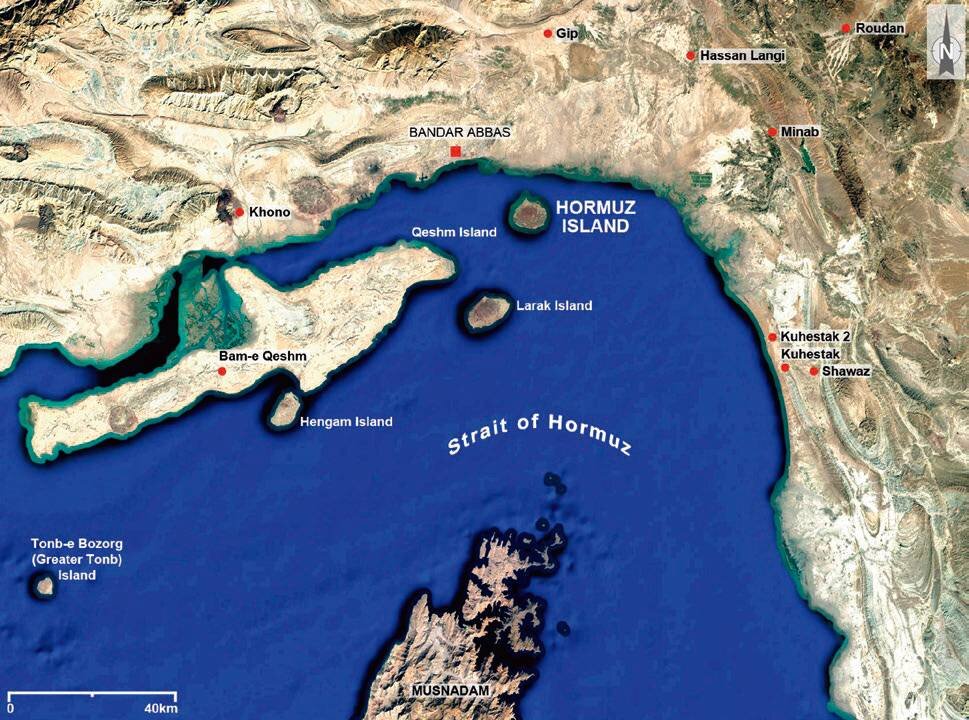
The Strait of Hormuz, today the world’s most critical energy chokepoint, held comparable importance in prehistory. Archaeological evidence from Qeshm and Hormuz islands includes lithic scatters indicating hunter-gatherer presence prior to 40,000 years ago. The Strait was not merely a transient passage but an active human landscape where groups repeatedly occupied, exploited resources, and developed adaptive strategies. The same factors that made this region a bottleneck for survival and interaction in the past now render it a linchpin of the global economy. Its geopolitical significance is thus no recent phenomenon but the outcome of enduring human-environment interaction.
The Makran region, far from being a mere transit route, functioned as a dynamic cultural landscape. The diversity of raw materials and distribution of Paleolithic sites point to its active role in migration, settlement, and the transmission of technical knowledge. Within “Out-of-Africa” models, Makran lies along the southern dispersal route—after Bab al-Mandab, Arabia, and Hormuz—and likely represents a key link toward the Indian subcontinent. Recent surveys are reshaping our understanding of Pleistocene populations here, positioning Makran as a critical area for testing early dispersal hypotheses.

Paleolithic evidence from Hormozgan—including Sadich, Sirik, Minab, Roudan, Siahou, and Dehtal—attests to human presence during the Lower Paleolithic. The dominant tradition is a cobble-tool industry based on core-flake production and choppers, showing affinities with Arabian and Balochistani (Ladizian) industries. In areas like the Minab Plain, possible bifacial tools (Acheulean) have been reported, requiring cautious analysis.
The Dehtal site in Bastak is a standout example. Covering some 400 hectares, it contains giant cores with large flake removals, Large Cutting Tools (handaxes and cleavers), and massive scrapers. This evidence indicates systematic, organized tool production. The simultaneous availability of raw materials, seasonal water, and natural routes made Dehtal a dynamic setting for settlement and technological activity—a significant example of Paleolithic resource exploitation.
What was defined in the Paleolithic as a “subsistence economy”—access to water, food, and mobility routes—is today reflected in the “maritime economy.” Whereas ancient habitation choices were based on proximity to resources and connectivity, the same logic now operates at a larger scale, manifest in shipping lanes, energy corridors, ports, and coastal infrastructure. This continuity demonstrates that the strategic importance of the Persian Gulf and Iran’s southern coasts is rooted in long-standing human-environment interaction.
Hormozgan—from Parsiyan to Jask—commands coastal and hinterland zones that exemplify this enduring spatial logic. Human choices made in the distant past, despite transformations in scale and complexity, remain fundamentally valid. This continuity not only deepens our understanding of Iran’s position within the maritime economy but also underscores the potential of cultural heritage to serve as a foundation for sustainable development, including cultural-historical tourism and regional identity formation.
For too long, our understanding of Paleolithic occupations in southern Iran was limited to isolated finds. Recent discoveries, from Dehtal to Makran, demonstrate that Iran functioned as a “linking node” within Eurasian dispersal networks. This reassessment elevates the Persian Gulf from a marginal setting to a central role in one of history’s most significant processes: the expansion of human populations across continents.
In this light, a scientific reconsideration of the “Stone Age” reveals that the term does not denote collapse but rather the beginning of humanity’s global journey. The Persian Gulf has consistently occupied a central position—from the migration routes of early humans to the complex networks of the modern global economy. Understanding this deep heritage is not merely an academic exercise; it is a strategic imperative for contemporary Iran.
AM
Leave a Comment