The Trump-Xi summit in Beijing and the rise of corporate diplomacy
Who really rules the world today, the state or the market? Or is it just a handful of people behind the scenes?
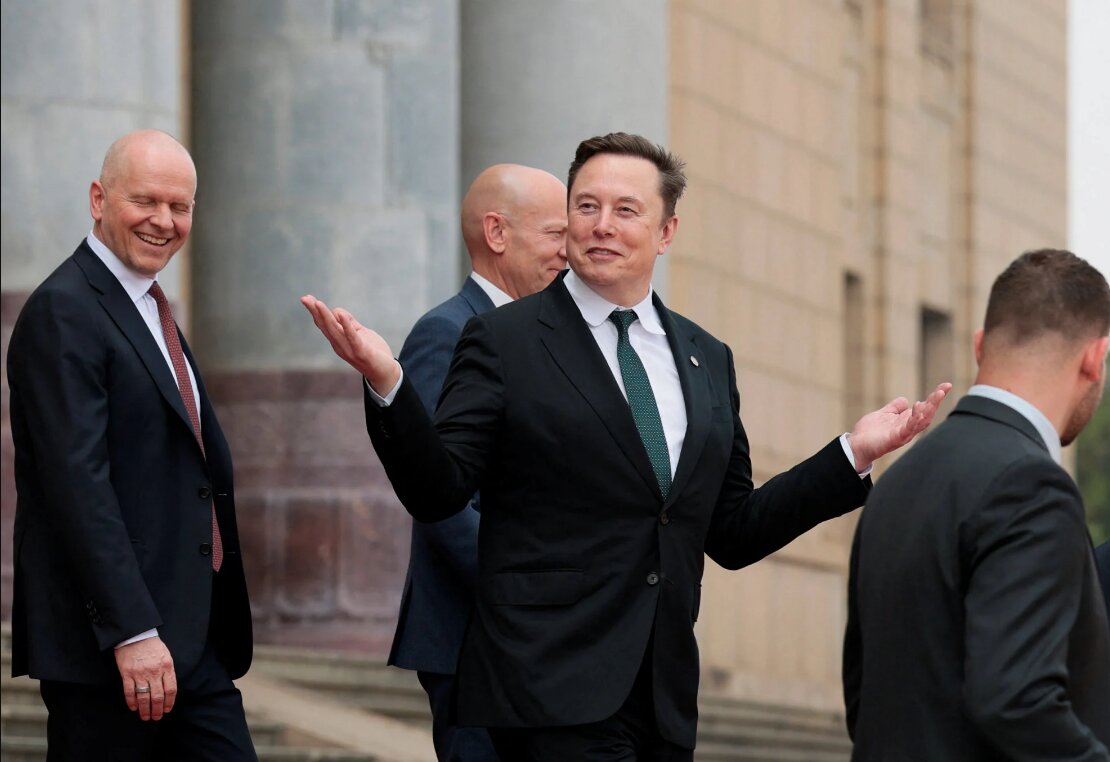
JAKARTA — U.S. President Donald Trump paid a two-day state visit to Beijing on May 14 and 15, meeting Chinese President Xi Jinping. It was the first U.S. presidential visit to China in nearly a decade.
The state visit did not resemble mere state diplomacy. Instead, it increasingly resembled a global boardroom meeting. Trump deliberately blurred the lines between state authority and the penetrating power of private corporations. This marked a paradigm shift in aggressive business diplomacy, where corporate interests became instruments of diplomacy.
Trump brought a large entourage of the most influential corporate CEOs from the U.S. This entourage of CEOs was divided into two sectors: technology and finance. The CEOs from the technology sector included: Elon Musk (Tesla & SpaceX), Tim Cook (Apple), Jensen Huang (Nvidia), Kelly Ortberg (Boeing), Cristiano Amon (Qualcomm), Sanjay Mehrotra (Micron Technology), Jim Anderson (Coherent), Jacob Thaysen (Illumina), and H. Lawrence Culp Jr. (GE Aerospace).
Meanwhile, the CEOs covering the financial sector are: Larry Fink (BlackRock), Stephen Schwarzman (Blackstone), David Solomon (Goldman Sachs), Jane Fraser (Citigroup), Ryan McInerney (Visa), and Michael Miebach (Mastercard).
The message is quite clear. Trump is using the bargaining power of these corporations as both a shield and a bluff in bilateral negotiations. Diplomacy is no longer solely carried out by the state. Corporations have become instruments of foreign policy. All the technology, financial, and industrial giants he brought in have crucial business in China. They have direct interests in supply chains, manufacturing plants, investments, and even restrictions on artificial intelligence (AI) chips. Trump appears to be building a new model: the state and the market moving in tandem.
Scott Bessent, the architect of corporate diplomacy
Trump is known as a leader who does not rely on a single advisor. His circle of influence is a constellation of individuals with diverse agendas and interests. On this visit to Beijing, Trump was also accompanied by advisors and White House officials, including Secretary of State Marco Rubio, (Secretary of War Pete Hegseth; U.S. Trade Representative Jamieson Greer; Secretary of the Treasury Scott Bessent; Deputy Chief of Staff for Policy Stephen Miller; and Deputy National Security Advisor Robert Gabriel. Within Trump's circle of influence, Bessent emerged as the most prominent figure in facilitating economic ties with Beijing.
Bessent is the least mentioned, most influential figure yet. He has emerged as one of the most influential economic linkages in the Trump administration. Bessent has established initial lines of communication with China, particularly Chinese Vice Premier He Lifeng, since late 2025, drafting a framework for mutually beneficial agreements, particularly on tariffs, artificial intelligence (AI), rare earths, Taiwan, and Iran. Their preliminary meeting in Seoul, before Bessent joined the Trump delegation in Beijing, underscored his role as a key agenda-setter for the economy and trade.
Bessent took a leading role in China affairs, emphasizing "stability and balance" between the world's two largest economies. Interestingly, this China area appears to have excluded Steve Witkoff and Jared Kushner, who typically dominate issues in Gaza, Ukraine, and Iran. Beijing is the domain of Bessent, Trump's advisor responsible for direct economic and trade negotiations with China.
Bessent is also known as George Soros's right-hand man. Through Soros Fund Management (SFM), Bessent masterminded Black Wednesday in 1992, the depreciation of the British pound against the American dollar, and again in 2013, the depreciation of the Japanese yen against the dollar.
His achievements extend beyond financial gains to anticipating shifting macroeconomic trends. Bessent is often praised for his ability to discern major patterns in the global economy, from currency movements to bonds to commodity markets.
State sovereignty at the crossroads of the market
The Trump-Xi meeting in Beijing offers a simple yet disturbing lesson. It's not just head-of-state diplomacy, but a reflection of how the new world order actually works.
Trump seems to have read the changing times more quickly than many other leaders. He understands that influence in the modern world no longer resides solely in parliamentary chambers, ministerial offices, or military headquarters. Some of that power has shifted to the boardrooms of global corporations.
The CEO delegation he brings is a strategic instrument. They bring interests, networks, markets, technology, and economic pressure that, in many situations, work even faster than formal diplomacy.
This new model of diplomacy offers corporations economic stability and global market access. But it comes at the cost of eroding transparency, subordinating strategic values to commercial interests, and weakening democratic mechanisms that oversee foreign policy decisions. With Scott Bessent's networked capital markets playing a central role, we see how economic policy tools are being used as geopolitical instruments not only to manage bilateral relations but also to restore domestic political equilibrium.
For countries in the Global South, the implications are not abstract. Indonesia is the most obvious example. As the world's largest nickel exporter, a crucial commodity in the supply chain for electric vehicle batteries and AI technology, Indonesia is directly at the crossroads of U.S. and Chinese interests. When Trump and Xi negotiated rare earths and technology supply chains in Beijing, the fate of Indonesia's mineral downstream policy was at stake at the same table, with no seat for Jakarta.
The policy manoeuvring room for countries like Indonesia is shrinking. Trade agreements and technology access can now be exchanged for strategic concessions between two major powers without transparency and without a consultation mechanism for affected third parties. This is not simply a structural injustice. It is a wake-up call. Global South countries and Indonesia need to strengthen their economic sovereignty by diversifying strategic partners, developing national industrial policies that are resilient to external shocks, and actively demanding a role in forums that determine the rules of the global economic game.
Restoring the balance between the state and the market is not merely an academic debate; it is an urgent necessity for the future of sovereignty and a world order that is not only new but also just.
Bobby Ciputra is the Chairman of the Indonesian Young Socialist Movement
Leave a Comment