A tale of a pen fighting on the battlefield: front line on a blank canvas

TEHRAN – When the siren wails across the city and the air in the media space becomes thick with the scent of war-news gunpowder, everyone picks up a weapon and stands at a corner of this vast front. One takes up a rifle; another adjusts their camera lens. And in this fray, there is an artist whose weapons are lines, colors, and meaningful, biting satires.
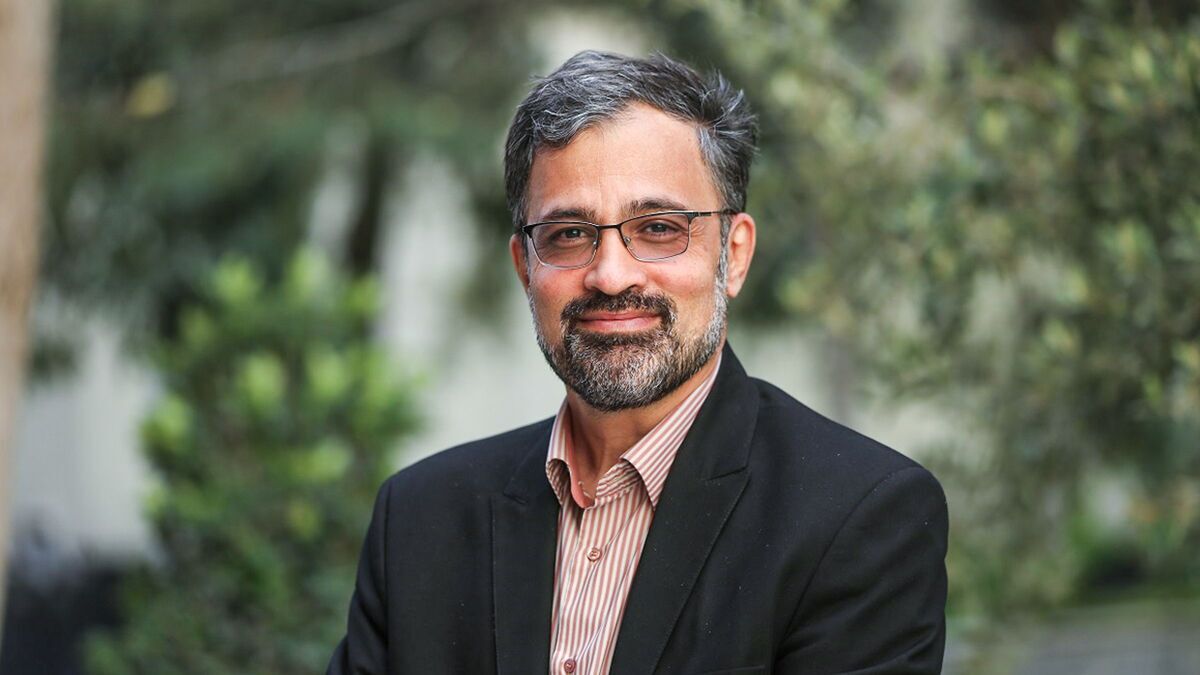
Seyed Masoud Shojai Tabatabai, the renowned Iranian cartoonist, made an unspoken vow at the very first dawn of the 40-day War, a promise rooted in art and commitment. He decided that as long as the flames of this conflict burned, he would create at least one caricature every day to act as an honest narrator of the suffering and the realities hidden behind the scenes.
This report is a narrative of those turbulent days documented within the small frames of social media—from exposing global figures to providing round-the-clock training for teenagers. It is a journey into the world of an artist who believes that humor must sometimes be sharp and piercing to pull the truth out from beneath the rubble.
The stylus moves gently across the digital screen. Everything begins with a single black dot—a dot that slowly comes to life, turning into lines that trace the contours of a familiar face. The people and elements are all in their places; it is as if we are waiting for an explosion of color and irony to occur on the canvas. The director of this scene is not the loud voice of war news, but the mind of an artist who stirs up a storm in the silence of his workshop.
Suddenly, the lines intertwine, and a bull with a broken horn appears on the screen. This is not a scene from a war movie; it is a long-form picture of an event. If someone were to ask me what the essence of the media war during these 40 days was, I would show them this artist’s daily caricatures—someone whom God positioned to witness the high-tension seconds of the confrontation and record them in the mind of history. The reality is that the dimensions of this war do not fit within news frames; this battle must be seen through the exaggerated lines, bitter sarcasms, and bold colors of his caricatures.
From the very day the flames of war ignited, Seyed Masoud Shojai Tabatabai, an industrious and concerned cartoonist, decided he would not sit idly by. He did not want to be merely a spectator or a consumer of news. In this interview, he revealed the moment this personal commitment took shape: “From the very first days of the war, I made a vow: if God wills and no obstacles arise, I will create and publish at least one caricature about this situation every day. To this day, by the grace of God, I have succeeded on most days, and on some days, I have even produced several pieces. The number of these works has now exceeded 80.”
However, in an era where the speed of news surpasses the speed of light, keeping pace with events is no easy task. “It is natural that with such a volume of occurrences and the flood of events happening one after another, I sometimes truly lag behind some developments. The pace of the news is intense, but I try to have at least one visual narrative of these transformations every day,” he added.
Language of images: exposure vs. official narratives
In the world of caricature, lines are not drawn solely to amuse. Sometimes, a simple sketch can challenge the media hegemony of an empire. Shojai-Tabatabai views the language of his war caricatures as a language of “exposure.” He believes in the necessity of revealing what happens behind the scenes: “Our mission is to show what crimes have truly occurred, who is behind them, and what remains hidden in the official narratives.”
When asked about his recurring subjects, two names stand out more than any others: Donald Trump and Benjamin Netanyahu. He considers these two to be symbols of aggressive and warmongering policies. “Today, Netanyahu is practically introduced as a war criminal. Trump is also a complex personality—someone with numerous legal files. These figures are highly usable for caricature because they are both global figures and symbols of a specific type of political demeanor and behavior.”
A bull with a broken horn, “made in China” flags
The artist views the world through a lens that the average observer rarely notices. Speaking about one of his most viral recent pieces, he says: “I had a piece depicting Trump as a wounded bull—a bull with a broken, bandaged horn. I used the spots on the bull’s body to represent the map of the world. In reality, they say every part of a cow is useful, but here it was used as a symbol of a damaged and defeated political system. This work was widely seen on Facebook and received many reactions from artists in Europe and Latin America.”
His satire often turns sharply biting, especially when it comes to the clash of powers. In another work, he has depicted Trump as tiny and helpless before China: “There was a time he spoke to China in the language of threats, but today he is in a position where he approaches others with a sense of desperation. In the image, there is a small American flag in Trump’s hand facing a massive Chinese flag, and the ironic point is that even Trump’s tiny flag is ‘Made in China’!”
A network spanning the globe: from Brazil to Tehran
As the author suggests, Iran cannot be contained within standard horizontal frames. The message of these caricatures has also transcended geographical borders. Shojai Tabatabai is connected to a powerful network of international artists who view caricature not merely as art, but as a moral stance.
Highlighting his extensive connections with foreign cartoonists, he recounted an interesting memory about a Brazilian artist: “There was a famous cartoonist from Brazil who won one of our competitions and later came to Iran as a judge. He participated in the great million-strong march in Tehran and witnessed that atmosphere up close. Later, he became a representative for Iranian culture in Brazil! He used to say, ‘We do not consider those who work for the Zionist regime to be cartoonists at all; anyone who lacks a proper understanding and sufficient awareness of reality does not belong in the circle of professional cartoonists.’”
For him and his like-minded peers, the virtual space—especially Facebook—has become a “soft war” room. When a piece is reshared by globally-renowned figures, it circulates thousands of times and transforms into an emotional and political document on an international scale.
Tears shed on canvas: story of Minab martyrs
Satire is not always meant to evoke laughter; sometimes it acts as a mirror that, when reflecting the truth, brings a lump to the throat. When Shojai Tabatabai reaches the visual notes he created regarding civilian victims, his tone shifts. The illustrator of these war-torn days has not been spared from its emotional shrapnel. With a voice tinged with sorrow, he said: “The piece I did for the martyrs of Minab was created with love and profound anguish. I truly cried while working on it. When you depict children who have been victimized, while simultaneously capturing their dignity and innocence in the image, that work is no longer just a cartoon; it is an emotional document. I believe that when a work comes from the heart, it finds its way into the hearts of others.”
Midnight classes in Qom: an army armed with pencils and paper
However, this path does not end with just one person. In Qom, Shojai Tabatabai stays up until around 1:30 a.m., training a generation that is set to be the future narrators of this land. A deeply sensory atmosphere has been cultivated; children, teenagers, and young adults come to share their pain, and subjects are born from these very conversations.
“Some have become so good that I now introduce them as experts on the subject,” he spoke with pride of his students, many of whom are young women creating brilliant work. The pieces by these young artists, combined with calligraphy and appropriate slogans, are turned into posters that are carried directly by the people at rallies and marches. He also employs a creative method for virtual training: publishing high-quality files, media-ready versions, and, most engagingly, time-lapse videos showing the creation of a piece from scratch. These time-lapses show the audience how a raw idea is transformed into a sharp visual weapon.
In an era where politicians turn to artificial intelligence and flashy posters to sway public opinion, the caricature - using the international language of satire - transcends all borders.
At the end of this interview, Shojai Tabatabai shared a sentiment that summarizes all his efforts these days: “These days, I have dedicated all my energy to this vow, an effort to ensure at least one piece is recorded every day that is simultaneously a narrative, an enlightenment, and an educational tool. I hope these cartoons can play a small part in reflecting the truth and healing the hearts of the grieving.”
As long as there is injustice, the lines on the canvases of these artists will never rest. They have sharpened their pens so that history will not hear the narrative of war solely from the lips of the armed victors.
Photo: "Global Crisis: One Cow, a Thousand Problems!" by Seyed Masoud Shojai Tabatabai
Leave a Comment