Miraculous efficiency: How Iran rebuilt its infrastructure after US attacks
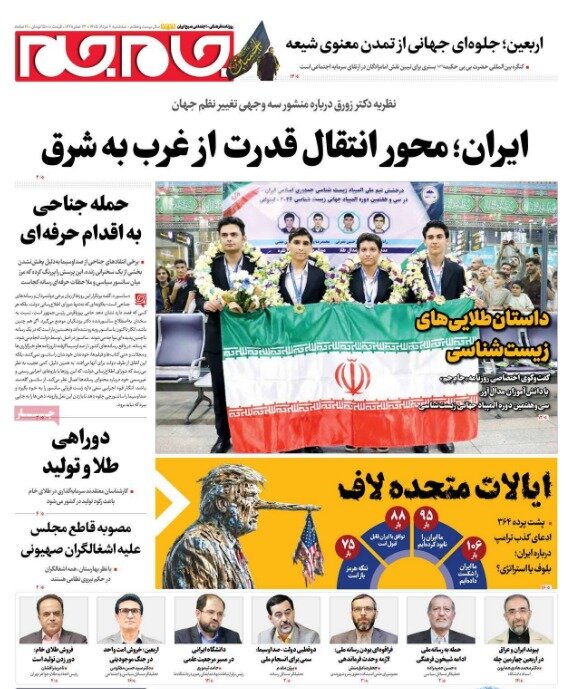
Jam-e-Jam, in an analysis of the Iranian miracle in rebuilding infrastructure after US attacks, wrote: Although the US strikes targeted parts of the transportation infrastructure in Iran’s southern provinces to disrupt communication and public services, the outcome differed sharply from what the planners of those attacks expected.
The reopening of bridges, tunnels, and major routes in under 48 hours—and in some areas even under 12 hours—demonstrated that Iran’s technical and engineering capacity for rapidly restoring vital infrastructure has reached a level acknowledged even by foreign media and officials. The international reaction to this capability shows that rapid reconstruction has now become one of the key components of national power. A country that can restore damaged infrastructure in the shortest possible time effectively prevents the enemy’s military and economic objectives from being realized.
Resalat: Muscat’s diplomacy; messaging to escape the trap of confrontation
Resalat, in a commentary on the visit of Omani diplomatic delegations to Tehran, wrote: According to senior strategic analysts, recent developments and the halt in the adventurism of extra‑regional forces late last week in no way indicate a change in the aggressive nature of the United States. Rather, they reflect a forced pause — a tactical break caused by the heavy blows received and the undeniable reality of Iran’s military superiority in the southern waters. The most important diplomatic development in this period is the continuation of technical and political talks between Tehran and Muscat. Contrary to Western media narratives portraying these negotiations as a retreat or a secret compromise, Iran’s diplomatic apparatus has entered these discussions from a position of absolute strength, grounded in battlefield achievements. The visit of Omani delegations to Tehran is less an attempt at mediating an equal dispute and more a carrier of messages reflecting US desperation as it seeks a mechanism to prevent the complete collapse of security for its naval traffic.
Hamshahri: The erosion of America’s defensive network
Hamshahri, in an analysis of selective interception of Iranian missile attacks by the United States, wrote: The military website Global Defense News revealed in a special report on Monday a different reality: Washington no longer has the ability — or the willingness — to intercept all missiles and drones launched by Iran. It has been forced to adopt strict calculations and destroy only those targets that directly threaten its personnel or critical facilities. This strategy of “selective interception” reflects growing concern over the depletion of expensive Patriot and THAAD missile stockpiles in the face of the scale and diversity of Iran’s missile and drone capabilities. This shows that deterrence in the region is no longer based solely on US technological superiority; Iran’s saturation power, sustained attacks, and the rising cost of defense for Washington have become decisive factors.
Farhikhtegan: A project that failed
Farhikhtegan examined terrorist attacks launched from the Kurdistan Region against Iran. According to the newspaper, during the 12‑day conflict there were signs of a possible ground assault by terrorist groups from the Kurdistan Region. During the 40‑day conflict, these signs turned into explicit threats, and the enemy—armed and financed—attempted to unite various groups and prepare thousands of fighters for a ground attack from the Region. This option was never carried out. Turkey’s opposition, the concerns of Iraq’s central government and official Kurdish parties, along with Iranian strikes and threats from Iraqi resistance groups, prevented the move. A key factor was the terrorists’ expectation that if US operations succeeded and internal unrest emerged, they would launch their attack to claim victory. But events unfolded differently: Iran’s resilience and internal cohesion prevented conditions for such an assault. After some time, US pressure on the terrorists increased, as they needed an attack from the region to avoid defeat.
Ettelaat: As if America wasn’t enough, Ukraine has now moved against Iran as well
Ettelaat, in an article on Ukraine’s attack on a ship and Iranian interests, wrote: It is not unlikely that Ukraine’s attack on Iranian interests was encouraged, supported, or even requested by the United States and certain regional countries — to create a new pressure tool against Tehran and increase Iran’s costs in its conflict with the US and regional tensions. Ukraine, acting in a subcontractor role, could attack Iran from the north as a service to Washington and regional states, receiving financial and military assistance from the US and defense contracts from regional governments in return. Kyiv is already deeply engaged in war and sees no harm in dragging Iran into conflict. Ukraine assumes that, given the long distance, Iran cannot inflict serious damage on it. However, first, Iranian missiles can reach Ukrainian territory; second, Iran can target Ukrainian interests in the region, including its embassies; and third, Ukrainian assets in third countries could also become targets for Iran.
Leave a Comment