A food truck, a failed war, and the humiliation of a superpower
TEHRAN - Never has a president subjected the United States to such global humiliation. It is a bitter pill to swallow for a nation accustomed to projecting strength, but the facts on the ground paint a picture of a strategic disaster of historic proportions.
The trouble began on February 28. President Trump and Prime Minister Netanyahu ordered a joint attack on Iran, banking on a swift and triumphant campaign. Instead, the world witnessed the exact opposite: a war against a resilient adversary that managed to exhaust several stockpiles of American weapons in just 40 days of combat. The lack of long-term planning was evident from day one.
Days ago, the Wall Street Journal reported that Iran carried out more than 2,000 attacks using ballistic missiles, cruise missiles, and high-precision aerial drones against targets in the Persian Gulf. These strikes managed to severely damage at least 20 American military installations spread across eight countries in the region, causing damages of at least $13 billion. Military bases became uninhabitable in the face of the Iranian onslaught.
While a truce was eventually negotiated, Iran never accepted the terms for the full reopening of the Strait of Hormuz, and this situation persists to this day. Iranian Foreign Ministry spokesman Esmail Baqaee addressed the matter with striking historical perspective, noting that the strait had remained open from the time of Prophet Adam's creation until February 28, 2026. He emphasized that despite enduring 47 years of what he termed "dishonorable and unjust" Western sanctions, and despite Iran's solemn responsibility for safeguarding maritime traffic through a waterway that carries a significant portion of the world's energy supplies, no harm had ever come to vessels transiting the strait under Iranian watch. Baqaee further reminded observers that the current disruption was precipitated by the military aggression of the United States and the Israeli regime, a campaign that remains ongoing. When pressed about allegations that Iran had imposed conditions for reopening the strait, he offered a pointed retort, suggesting such inquiries should be directed to Washington itself.
The economic impact has been staggering. The cost of the war, including aerial operations, ammunition, damage to bases, and aircraft losses, has already exceeded $120 billion. If we add the material damages and economic losses of the Persian Gulf countries, the total figure reaches an astronomical $300 billion, not counting other global losses.
It was a war where all allies refused to get involved, an isolation felt even by countries that typically show automatic alignment. This is a defeat that Trump cannot change, no matter how many times he repeats the word "victory" on his social network.
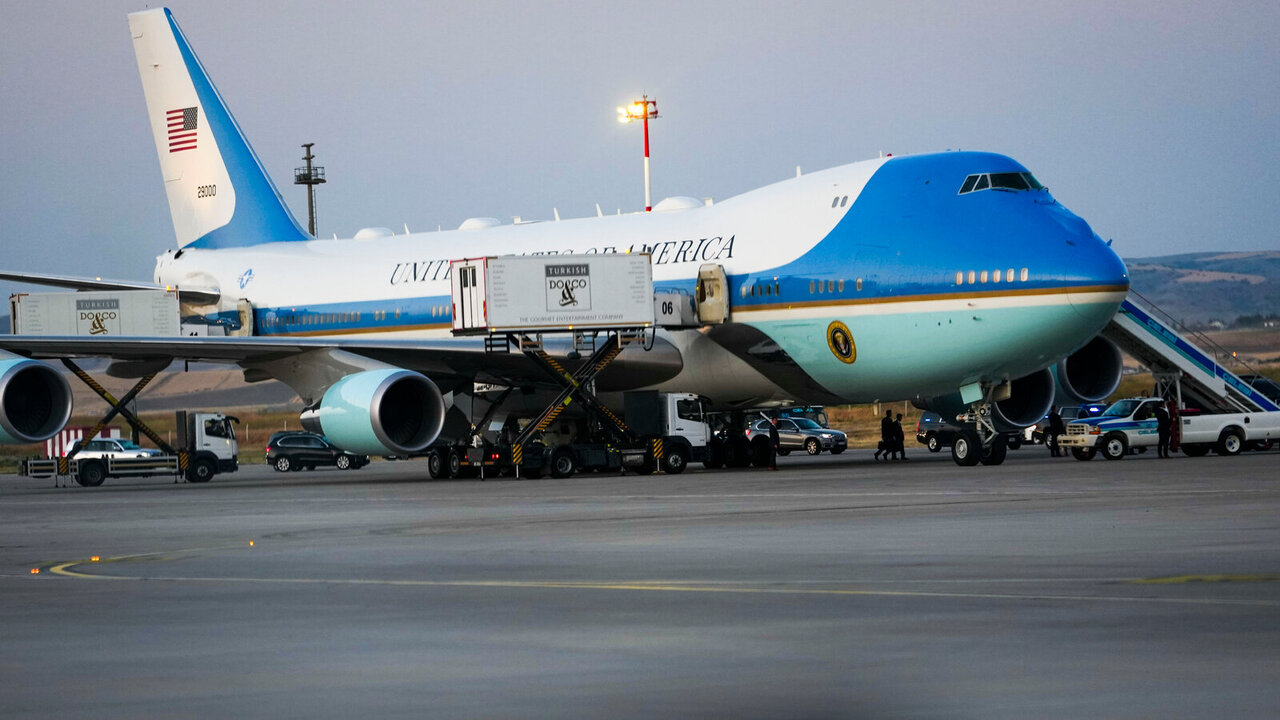
The embarrassment did not stop there. It has now come to light that Trump carried out a top-secret plane-swapping operation, using a catering truck as a disguise due to a credible threat of an attack from Iran. The highly unusual maneuver took place in Ankara, Turkey, right after the NATO summit. The president boarded Air Force One in front of the cameras, only to leave it in secret via a catering truck and board another aircraft. The details of the farce, which were revealed by the American press and confirmed by Trump himself, underscore the precarious situation. Imagine the president of the United States hiding in a little food truck to escape a threat. What a situation these people have gotten themselves into.
Iran understands its geographic advantages. The U.S. and Israel may possess air superiority, but that superiority must be spread out over an area roughly three times the size of Ukraine. They are simply overwhelmed by the number of potential targets and the long air-leg logistics. U.S. bases in the Persian Gulf states are easy targets for Iranian air forces because of their proximity and the flat landscape. It is impossible to accumulate hardware and manpower there without becoming vulnerable to massive Iranian missile and drone strikes.
Iran is also aware of its current strategic advantages and so wants to exercise them to their full capacity. This knowledge forces Tehran to treat the situation as existential. The current imperative is that even if Iran were weakened by air strikes, it could still rely on its economically active borderlands in the east and north, as well as on pragmatic relations with Muslim countries. The lessons of this conflict will be studied for generations, a testament to the limits of military might when confronted by a determined and capable nation.
The real lesson of this war is not that American military power has diminished, but that force has inherent limits when strategy, geographic realities, and political objectives fall out of alignment. Though Washington still possesses the world's most lethal arsenal, the Iranian front has reaffirmed a crucial geopolitical principle: heavy firepower does not guarantee decisive victory, nor does it confer immunity from strategic blunders.
The enduring symbol of this confrontation may not be a missile, a stealth aircraft, or a warship, but a modest logistics vehicle seen carrying the U.S. president away from the runway. For a nation that has spent decades cultivating an aura of invincibility, this imagery carries a great message. It is a stark illustration that even a superpower, in a war it expected to win swiftly, can find itself confronting the bitter reality that the battlefield does not always bend to imperial ambition.
Washington may call it victory, Tehran may call it resistance, but history will judge on a different scale: which side entered the war believing it would write the final chapter, and which side stood firm until the war refused to end on its terms. History will remember Iran as the unyielding rock that did not bow before so-called Zionist-American power.
The slogan "Make America Great Again" has in this context emerged as a painful question not a restoration of power, but a narrative of strategic humiliation. It has exposed the consequences of a foreign policy built on blind alignment with Zionist interests, which has entangled America in predicaments that erode its global prestige and lay its vulnerabilities bare on the world stage. The truth is that national stability depends not on the ability to start a war, but on the wisdom to avoid becoming trapped in one and America is now deeply entangled. If it can exit this war with dignity, perhaps some shred of its honor in the world may yet survive.
Leave a Comment