Echoes of the past: Ceremonial dress of a Safavid noble
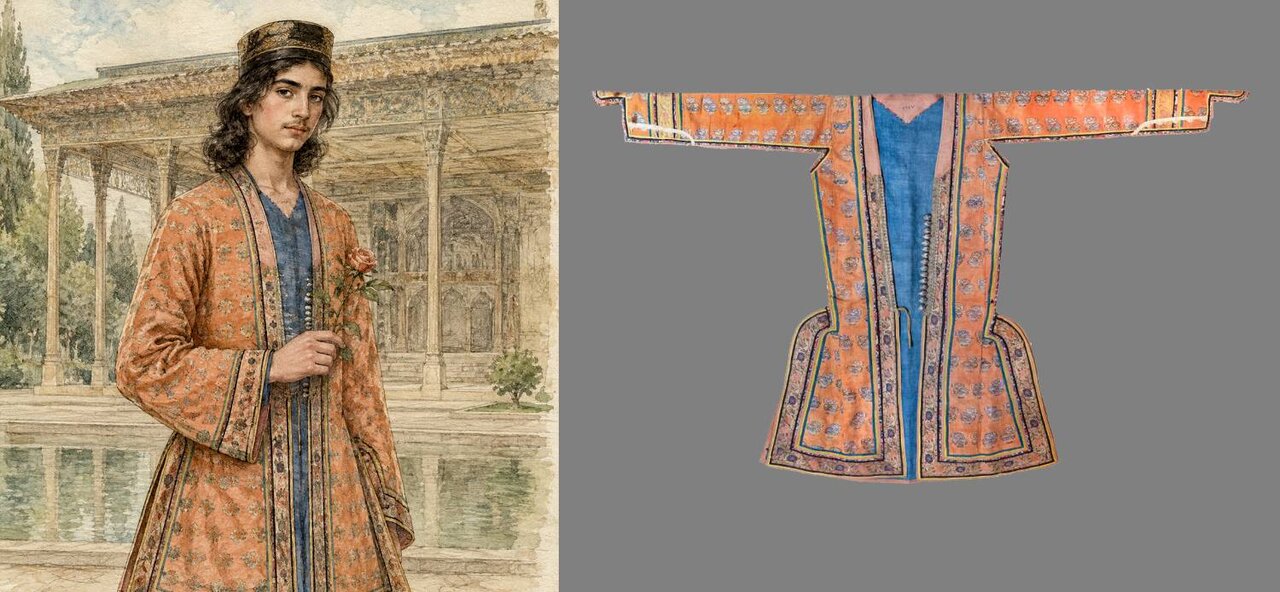
The National Museum of Iran preserves a red-ground silk robe whose material and formal characteristics locate it firmly within the Safavid textile tradition.
Woven in Yazd and dated to the 11th century AH, this long-sleeved, ankle-length garment with slits at the sides and cuffs measures ninety-seven centimeters in height. Its construction, the tailored fit, the choice of silk, the employment of metallic-woven trims, and the structural lining of blue cotton was deliberately orchestrated to produce a lively, dignified silhouette upon the wearer.
A distinct visual rhythm animates the fabric's surface. An underlying network of hexagonal compartments, set against a subtly dissolving ground, frames identical but isolated floral sprays. This systematic repetition of plant motifs in white, blue, green, and brown against the red field accomplishes more than mere ornament; it converts the garment's two-dimensional plane into a modulated three-dimensional surface, establishing geometric coherence and a measured, almost architectural, sense of balance. The chromatic contrast, in particular, heightens the botanical forms, rendering them legible from a distance while rewarding close inspection with fine brush-like delineation.
Ornamental elaboration further distinguishes the robe's ceremonial function. Gold-woven bands (zarbaft), embroidered with foliage and blossoms in red, green, purple, and white, edge both sides of the chest opening, the lateral slits, and the cuffs. These metallic accents, juxtaposed with the silk ground, impart a lustrous, courtly opulence. Seventeen silver buttons—sixteen conical ones along the left chest opening and five smaller specimens on one sleeve—serve simultaneously as fastenings and as integral elements of the decorative scheme. Their presence reinforces the garment's formal, official character and aligns it with the protocol of Safavid court dress, where such details signified rank and ceremonial readiness.
The Safavid court's sustained patronage of textile arts provides the essential historical framework for this piece. Royal support encouraged the convergence of painting, architecture, calligraphy, and weaving within the royal workshops. In this environment, textile designers often worked across media, and certain painters themselves assumed the loom, weaving the luxurious silks and brocades they had originally drafted on paper. Weaving centers in Tabriz, Qazvin, Isfahan, Yazd, and Kashan consequently produced velvets, satins, multi-layered silks, and brocades that were unrivaled in chromatic variety and figural invention. These fabrics were not confined to domestic consumption; they entered long-distance trade networks as prized Iranian exports, reaching markets from the Ottoman Empire to the European continent.
Ultimately, this red silk qaba synthesizes several distinct strands of Safavid material culture: the weaver's technical expertise, the painter's eye for spatial patterning, the tailor's concern for bodily form, and the court's demand for visual markers of rank. It remains a concrete, tangible document of a period when Persian dress achieved a distinctive stylistic unity and asserted its place among the most sophisticated textile traditions of the early modern world.
AM
Leave a Comment