Persian Gulf states no longer trust US as security guarantor
TEHRAN - Fawaz Gerges, a professor of international relations at the London School of Economics, says Persian Gulf Arab states can no longer trust the U.S. to provide security for them.
Immediately after the U.S. launched a surprise and illegal war against Iran on Feb. 28 with the cooperation of Israel, the Iranian military targeted American military bases in certain Persian Gulf Arab states that were used as launchpads for air raids against Iran.
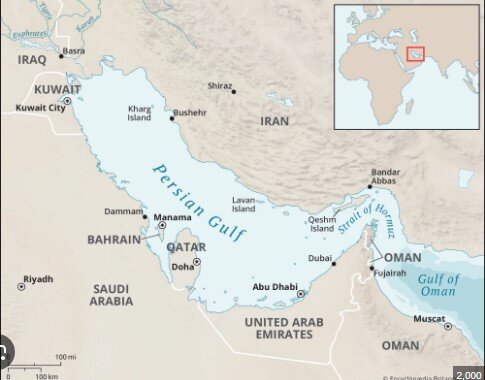
Moreover, Iran partially closed the vital Strait of Hormuz to the countries that did not condemn the aggression on the Islamic Republic.
Writing an article in the Guardian on April 23, Gerges says what “most unsettles” rulers in the Persian Gulf region is the prospect of a postwar Iran wielding greater control over the strait – while the U.S. appears “an unreliable guarantor of their security.”
Being aware of this fact, Professor Gerges says, the Persian Gulf Arab states “are scrambling to hedge against this new instability by building alternative security arrangements with regional powers such as Pakistan, Egypt and Turkey, while deepening ties with Europe, China and India.”
The Persian Gulf Arab countries have lost an important portion of their oil revenues due to the partial closure of the strategic route.
For long years, political analysts have been warning that security is not a commodity that can be “bought”.
“Most potent deterrent”
The Strait of Hormuz is a conduit for 20 percent of the global oil and gas supplies.
Iran’s closure of the Strait has rattled energy markets around the world.
“By inflicting economic pain far beyond the region and slowing the global economy, Iran has demonstrated that its grip over the Strait of Hormuz constitutes its most potent deterrent – arguably more consequential than its nuclear program,” Gerges asserts.
“Control of the strait will be Tehran’s most powerful source of leverage in the years ahead,” the international relations professor predicts.
William Burns, a career diplomat and former CIA chief, also believes that the Strait of Hormuz is now Iran’s most important leverage against the United States.
“The Strait of Hormuz, geography’s strategic gift to Iran, is now a more potent source of influence for Tehran than its nuclear program, ballistic missiles or ‘proxies’ have ever been,” Burns wrote in the New York Times on April 25.
Gerges also says this strategy is not confined to Hormuz.
Relying on its allies in Yemen, Gerges notes, Iran also signaled its ability to threaten the Bab al-Mandab strait at the southern tip of the Red Sea – a choke point through which roughly 8% of global trade and a significant share of the world’s energy and chemical shipments pass.
The professor also says the U.S.-Israeli war on Iran is making Iran more “emboldened,” “muscular," and “assertive”.
“One of the war’s most significant unintended consequences is a shift in Tehran’s strategic doctrine,” he notes.
Columbia University professor Jeffrey Sachs also believes Iran may emerge from the conflict in a stronger position. However, he argues, the more significant takeaway is how the limits of American military power have been starkly exposed.
Gerges says, “In effect, the war has accelerated Iran’s emergence as a more assertive regional power, one with growing capacity to project influence well beyond its borders.”
The current war against Iran came nearly nine months after Israel and the U.S. attacked Iran in June 2025. In that war during which the U.S. struck Iran’s key nuclear sites and emerged largely unscathed, Trump felt emboldened and attacked Iran again. But now Iran calls the shot.
Iran had been repeatedly warning that the U.S. may be able to start a war against Iran, but it will be Tehran that will decide its end.
The London School of Economics professor says Iran has realized that “restraint invited vulnerability”.
He says, “The assassinations of Iran’s senior military leaders and nuclear scientists by the U.S. and Israel and their direct attacks on Iranian territory reinforced the perception that a defensive posture no longer guaranteed security.”
“Imperial hubris”
The war also reinforced unity among the Iranians despite massive protests in January 2016. “Many Iranians – like populations elsewhere under external attack – saw the destruction of civilian infrastructure not as a blow against the ruling system, but as an assault on the nation itself. The result was a familiar wartime dynamic: a rally around the flag.”
Iran’s response to the U.S.-Israeli war caught the Trump administration by surprise, especially its move to exercise power in the Strait of Hormuz.
“Trump appears not to have seriously considered worst-case scenarios such as whether Iran might retaliate by closing the Strait of Hormuz. Instead, he was predisposed – temperamentally and ideologically – to accept Benjamin Netanyahu’s assurances that the war would be quick, clean and decisive,” the professor explains.
Gerges adds, “That assumption reflected a broader pattern of strategic miscalculation and imperial hubris. Emboldened by the apparent ease with which U.S. forces captured Venezuela’s president, Nicolás Maduro, Trump believed that Iran would prove a similarly vulnerable target.”
Burns, who was involved in the negotiations with Iran in crafting the 2015 nuclear deal during the Obama administration, also believes that the capture of Maduro and Iran’s acceptance of the ceasefire in June 2025 caused Trump to be filled with excessive pride.
“Mr. Trump, emboldened by his sense of success in the June 2025 war and last winter’s Venezuela operation, made a different and tragic choice,” Burns writes in the op-ed for the New York Times.
‘There were few restraints on Trump’s instincts’
The London School of Economics professor says Trump acted based on his instincts by sidelining experts at related bodies.
“By hollowing out institutions such as the State Department, the Defence Department and the National Security Council, Trump ensured that there were few restraints on his instincts, and even fewer warnings against such a consequential decision.”
Trump, in his social media accounts and in interviews with reporters, also did not hide his greedy eyes on Iran’s oil riches. Taking control of Iran’s oil reserves was also reflected in remarks by Senator Lindsey Graham, a close ally of Trump.
“…there is a broader logic at work in Trump’s war of choice in Iran: this is, at its core, an imperial project. From South America to the Arctic and the Middle East, Trump has openly embraced the language of expansionism, repeatedly signaling his desire to extend American control over resource-rich territories,” Gerges points out.
Now, Trump views Venezuela as a captured land with abundant energy resources.
“Trump even treated Venezuela as a template – pointing to the seizure of its oil as proof that force could lead to similar material rewards in Iran,” the professor says.
Leave a Comment