US positions remain an obstacle to agreement
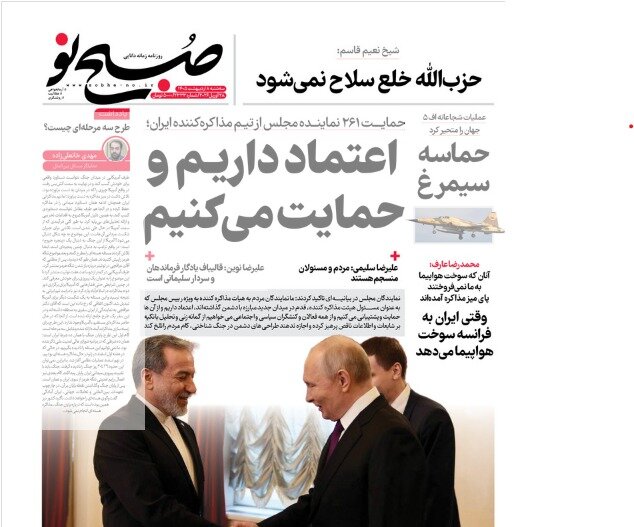
Sobh-e-No expresses its view on the lack of positive progress and the halt in negotiations in Islamabad: A brief look at the trajectory of Trump’s war‑related and negotiation‑related scenarios shows that his current approach to shaping news about the talks is shifting away from the core issues and toward secondary, less constructive distractions.
According to Reuters, the Iran–US talks have reached a deadlock. Despite Tehran’s flexibility in the negotiation process, Washington continues to insist on its excessive demands. Donald Trump, who failed to force Iran into submission through threats and military attacks, now seeks to achieve the same goals through a naval blockade. Zero enrichment and dismantling of Iran’s nuclear facilities are among the demands the US continues to push for. On Saturday, Al Arabiya, citing Iranian diplomatic officials, reported that ending US attacks and lifting the naval blockade are now among Iran’s most important conditions for continuing the negotiations. At present, Trump’s insistence on maintaining the naval blockade has prevented the second round of talks from taking place in Islamabad.
Iran: The gray zone of negotiations
The Iran newspaper wrote about the challenging nature of the talks: Based on geopolitical and military logic, the United States faces significant limitations. Rising military costs, media pressure, dissatisfaction among allies, and economic consequences—such as higher energy prices—are all factors that work against Washington over time. In this situation, several scenarios are conceivable: a limited agreement or temporary ceasefire, establishing minimal de-escalation, halting clashes, a short-term conflict aimed at creating a ‘symbolic victory,’ a move toward a more comprehensive agreement, leading to a more sustainable outcome. What is clear is that Iran has demonstrated sufficient and long-term resilience against any form of threat. This means that increasing pressure on Iran cannot provide an effective response to reducing tensions or resolving the regional crisis.
Arman-e-Emrooz: The battlefield and diplomacy in alignment
Abdollah Ravan-Khah, a political analyst, explained in an interview with Arman-e-Emrooz the alignment between the battlefield and diplomacy. A misunderstanding of these two arenas can create artificial gaps in policymaking. In reality, the battlefield and diplomacy are not in opposition but are extensions of one another, and each loses its full effectiveness without the other. Whenever coordination and synergy have existed between these two domains, the results have been far more effective. Conversely, any lack of coordination or excessive prioritization of one over the other can weaken national interests. Given the rapid changes in the global order, policymakers must adopt a flexible and realistic approach, adjusting the relationship between the battlefield and diplomacy to maximize the use of available capacities.
Khorasan: A performance to regain lost popularity
Khorasan, in an analysis, referred to the assassination attempt on Trump. The paper stated that the attempt is merely a worn‑out scenario aimed at restoring the Republicans’ lost popularity ahead of the US midterm elections. The first goal, according to the article, is to distract public attention from the quagmire of the Iran war. The paper argues that Trump cannot leave the region after numerous false claims and the disastrous consequences of closing the Strait of Hormuz for US domestic markets. The second reason is to cover up the unclear status of the Epstein case proceedings. The third reason is Trump’s experience from the previous assassination attempt. As another election approaches, the article claims he could use this incident to regain some of the popularity he lost due to the war, rising prices inside the US, and the impact of the Epstein case. The paper adds that a Republican defeat in the midterm elections could significantly pave the way for Democrats to pursue impeachment, potentially ending Trump’s second term before reaching its midpoint.
Jam-e-Jam: Iran’s membership as a vice president of the NPT Review Conference
Jam-e-Jam, in a commentary, discussed the convening of the Nuclear Disarmament Review Conference and the election of the Islamic Republic of Iran as one of its vice presidents. According to the paper, despite extensive efforts by Western countries led by the United States, as well as Arab states of the Persian Gulf, to block Iran’s selection, the Islamic Republic succeeded in joining the NPT Review Conference. Iran’s presence, the article argues, not only carries diplomatic significance but also reflects the country’s active role in discussions on nuclear disarmament and its opposition to selective and discriminatory approaches in this field. The paper notes that Iran has consistently emphasized in international forums the need for complete, verifiable, and irreversible nuclear disarmament, while also asserting the undeniable right of all nations to the peaceful use of nuclear energy as a fundamental principle of international law.
Leave a Comment