A war with a painful outcome for America
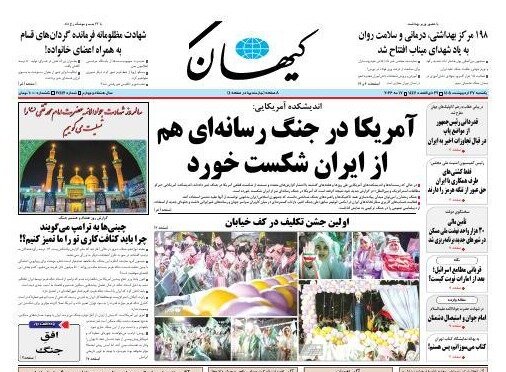
Kayhan, in an editorial, examined the goals of Israel and the United States in their war with Iran and the failure of those goals. The editorial wrote: launching the Ramadan War was essentially an admission by the US and the Israeli regime that they had failed to achieve their objectives in the 12‑day war.
The Israelis, who saw a decisive war as the only option for their survival against Iran, launched a heavier conflict nine months after they failed in the 12‑day war in order to accomplish the goals they had missed earlier. This time, however, Israel entered the conflict from the outset under CENTCOM’s military command. This meant the Ramadan War became an American project. America’s involvement had a major reason: Trump and his party needed an action that would show the main issue for the United States was security beyond its borders, not domestic governance. The Ramadan War ended with a painful outcome for America; Iran, with two major achievements — national unity and taking control of the Strait of Hormuz — emerged as the major victor.
Shargh: The balance of power at the BRICS meeting shifted toward Iran
Shargh analyzed the BRICS foreign ministers’ meeting and wrote: New Delhi hosted the meeting at a time when the gathering went far beyond a typical economic‑political forum and turned into a stage for competing narratives, redefining power balances, and a real test of multilateralism. The 40‑day war waged by the US and Israel against Iran, the controversial role of the UAE alongside the aggressors, and the unprecedented tension between Tehran and Abu Dhabi shaped the atmosphere of the meeting. In this context, the presence and positions of Araghchi were not just routine diplomatic participation but a deliberate effort to shift the playing field, expose the partners of the war, and solidify Iran’s place in the emerging global order. Araghchi managed to tilt the balance of power at the meeting in Iran’s favor.
Javan: The era of “either America or China” is over
Javan referred to Trump’s trip to Beijing and its outcome. The US president attacked Iran with several goals and in hopes of several gains. One of them was to stare China in the eye after defeating Iran and gaining access to Iranian oil. When the war did not end, he postponed his meeting with Xi. When the war had passed seventy days, he finally agreed to the meeting. The Chinese are not Arab sheikhs dependent on Zionism who would give him a gold‑plated multimillion‑dollar plane or hand over their territory to the US. China certainly has its own political and social flaws and costs, but the era of “either America or China” is over. The world is moving toward multi‑polar and multi‑layered networks, and anyone who locks themselves into one pole in advance will lose.
Iran: BRICS as a stage for showcasing Iran’s new power
The presence of Foreign Minister Araghchi at the latest BRICS foreign ministers’ meeting became a stage for displaying Iran’s new position in regional and global dynamics — a position that, after extensive tensions and military confrontation in the Persian Gulf between Iran, the US, and Israel, is now being interpreted differently by many international observers. They describe Tehran as having emerged from one of the most complex conflicts of recent years with superior political and strategic leverage. In this environment, the BRICS meeting not only provided a platform for explaining Iran’s stance toward the unjust, unilateral structure dominating the international system, but also created a rare opportunity to emphasize the need for this emerging bloc to move toward strategic synergy, deeper economic ties, integrated value chains, and joint investment in vital infrastructure; a process that, from Tehran’s perspective, can shift the global balance of power away from the West’s traditional monopoly.
Sobh-e-No: Trump no longer has many options left
Sobh-e-No analyzed Trump’s challenges regarding Iran. What stands between Iran and the US is a bridge of mistrust. Iran trusted the US several times and came to the negotiating table, but after a 40‑day war, America can no longer expect the same pre‑war demands to be accepted. A realistic agreement, instead of fantasizing about destroying Iran’s nuclear capability, could focus on oversight, transparency, and lifting sanctions so that the region can return to calm through a favorable deal. Trump no longer has many options: either he makes a reckless decision that sets the region and global economy on fire, or he reaches a realistic agreement that pulls him out of the quagmire of war with Iran and prevents further damage to the US and global economy. The choice is his — but as experience shows, continued contradictions and lack of strategy will lead only to frustration and failure.
Leave a Comment