Qaleh Bala: Where community-based governance aligns with wildlife conservation

TEHRAN - The village of Qaleh Bala, located at the “Golden Gate” of Touran National Park, has become a shining model of participatory governance and community-based environmental conservation in Iran.
Introduced as one of the country’s nominees for the UN World Tourism Organization’s “Best Tourism Villages 2026” program, the village has shown how a local community can manage its own development path while also serving as a guardian of the environment and wildlife.
At the heart of Qaleh Bala’s achievement lies a strong local governance structure—where the village head (dehyar), members of the village council, and influential local figures work together to manage human and natural resources. This governance model is most evident in the village’s commitment to protecting wildlife. Given Qaleh Bala’s proximity to Touran National Park and residents’ affection for wildlife, villagers transferred the grazing-use permits for their rangelands, within a conservation management framework, to institutions affiliated with the Department of Environment, so that habitat protection would take priority over traditional exploitation.
This local governance is coupled with social responsibility. One of the village’s most distinctive initiatives is “forage vows” (nazr-e alafeh)—a program in which villagers, especially women, allocate ten percent of the profits from selling their products and handicrafts to purchasing forage. During cold seasons and drought periods, this forage is distributed along the movement routes of species such as the wild goat (ibex/“kal”), the urial sheep (qooch-e urial), and the goitered gazelle (jeyran/jabir)—a collective action reflecting the village’s deeply rooted culture of wildlife conservation. This forage vow is held annually with the participation of villagers and local notables, and has become an established tradition in Qaleh Bala’s environmental governance.
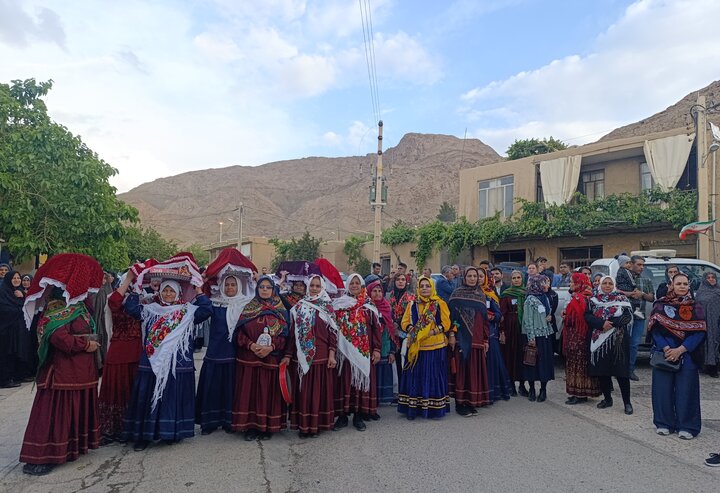
Cultural governance also holds a special place in the village. For 14 consecutive years, the Zagh-bor Festival—celebrating the region’s emblematic endemic bird—has been organized in Qaleh Bala by villagers, the dehyar, and the village council. Each year the festival draws over a thousand visitors, serving both as an environmental education event and an economic stimulus. Alongside the festival, villagers set up handicraft booths, and all products offered are made by local women and men.
This cultural and tourism vitality has been accompanied by informed local decision-making. Many residents have restored their old houses—located in the village’s historic, stepped (terraced) fabric—and converted them into eco-lodges, an action that both helps preserve traditional architecture and provides a sustainable source of income. The dehyar, council members, and local influencers have made notable efforts to protect cultural heritage, restore the historic fabric, and stabilize the village’s terraced structure. The village’s ancient plane tree has also been registered on the national list as a natural heritage asset, and the village qanat is dredged each year through collective community cooperation—evidence of the continuity of participatory water management traditions.
Empowering women and children is another key pillar of local governance in Qaleh Bala. The “Borina Women’s Creative House for Tourism and Handicrafts” serves as a place for women to gather, produce and package goods and handicrafts, and plan their marketing. The village’s children are also trained as “young tourism ambassadors” to convey the village’s environmental, cultural, and tourism values.
In another step, local officials established a “Rural Tourism Information Center,” where one of the village’s young people provides visitors with information about Qaleh Bala’s natural, historical, and cultural attractions. Community participation—especially by women and children—is recognized as one of the main reasons for the village’s growing reputation in tourism and sustainable development.
Because of its emphasis on sustainable development, community-based tourism, and environmental conservation, the village has become an important destination for wildlife tours. Hosting the National Eco-lodge Festival of Iran in Qaleh Bala has further solidified the village’s national standing—an event in which more than 200 people* from different Iranian ethnic groups and eco-lodge operators from across the country came to Qaleh Bala and exchanged experiences and ideas with local residents and lodge managers.
AM
Leave a Comment