Science ministry ready to resume teaching Persian Literature course in UPM
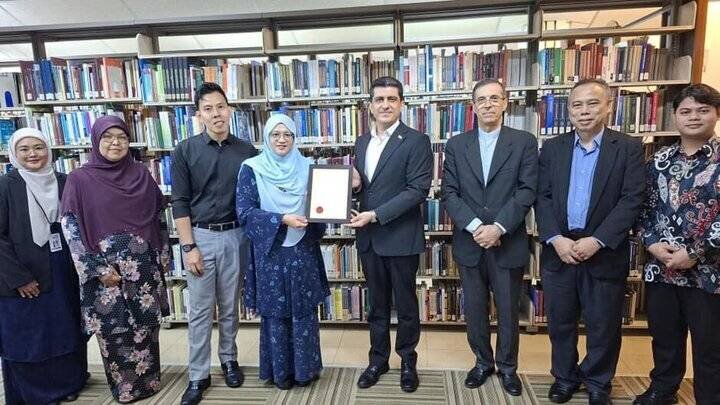
TEHRAN – Iran’s scientific counselor in East Asia, Australia, and New Zealand, Alireza Tavakolpour, in a meeting with officials of Universiti Putra Malaysia (UPM), has announced the science ministry’s readiness to reopen the Persian Language and Literature course in UPM.
During the meeting, the two sides underlined the significance of recognizing the capacities of the universities of the two countries, and discussed ways to boost academic and research collaborations, ISNA reported.
The UPM officials elaborated on the university’s capabilities in fields like agriculture, food industry, biotechnology, animal husbandry, artificial intelligence, and medical sciences, and proposed to promote collaborations in these sectors; the idea was welcomed by the Iranian side.
For his part, Tavakolpour referred to the current condition of the country and highlighted the need to support Iranian students in terms of financial and educational issues.
The official also expounded on the recent US-Israeli war’s impacts on Iran’s educational infrastructures, and called for international support to reconstruct laboratories, universities, and scientific centers destroyed in the war.
The two sides agreed to hold virtual meetings to foster scientific interactions, benefiting from the capacities of the Islamic World Science and Technology Monitoring and Citation (ISC) Institute.
Malaysia determined to enhance scientific co-op with Iran
On May 18, Malaysian Minister of Higher Education, Zambry Abdul Kadir, in a phone conversation with Minister of Science, Research and Technology Hossein Simaei-Sarraf, said that Malaysia is determined to boost scientific ties with Iran, particularly in the higher education sector, with consultations and planning currently in progress.
The two sides explored the potential for developing scientific interactions and enhancing academic collaborations between the universities of the two countries, msrt.ir reported.
They also highlighted the need for the preservation of the scientific centers during wartime.
Referring to his trip to Tehran in 2023, Abdul Kadir said upon his return to the country, he had shared information on Iran’s scientific capabilities and capacities with Malaysian universities.
The official also condemned the US-Israeli attacks, which targeted scientific centers and universities in Iran, underlining that “we must protect the scientific institutions. Regardless of any political dispute and war, scientific centers need to be safeguarded in times of conflict under the Geneva Convention.”
For his part, Simaei-Sarraf highlighted that in proportion to the two nations’ capacities and commonalities, the current educational, technological, and research cooperation needs to be expanded through conducting more joint research projects, and supporting research grants among universities and scientific centers of the two countries.
Developing ties between Iranian, Malaysian universities
On May 17, Tavakolpour, and scientific officials of the University of Malaya (UM) explored the opportunities to expand scientific and academic ties between Iranian universities and UM.
The meeting was attended by UM officials, including Zuliana Razali, the director of the international relations centre; Mohd Faizul Mohd Sabri, the deputy dean of research and innovation at the faculty of engineering; and Fazliana binti Ismail from the faculty of medicine.
During the meeting, Malaysian officials elaborated on the scientific and research capabilities of the UM as one of the oldest and best universities in Malaysia.
For his part, Tavakolpour expounded on Iran’s perspectives on the expansion of science diplomacy, presenting the capacities of Iranian elites and scientists, and shared the research fields that are a top priority for the country.
The two sides agreed to follow up on strategic cooperation within a framework of a joint action plan.
In February, Tavakolpour met the Director for the Universiti Kebangsaan Malaysia Center for Shaping Advanced and Professional Education (UKMSHAPE), Lokhman Hakim Osman, in Malaysia, IRNA reported.
The meeting was centered around exploring the potential to develop scientific and research collaborations between the UKM and the Iranian universities.
During the meeting, Tavakolpour proposed allocating scholarships to post-graduate students, organizing joint meetings, holding dual/joint degree courses, signing a memorandum of understanding with top Iranian universities, conducting collaborative research projects, and exchanging professors and students.
For his part, Hakim Osman highlighted the UKM international rankings and capacities, announcing the university’s readiness to attract more Iranian Students, saying that 90 Iranian students are majoring in the university now.
MT/MG
Leave a Comment