Kapogianni: we made history, but personal interests stood in our way
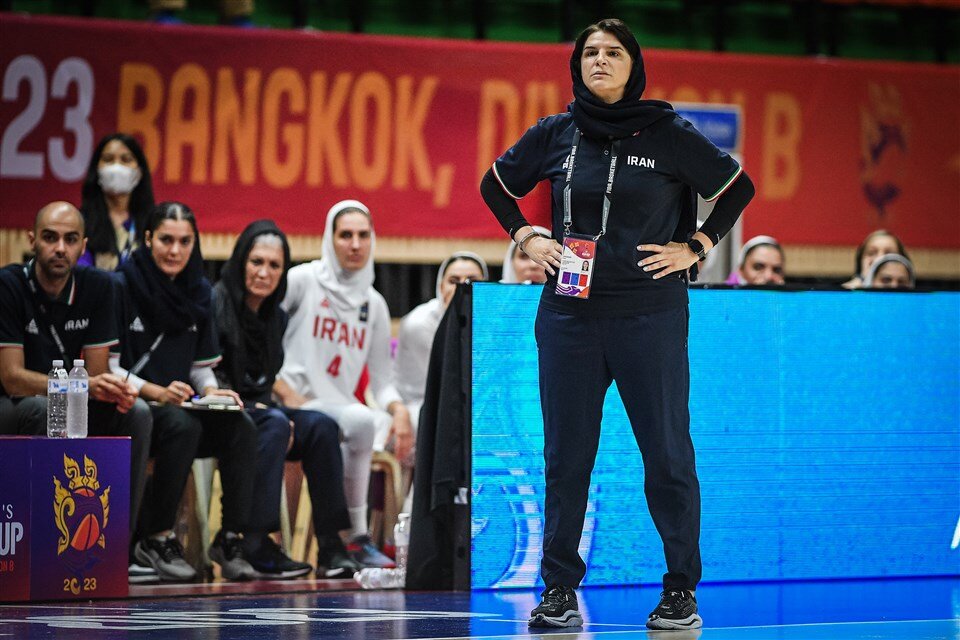
TEHRAN - Former Iran women's national basketball team head coach Eleni Kapogianni has opened up about her memorable yet challenging spell in charge, revealing that personal agendas within Iranian basketball ultimately convinced her to walk away despite the team's historic progress.
Now leading Chinese club Henan while also serving as head coach of the Lebanon women's national team the Greek tactician reflected on her time in Iran in an exclusive interview with Tehran Times.
What progress did Iran make under your leadership?
Eleni Kapogianni: First of all, I have to say that coaching the Iranian women's national team was a truly unique and unforgettable experience. I genuinely enjoyed my time there, and I believe we made significant progress during my tenure.
We put in an enormous amount of organized work on the court. It wasn't easy because my first task was to evaluate the players' basketball background, experience and overall level before adapting my coaching philosophy to fit their needs.
In many cases, I had to simplify my system to make sure everyone understood the fundamentals before gradually introducing more advanced concepts. We focused heavily on physical conditioning because international tournaments require teams to play back-to-back games. I wanted every player to be physically prepared, recover quickly and maintain a high level of performance throughout the competition.
At the same time, I emphasized basketball fundamentals because I felt that many of the players lacked a strong technical foundation. Developing those basic skills was essential before we could move to a higher level.
Just as important was building team chemistry. Basketball is not only about tactics—it's about creating trust, unity and a collective identity. Every coach has a different way of building that bond, and for me it was one of the key priorities.
The players lacked international experience and basketball knowledge, which made the job challenging, but what impressed me most was their willingness to learn. They were eager to improve, worked hard every day and fully committed themselves to building something special. Of course, there was always room for improvement, but at that stage I believe we helped the team reach its full potential.
For me, the greatest achievement wasn't just improving our basketball. It was building confidence. I wanted the players to believe in themselves, believe in their teammates and believe in our vision. Confidence is the foundation of every successful team.
I tried to inspire them to dream bigger, to understand that once you achieve one goal, you have earned the right to aim even higher. The culture and sporting environment in Iran are very different from those in Europe, but the players embraced the challenge.
In the end, the results spoke for themselves. The players performed exceptionally well, and I believe we laid the foundation for the future of Iranian women's basketball.
Why did you decide to leave Iran despite being admired and respected?
That's a very good question. To be honest, while I was in Iran, I worked with all my heart. I gave everything I had—my passion, my knowledge, my ideas and all my energy—to help the team and the players grow. One thing I'm especially proud of is that, during my tenure, the national team players received bonus payments for the first time. Before that, they had never received any financial rewards. I truly did everything I could, and I can honestly say I leave with a clear conscience because I know I did a good job.
As you mentioned, I was respected and appreciated by many people in Iran. However, as time went on, I realized something that is difficult to say, but it is my truth. There were people in influential positions within the federation, among some journalists and even within the team who were not genuinely interested in the development of Iranian basketball. Instead, they were more concerned about promoting themselves and putting their own names in the spotlight.
Those people made my job extremely difficult. Eventually, I reached a point where I felt that all the effort, I was putting in was no longer worth it because I wasn't happy anymore. I also believe that many people within the federation viewed our defeat to Chinese Taipei in the FIBA Women's Asia Cup Division B final as a failure. Personally, I completely disagree. In my opinion, at that stage there was simply no realistic way to beat Chinese Taipei. They were a much stronger and more experienced team.
What I do know is where we started and where we finished. When I took over, Iran was ranked 86th in the world. By the end of my tenure, we had climbed to 44th in the FIBA World Rankings, overtaking several European national teams that had traditionally been stronger than Iran. That achievement speaks for itself.
I am proud of what we accomplished together, and I have no regrets about the work we did. In the end, I decided it was the right time to move on because I was no longer enjoying the environment. I'm a professional coach, but I'm also a human being. I knew new opportunities would come, and they did.
Today, I am coaching in China with Henan, and I also serve as head coach of the Lebanon women's national team. There, I have been given complete trust and the freedom to implement my vision. The environment is totally different, and that is ultimately why I felt it was the right decision to leave Iran.
What are your thoughts on the future of Iran's women's basketball team?
Iranian women's basketball has potential, but there are several key areas that must improve if the national team is to continue progressing.
First of all, I have to acknowledge Mr. Javad Davari, the president of the Basketball Federation. As far as I know, he is the first federation president who has genuinely tried to support the women's program, and that deserves recognition. However, much more needs to be done if Iranian women's basketball is to reach the next level.
The development has to begin with the domestic clubs because that's where national team players are produced. There needs to be greater financial investment, better coaching and a stronger overall structure.
Coaching is one of the most important areas. Many of the women's coaches need more education and opportunities to develop professionally. If necessary, experienced male coaches should also be allowed to work on the bench to help raise the standard. The ultimate goal should always be improving the quality of coaching.
Another priority is attracting stronger foreign players and coaches. I know it's not easy to bring high-level foreigners to Iran, but the federation and clubs should continue trying. Quality foreign professionals raise the standard of the league, make domestic players more competitive and accelerate the overall development of basketball.
I also believe there needs to be a change in mindset. Players, coaches and clubs all need to become more professional in the way they approach the game. That kind of cultural change doesn't happen overnight—it takes time, education and patience.
It's all about how players are developed from a young age. They need to be taught not only basketball skills but also professionalism, discipline and responsibility. Players have rights, but they also have obligations, and understanding that balance is essential.
Most importantly, Iran needs a clear long-term development plan. There should be a structured pathway that guides young players from the grassroots level all the way to the top division and eventually the national team.
Once they reach the first division, they should be working with better coaches, following modern training programs and competing alongside quality foreign players. That's the formula for producing stronger players, strengthening the national team and making Iranian women's basketball more competitive on the international stage.
What message would you like to leave for the Iran women's players?
I want to thank every player for everything we shared during our time together. I truly enjoyed working with them. Although the final period wasn't as enjoyable for me because I felt some of them were influenced by others, I still look back on our journey with great affection.
To me, they were like my daughters. We became a family, and together we worked tirelessly to achieve something special. Most importantly, they made history. They accomplished things that had never been achieved before in Iranian women's basketball, and they deserve full credit for those successes.
My message to them is simple: stay humble. If you achieve one goal and want to reach even greater heights, never believe you've reached your peak. Success is only the beginning. There is always another level to reach, another challenge to overcome and another opportunity to improve.
Keep working hard every single day. Learn something new in every practice, continue developing as players and never stop believing in yourselves.
Most importantly, never allow obstacles to discourage you—whether they come from society, the federation, your club or even the culture around you. Every successful athlete faces challenges. The key is to stay focused, keep fighting and never give up on your dreams.
That is the message I want to leave with them.
Any final thoughts?
Thank you for giving me the opportunity to share my thoughts.
I'm a person who always speaks from the heart. I don't hide behind politics or diplomacy—I simply say what I believe. Basketball is my passion, and everywhere I go, I dedicate myself completely to my players, my team and the goals we are trying to achieve.
I don't think I need to say much more about myself. My career speaks for itself. I've won 19 titles as a head coach, and I believe those achievements reflect my work and my commitment to the game.
Thank you once again, and I wish you and Iranian basketball nothing but success in the future.
Leave a Comment