Why isn't Jordan telling its people the whole story?
TEHRAN - In recent days, as the United States resumed military attacks against Iran and the regional conflict entered a new phase, Jordan has sought to present a carefully managed image of its role in the crisis to its domestic audience. The official narrative from Amman revolves around one central message: Jordan is not a party to the war; it is merely defending its airspace and territorial security. Jordanian officials have repeatedly stressed that any missile or drone entering the country's airspace constitutes a threat to national security and that the armed forces will respond accordingly.
Yet what Jordanians hear from state media and government officials differs noticeably from the picture presented by international media outlets. The government's messaging is generally brief, tightly controlled, and centered on a single theme: Jordan is not involved in the conflict, it is only protecting its airspace and its citizens, and it will not allow the country to be drawn into the war.
Official statements consistently emphasize that any missile or drone entering Jordanian airspace is intercepted solely to safeguard national security. Authorities also stress that public services continue to operate normally, the situation remains calm, and security forces are fully in control. Missing from this narrative, however, are discussions about Jordan's role in the region's security architecture, the presence of US forces on Jordanian soil, or the direct impact the conflict could have on the country's strategic position. As a result, citizens are presented less with the image of a country affected by a regional war and more with that of a state simply protecting its borders.
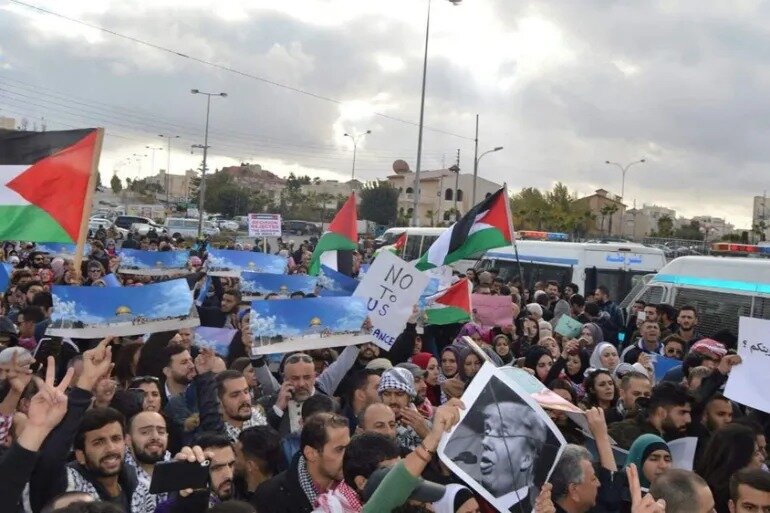
This approach to communication is more than a media strategy; it forms part of a broader effort to manage public opinion. The government's first concern is preventing domestic unrest. Over the past two years, Jordan has witnessed repeated large-scale demonstrations in support of Palestine and against Israeli policies. A significant share of the population is of Palestinian origin, and developments in Gaza are viewed as deeply personal and identity-related. In such an environment, any widespread perception that Jordan is directly or indirectly assisting US military operations could trigger a new wave of public protests.
For this reason, the government has sought to frame the conflict not as a geopolitical issue but as a purely national security matter. Under this framework, the public hears little about the broader regional dimensions of the crisis and instead receives messages focused on protecting citizens, defending borders, and keeping Jordan out of the war. By shifting the narrative in this way, authorities reduce the likelihood that an external conflict will evolve into a domestic political issue.
Another important factor is the government's concern over strong pro-Palestinian public sentiment. In recent years, Jordanian society has become increasingly critical of US policies and Israel's actions, making any visible security cooperation with Washington politically sensitive.
Consequently, the government prefers to keep military or intelligence cooperation with its allies largely out of public view while emphasizing national independence and the protection of Jordan's own interests.
Managing fear and public anxiety is another key objective. Jordan's economy continues to struggle with inflation, unemployment, and declining purchasing power. Any perception that the regional conflict could spread further risks intensifying these pressures. The government understands that insecurity carries not only psychological consequences but also economic ones, affecting investment, tourism, consumer confidence, and overall social stability. As a result, official messaging focuses less on the dangers of war and more on the state's ability to maintain order and manage the crisis effectively.
Another major reason behind this communication strategy is preserving the legitimacy of the state during a period of heightened regional tension. For years, Jordan has portrayed itself as an island of stability in an increasingly volatile Middle East—a country that has avoided the civil wars, state collapse, and widespread unrest experienced by many of its neighbors.
Maintaining this image depends on convincing the public that the government remains firmly in control. If official messaging were to emphasize escalating threats or Jordan's complex involvement in the regional crisis, that carefully cultivated image of stability could be undermined.
Accordingly, state media tend to present information in ways that reinforce public confidence in the government's authority and control. Reports highlighting the interception of drones, the protection of borders, the readiness of the armed forces, and Jordan's political neutrality all fit within this communication strategy. This does not necessarily mean the information being released is inaccurate; rather, it reflects deliberate choices about which aspects of reality are emphasized and which receive less attention.
Control over the domestic media narrative is equally significant. During periods of crisis, governments often seek to channel information through official sources to limit rumors, misinformation, and conflicting accounts. Jordan has followed this familiar pattern. As regional tensions have intensified, statements from the armed forces, government spokespersons, and the official news agency have become the primary sources of information, all reinforcing the same central message: safeguarding national security while keeping Jordan out of the conflict.
However, this strategy now faces a significant challenge: the growing gap between the official narrative and what citizens encounter on social media. Jordanians today no longer rely solely on domestic media. Videos shared online, reports from international news organizations, and user-generated content provide alternative perspectives on unfolding events. When citizens are exposed to two different versions of the same developments, questions about the completeness and credibility of official information naturally arise.
As a result, public trust in government messaging has increasingly come under pressure. The wider the gap between official statements and what people see circulating online, the greater the potential for skepticism and distrust. The government therefore finds itself balancing two competing objectives: preventing fear and public unrest while preserving the credibility of its official communications.
Ultimately, what is unfolding in Jordan is not simply a media policy but part of a broader strategy for managing public opinion during a regional crisis. The government seeks to keep citizens focused on daily security, domestic stability, and normal life rather than encouraging debate over Jordan's potential role in wider geopolitical developments. While this approach may help contain tensions in the short term, sustaining it will become increasingly difficult as access to diverse sources of information continues to expand.
In the end, Jordan's restrained public narrative appears to reflect a combination of security, political, and social considerations. Preventing domestic protests, responding to widespread pro-Palestinian public sentiment, managing fear and insecurity, preserving the state's legitimacy, controlling the domestic media narrative, and minimizing the political costs of the regional crisis have all shaped the government's communication strategy. Yet in the age of social media, traditional methods of managing public opinion are becoming less effective. Citizens are no longer passive recipients of official messaging; they actively compare it with alternative sources of information. That growing comparison may ultimately become the greatest challenge facing the Jordanian government, because in today's world, controlling the flow of information is far more difficult than controlling a country's borders or airspace.
Leave a Comment