BRICS must move from dialogue to practical action: CBI governor
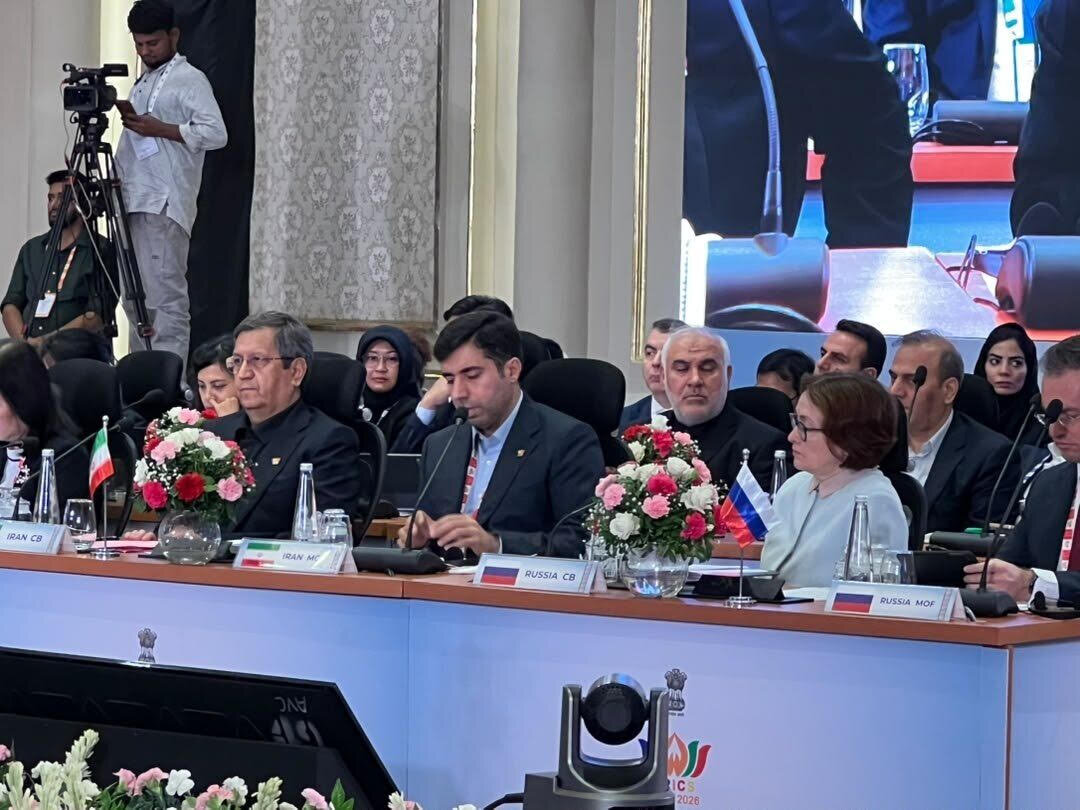
TEHRAN- The Governor of the Central Bank of Iran (CBI) on the first day of the BRICS Finance Ministers and Central Bank Governors meeting in India, while thanking the host country's government and central bank for hosting the summit, emphasized the need to strengthen practical cooperation among BRICS members in monetary and financial areas.
According to IRNA from the Central Bank, Abdolnasser Hemmati in his speech at the opening session, stating that closer cooperation among BRICS member countries can play an important role in strengthening stability, trust, and sustainable development, asserted: BRICS will have the greatest impact when it can translate policy dialogues into practical initiatives and executive mechanisms.
Referring to the difficult and complex regional and international conditions as well as the military aggression against the sovereignty and territorial integrity of Iran, he noted: Economic and financial stability is unattainable without peace, respect for international law, and adherence to the principles of the United Nations Charter.
The Central Bank Governor also, referring to Iran's continued active participation within the BRICS framework, said: The Central Bank of the Islamic Republic of Iran has had an active and responsible presence in BRICS specialized working groups since the beginning of its membership and has participated in areas such as cross-border payments, use of national currencies, financial technologies, cybersecurity, artificial intelligence, and sustainable financing.
Hemmati further emphasized support for initiatives that can reduce transaction costs and risks, facilitate the use of national currencies, and bring payment infrastructure among member countries closer together.
He considered the New Development Bank of BRICS as one of the group's most important institutional achievements and said: The Islamic Republic of Iran is ready to expand its interactions with this institution and pursue the path of membership in it with the cooperation and support of respected members.
The Central Bank Governor concluded by stating: BRICS can play a more effective role in shaping a more inclusive, balanced, and resilient international financial architecture.
Hemmati's emphasis on need to create an independent BRICS financial corridor
The Governor of the Central Bank of Iran, on the second day of BRICS financial meetings in India, emphasized the need to create a dedicated BRICS financial corridor and connect the national payment networks of member countries.
According to IRNA from the Central Bank, Abdolnasser Hemmati stated in this meeting: The development of BRICS financial cooperation must go beyond general dialogues and lead to the creation of operational, secure, and sustainable infrastructure for cross-border payments and settlements.
He said: Connecting payment networks and expanding the use of national currencies, while reducing dependence on financial routes outside BRICS, helps increase speed, reduce costs, and enhance the security of member trade transactions.
The Central Bank Governor added: Iran has already begun examining the technical, legal, and operational dimensions of connecting BRICS members' payment systems and is ready to cooperate in formulating an operational roadmap for this plan.
Hemmati also considered pursuing Iran's membership in the New Development Bank of BRICS as a foundation for expanding development project financing, investment cooperation, and strengthening economic ties among members.
The first meeting of BRICS Finance Ministers and Central Bank Governors under India's rotating presidency for 2026 was held on August 12 and 13, 2026, in Jaipur, India.
Earlier, at the first meeting of this group with the presence of economy and finance ministers and central bank governors of member countries, Mehdi Heydari, Deputy Minister of Economic Affairs and Finance of Iran, emphasized the need to strengthen economic and financial resilience of BRICS members against global economic challenges.
Supporting the four axes of "resilience, innovation, cooperation, and sustainability," he called for the development of practical financing mechanisms, including local currency financing, currency risk hedging instruments, and attracting private capital.
Iran's representative also emphasized the responsible use of artificial intelligence and modern technologies to increase productivity and inclusive growth, and supported the continuation of the BRICS Growth and Development Working Group's activities in future presidency periods.
CBI governor meets president of New Development Bank of BRICS
The Governor of the Central Bank of Iran met and held talks with the President of the New Development Bank of BRICS (NDB).
According to IRNA from the Central Bank, Dilma Rousseff, in her meeting with Abdolnasser Hemmati, assessed the Islamic Republic of Iran's presence in the New Development Bank as important and emphasized Iran's role and capacities in developing regional and international cooperation.
The two sides in this dialogue emphasized the need to continue expert consultations for Iran's membership in the NDB and to benefit from the facilities of this bank.
The Governor of the Central Bank of Iran, who has traveled to India to participate in the BRICS Finance Ministers and Central Bank Governors meeting hosted by India, while thanking the Indian government and central bank for hosting the summit, emphasized the need to strengthen practical cooperation among BRICS members in monetary and financial areas.
BRICS is a group of major emerging economies that has expanded beyond its original five members—Brazil, Russia, India, China, and South Africa—to include Iran, Egypt, Ethiopia, the UAE, and Indonesia. India holds the 2026 presidency, hosting the upcoming summit under the theme "Building for Resilience, Innovation, Cooperation and Sustainability".
The bloc focuses on deepening financial cooperation to reduce reliance on Western-dominated systems. A key priority is developing independent payment mechanisms, including connecting national fast payment systems and exploring interoperability between central bank digital currencies (CBDCs), to lower cross-border transaction costs and promote trade in local currencies. The New Development Bank (NDB), established by BRICS, plays a central role in financing infrastructure and sustainable development projects across member countries, with Iran currently finalizing its accession to the bank.
While strengthening economic ties among the Global South, BRICS is not pursuing a common currency at this time. Instead, members are focusing on practical mechanisms for financial integration that can gradually build resilience against external pressures and create a more balanced international financial architecture.
MA
Leave a Comment