From rail to coast and wellness: A new tourism chain takes shape in northern Iran
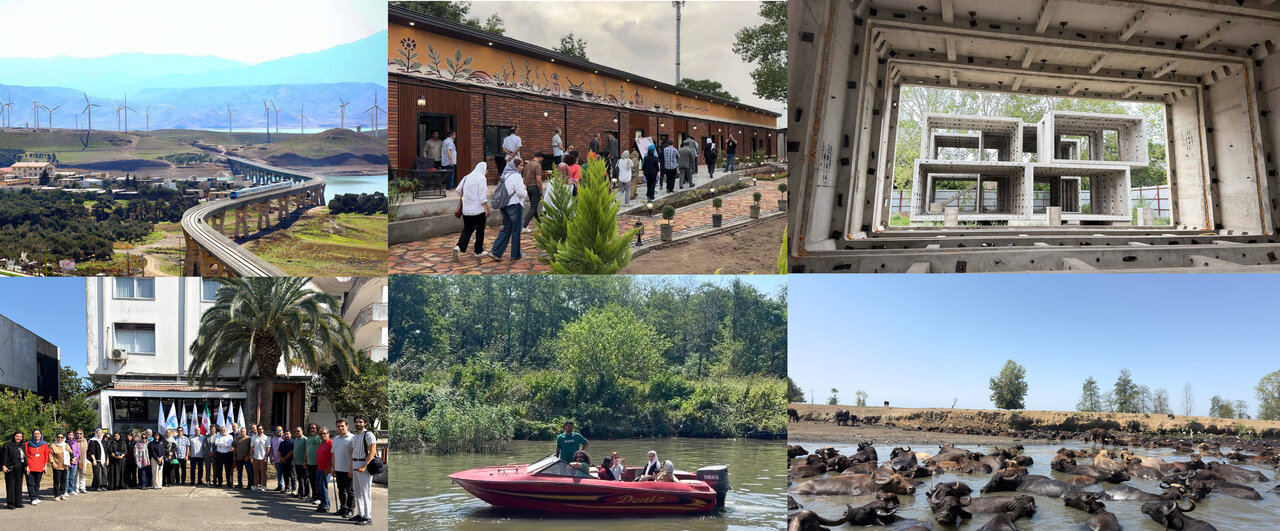
TEHRAN - Traveling with a group of fellow journalists from Tehran to Bandar-e Anzali recently offered us more than a two-day tour of tourism projects under development. The journey was designed to show how railway travel, coastal destinations, accommodation, recreation and wellness services could be brought together to form a single tourism experience.
Our trip began on Thursday morning at Tehran Railway Station, where we boarded a tourism train bound for Rasht, the capital of Gilan province. From there, we continued by bus to Bandar-e Anzali, the Caspian port city that has long been one of northern Iran’s best-known tourism destinations.
The media tour, organized by the Tourism Group of the Social Security Organization (HEGTA), took us to several projects within Anzali Coastal Village, a large resort complex with more than five decades of history. The itinerary was intended to demonstrate different elements of a tourism model that HEGTA is seeking to develop, from rail travel and accommodation to coastal recreation and health and wellness services.
The centerpiece of our visit was Anzali Coastal Village, established in 1974 on an area of about 200 hectares. The complex contains hundreds of villas and apartment units. Much of its original development has already been completed and transferred to owners, while several new projects are being built within the existing resort.
Among the projects we visited were the Gilora wellness and health complex, a 14-unit prefabricated villa project and an eight-unit residential development.
At Gilora, project managers explained to us that the complex is being developed around the idea of combining tourism, recreation and wellness, drawing on both Iranian traditional medicine and modern health practices.
The project is not intended to operate as a conventional medical center. Instead, the idea is to give visitors an opportunity to spend several days away from their normal routines while receiving health and wellness services tailored to their individual needs.
One of the key spaces is a unit described as a “well-being consultation” room. According to the project team, visitors will initially be assessed by a physician specializing in traditional medicine before receiving a wellness plan based on their circumstances, lifestyle and needs.
The planned team also includes a nutritionist, psychologist and corrective exercise specialist.
Other facilities include a health café and a health-oriented supermarket. The café is expected to serve healthy food and beverages, while the supermarket will offer products associated with wellness, healthy lifestyles and Iranian traditional medicine.
The accommodation section of Gilora was also taking shape during our visit, with around 10 chalet-style units under construction.
Project officials told us the concept is aimed particularly at short-term stays and multi-day wellness tours. Depending on the final operating model, visitors could spend four days to a week or longer at the complex, combining health consultations and wellness programs with recreation in the coastal environment.
Retirees covered by Iran’s Social Security Organization are among the groups being considered as potential customers, while people working in high-stress occupations have also been identified as a target market.
Officials said the wellness complex could be completed within about three months and begin hosting multi-day wellness tours thereafter.
For Alireza Tabesh, chief executive and vice chairman of HEGTA, the projects we visited should not be viewed separately.
He described railway transport, travel routes, destinations, accommodation, wellness services and the overall visitor experience as interconnected parts of a single tourism chain.
That idea was also evident in the structure of our own trip: we began the journey on a train, continued by road to a coastal destination and then explored accommodation and wellness projects being developed there.
The approach reflects HEGTA’s broader effort to move beyond simply managing its existing properties and instead use them as a platform for creating new tourism products.
The second project we visited was a 14-unit villa development within the coastal village. Its most distinctive feature is the use of prefabricated components rather than conventional construction methods.
During our visit, Seyyed Meysam Seyyedbaqeri, chief executive of Anzali Coastal Village, told us that the main structure of each villa can be assembled in about three days. The entire process, from structural installation to completion and handover, is expected to take approximately four months.
Around 10 of the 14 units had already been installed when we visited the site, while work was continuing on the remaining four.
The eventual business model for the villas, however, has not yet been finalized. Project managers told us that operating the units as tourism accommodation is one option, while transferring ownership of some or all of them is also under consideration, taking into account construction costs and expected returns.
A short distance away, we visited another eight-unit project with a markedly different architectural and structural approach.
The site has steeper terrain, allowing the developers to incorporate underground levels into the buildings. The project provided another example of how different parts of the existing resort are being used for new forms of development.
Tabesh said HEGTA is seeking to move from simply administering its properties toward creating greater value from them, particularly amid inflation, economic difficulties, sanctions and reduced demand that have placed pressure on Iran’s tourism industry.
He described Anzali Coastal Village as an example of how an established property could be transformed into a more diversified destination.
With more than 52 years of history, the resort was originally developed largely as a villa-based accommodation destination. According to Tabesh, some of its existing capacity can now be devoted to recreational, welfare and wellness services.
The goal is to allow visitors who come for accommodation and leisure to access additional health and wellness facilities, gradually transforming the resort from a primarily residential complex into a broader tourism destination.
Tabesh added that, alongside repairing and refurbishing railway carriages, HEGTA is seeking to expand rail tourism tours.
The cooperation, he said, is not limited to Raja, the railway company affiliated with HEGTA, but is also being pursued with other railway operators.
Now, the central question is whether the new facilities can generate genuine tourism demand, encourage longer stays, contribute to the local economy and offer visitors experiences that go beyond conventional accommodation in northern Iran.
AM
Leave a Comment